Poppy had four kittens in the tack room on a Sunday. By Wednesday she was raising nine.
The kittens came the way they always did on Ruth Ellery’s place, quietly and in the dark, on a folded horse blanket in the corner of the tack room where the calico had been dragging in bits of baling twine for a week. Ruth found them at first light: four blind, mewling scraps and Poppy curled around them like a comma, purring so hard the whole nest seemed to hum. Ruth had been keeping animals on this patch of Ohio for forty-one years, and the sight still stopped her at the door every single time.
She didn’t know yet about the ducks.
The mallard had built her nest in the tall grass at the edge of the farm pond, low and hidden, the way mallards do. Ruth had watched her all spring, a brown streak sliding off the water at dusk. Then one morning the hen wasn’t on the water, and she wasn’t the next morning either. Something had come through in the night. Ruth had lived on a farm long enough to know how that sentence ends, and long enough not to say it out loud.
She found the nest on the third day, only because she heard it. A thin, insistent cheeping, more than one voice, coming from the grass. Five ducklings, no bigger than her thumb, shivering in a nest gone cold, their down still slicked flat from the egg. The other eggs hadn’t made it. These five had, and they were loud about wanting their mother.
“Well,” Ruth said, to nobody, to the pond, to the empty water. “That’s a problem.”
Newly hatched ducklings are a full-time job and then some. They can’t hold their own heat. They need warmth close by every hour of the day and the night, or they fade fast, and Ruth was seventy-three with a bad shoulder and a granddaughter coming to stay for two weeks. She carried them up to the house in the front of her shirt, five small heartbeats fluttering against her chest, and set them in a shoebox under the desk lamp while she tried to think.
Her granddaughter Junie arrived that afternoon, twelve years old and already halfway into the shoebox before she’d put her bag down.
“Grandma. Grandma, they’re so small. Are they going to die?”
“Not if I can help it,” Ruth said, which was as honest as she could manage.
The lamp wasn’t enough and she knew it. A lamp doesn’t move, doesn’t cheep back, doesn’t tuck a cold duckling under a wing at three in the morning. By the second night one of the five had stopped eating, and Ruth sat at the kitchen table with the shoebox and a dropper and a cooling mug of coffee, running out of ideas.
It was Junie who said it. She’d been out to the tack room a dozen times that day to lie on her stomach and watch the kittens, and she came back in with hay in her hair and a look on her face.
“Poppy’s warm,” Junie said. “Poppy’s warm all the time. She never even gets up.”
Ruth almost said no on instinct. A cat is a cat. Forty years of barn sense told her exactly what cats do to small birds, and she’d buried enough spring chicks to trust that instinct. But she looked at the duckling that wouldn’t eat, gray and going still in the corner of the box, and she thought about the mallard hen who wasn’t coming back, and she thought maybe the rules she knew weren’t the only rules there were.
“We try it once,” Ruth said. “And I stand right there the whole time. First sign of trouble, they come straight back out.”
They went out to the tack room together in the last of the light. Poppy lifted her head from the nest, ears swiveling, watching the shoebox come toward her. Ruth crouched down slow, her heart going harder than she wanted to admit, and lifted the smallest duckling out into her palm. The kittens stirred and squeaked. Poppy’s tail gave one slow twitch against the blanket.
Ruth held her breath and set the duckling down in the warm hollow between the calico’s front paws.
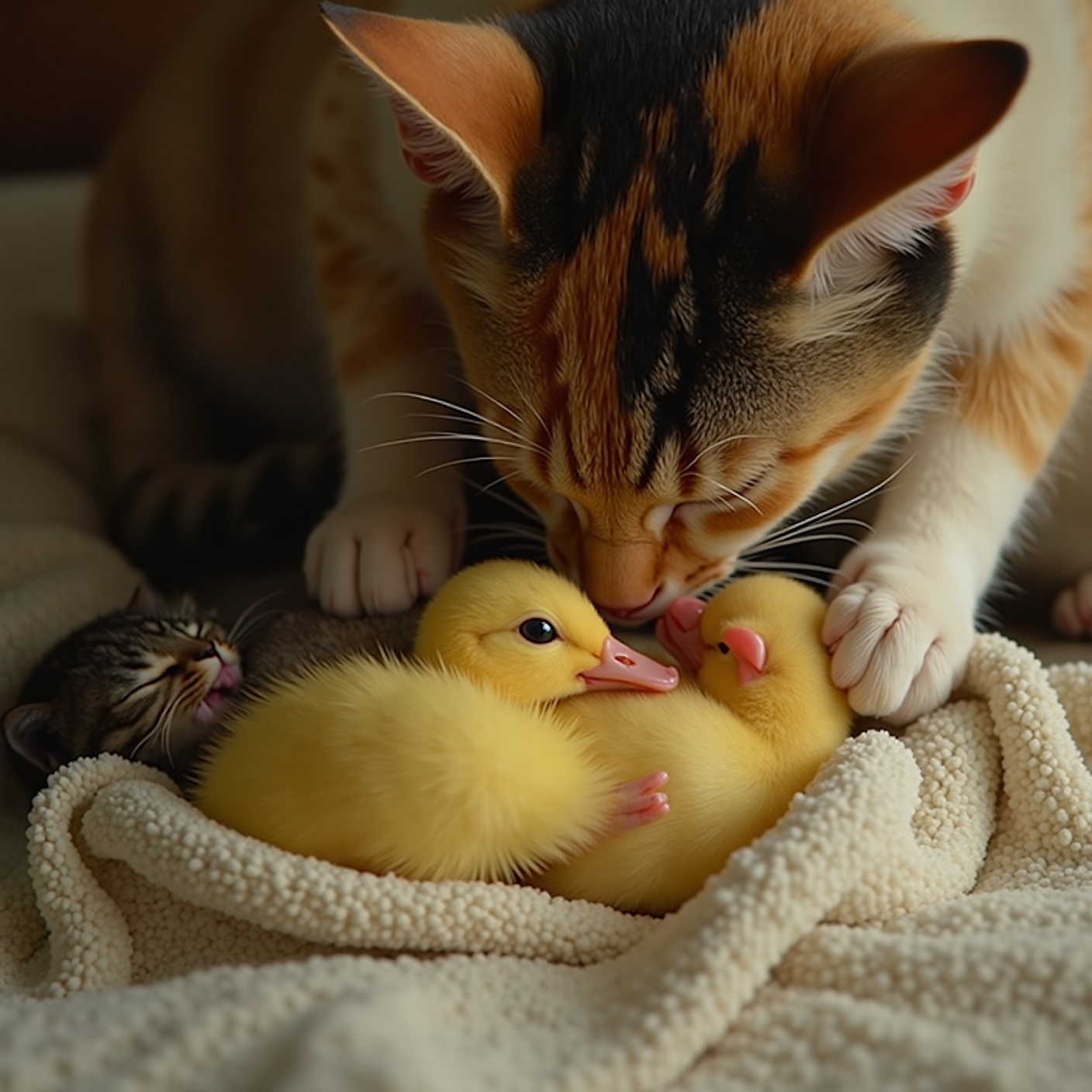
For a long moment nobody moved. The duckling cheeped, thin and lost, and pressed itself blindly toward the nearest warm thing, which happened to be Poppy’s chest.
Then the cat lowered her head and began to wash it.
Long, unhurried strokes of her tongue, the exact way she cleaned her own kittens, ears flat with concentration, that deep engine of a purr never once stopping. The duckling went quiet almost at once. It burrowed down into the fur beside a sleeping tabby kitten, gave one small shudder, and settled like it had found the thing it had been crying for all along.
Junie had both hands pressed over her mouth. Ruth realized she was crying and didn’t much care.
“Get the others,” Ruth whispered. “Slow. One at a time.”
They brought all five. Poppy washed each one as it came, nosed them in among her kittens, and stretched herself a little longer along the blanket to make room, the way mothers do. By full dark there were nine bodies breathing in that nest, four with fur and five with down, all of them tangled up warm in the middle of a calico cat who had decided, for reasons no one could explain, that they were hers.
The duckling that wouldn’t eat ate the next morning.
They grew up strange and happy after that. The ducklings imprinted on Poppy the way they’d have imprinted on the mallard, and for weeks the whole odd family moved around the farmyard as one unit: a calico cat walking the fence line with four kittens tumbling behind her and five ducklings hustling to keep up on their little rubber feet, cheeping in alarm every time she got more than a body-length ahead. Poppy would stop and wait. She always waited.
She’d hiss the barn tom off the porch if he came near any of the nine. She learned, eventually, to sit at the very edge of the pond while her ducklings paddled in circles just offshore, watching them with the faintly put-upon expression of a mother whose children have taken up a hobby she does not understand. The kittens thought the water was the worst idea anyone had ever had. The ducks disagreed. Poppy split the difference and supervised from dry land.
Ruth kept meaning to figure out where the ducks would go once they were grown, whether the neighbor with the big pond would take them, whether they’d fly. She never did get around to it. They stuck close, the way things do when they’re raised warm and safe and never once given a reason to leave.
“You know what’s funny,” Junie said near the end of her visit, lying in the grass with a duck asleep on her stomach and a kitten batting at her shoelace. “She didn’t have to. Poppy. She just did.”
Ruth watched the calico stretched out in the sun with the whole warm pile of them, birds and cats, rising and falling with her breath.
“No,” she said. “She didn’t have to at all.”