She asked on a Sunday in March, standing in Daniel’s kitchen with her coat still on, because his mother never stayed anywhere long enough to take her coat off.
“Two weeks, Danny,” Marcy said. “Three at the outside. I’ve got that whole downstairs to move and Kayla’s little car won’t take a bookcase.”
She was sixty-one that spring, just out of the rental on Delmar Street with everything she owned stacked in liquor-store boxes, moving into a one-bedroom over the laundromat on Grand because it ran two hundred cheaper and she liked the sound of the dryers through the floor.
The truck was a 2004 F-150, dark blue, two hundred and twelve thousand miles on the clock. He bought it at twenty-two with framing money, cash, in a gas station parking lot in the rain. It had a ladder rack he welded himself and a cigarette burn in the passenger seat from a man he never met. He hauled every job he ever ran out of that truck.
He put the spare key in her hand and told her not to let the temp gauge climb past the middle. “You’re a good boy,” she said, and she was out the door before he could answer that.
Three weeks and two days later his phone buzzed at six in the morning on a job site. A photo: a silver Kia sitting in a dealership lot with the sticker still on the glass, his mother’s thumb in the corner of the frame. Under it, one line.
“I sold the truck. I’ll pay you back.”
He called her from the top of a roof deck with the framing crew watching him. Eleven times. She picked up on the twelfth.
“Mom, tell me you’re joking.”
“I can’t right now, Daniel,” she said.
That was the entire explanation. Four words, and then the line went quiet and stayed quiet.
He drove over that night. She wouldn’t come down, and he stood in the lot calling up at a lit window.
His sister took her side inside of a week. Kayla came to his house, sat at his kitchen table, and said the most useless sentence anybody has ever said to him.
“There’s a reason,” Kayla said. “I’m not allowed to tell you the reason.”
“Then it isn’t a reason,” he said. “It’s a stolen truck.”
“Okay,” said Kayla, and she picked up her keys, and for four years that was more or less where they left it.
People imagine a rupture like that is loud. It is never loud. It is Christmas cards signed “Mom” with nothing written underneath. It is twenty dollars mailed for his daughter’s birthday and mailed straight back, and both of them knowing perfectly well the twenty dollars was never about twenty dollars.
She died in October, four years and seven months after she asked for the truck. Her heart. Fast, they told him, the way people hand you a word like it’s a gift.
At the church afterward, in that long low room with the coffee urn and the folding tables, Kayla put a manila envelope in his hands with his name on it in their mother’s handwriting.
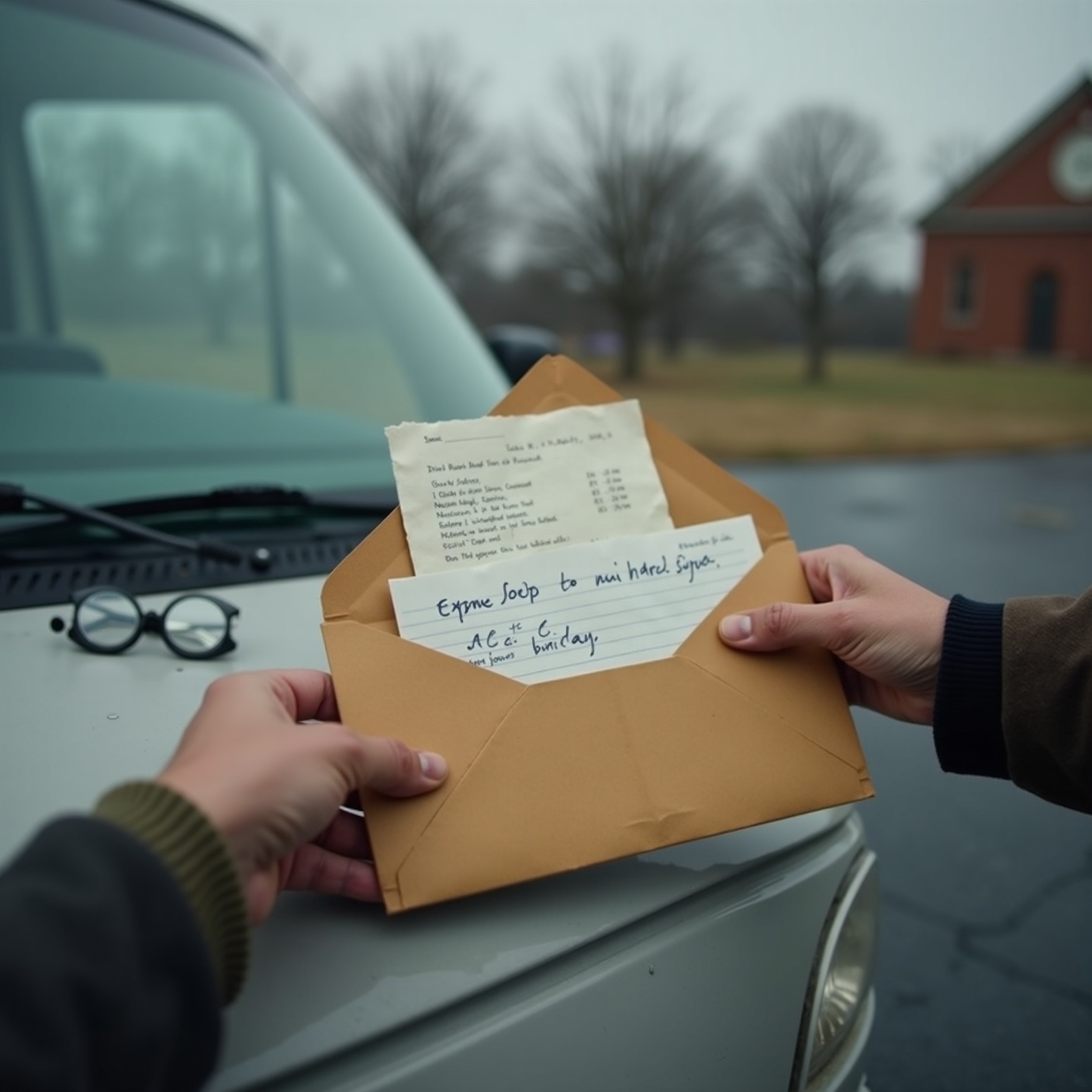
“She gave me this two years ago,” Kayla said. “She said if she went first, you get it at the funeral. Not one day before. I promised her, Daniel. I’ve been promising her for four years.”
He carried it out to the parking lot and opened it on the hood of his van with his coat still buttoned.
A bill of sale, one page, the kind you buy in a pad at the hardware store. Vehicle, 2004 Ford F-150. Sale price, three thousand dollars. Buyer, Ray Vance, an address out on Route 12 in Millbrook, forty miles north of anywhere she had ever lived.
Three thousand. That truck was worth eleven, twelve easy on a bad day. She hadn’t sold it out from under him. She had handed it to somebody. Behind the bill of sale, on a torn half sheet, four words in her looping schoolteacher print. “Go see the truck.”
There are a lot of Vances in that county. That is what he told himself in the van with the heater running. It doesn’t mean a thing, and he was not driving to Millbrook.
He drove to Millbrook the following Saturday.
The house was cinder block with a carport and a gravel drive. In the side yard, under a gray cover gone chalky from ten summers of sun, sat something the exact shape of his truck.
The man who came around the corner was about seventy, canvas jacket, coffee cup in his hand. Short, built like a fire hydrant. He looked at him three seconds longer than a stranger looks at you.
“You’re Marcy’s boy,” he said.
“I’m here about the truck.”
He set the cup on the step, walked over, and took the cover off in one long pull, the way you take a sheet off furniture in a house you’re opening back up. The ladder rack. The dent in the tailgate. The burn in the passenger seat.
“She always told me you’d come around eventually,” Ray said.
Daniel said the only thing in his head. “You bought my truck for three thousand dollars.”
“I paid fourteen thousand four hundred for that truck,” he said. “Three of it went on the paper.”
Then he told him who he was, standing in his own gravel with his hands at his sides. He left when Daniel was nine. He had been sending money since Daniel was ten. Money orders first, then cashier’s checks, twice a year. Marcy sent them back for a decade. When Daniel turned nineteen and found out, he took over the job himself. Nine envelopes, RETURN TO SENDER in his own block capitals. Ray kept all nine in a shoebox and brought it out to the tailgate so Daniel could watch his own handwriting get angrier year over year.
“She called me that February,” Ray said. “First time I’d heard her voice in six years. She said, he won’t take it from me and he won’t take it from you. But he’ll take it from a company.”
Nine days after that bill of sale, twelve thousand four hundred dollars landed in Daniel’s account. It came on letterhead from the lawyer who handled his grandmother’s estate. His mother told him on the phone it was the last of Grandma’s policy finally clearing probate, and he believed her, because she said it in a bored voice while she was doing something else. That money made payroll for two guys through a dead February and put a transmission in his work van. His business is standing today because of it. She paid a hundred and forty dollars in fees to make his father’s money look like his grandmother’s.
“Why wouldn’t she just tell me,” he said.
“Because you’d have paid it back,” Ray said. “You’d have gone to a bank and borrowed twelve thousand dollars to hand a man you don’t speak to. She knew you. She’d rather you thought she took a truck.”
She never kept a dollar of it. Ray offered her four thousand and she wouldn’t sit at his table long enough to argue.
Daniel asked why he never drove down and knocked on the door himself. Ray shrugged and said a man who leaves doesn’t get to pick the terms he comes back on. Then he said, “Get in. I’ll buy you a coffee.”
Ray drove. Daniel sat in his own passenger seat with his knees against the glovebox and watched him steer with his arms stretched almost straight, because the driver’s seat was still slid all the way back where he had left it four years ago. Five inches too far for him. He had driven that truck like that every Sunday for four years and never once touched the lever.
Ray offered him the keys in the diner parking lot. Daniel told him to keep it.
The truck stays where it is now. He drives up on Sundays instead, and Ray makes coffee that could strip paint, and they sit in the side yard with the cover folded on the tailgate. Four years he called his mother a thief. He got the answer three weeks too late to say one word of it to her, and that part he will carry for good.