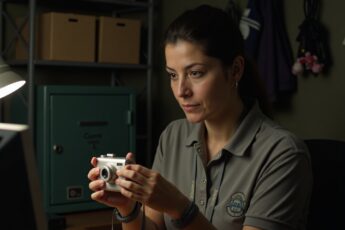
It came on a Thursday, between the power bill and a seed catalog I never ordered.
Plain white envelope, a little yellowed along the top. My maiden name. Purple gel pen, big round loops, a heart over the i, the address written by somebody who clearly ran out of room and squeezed the zip code down the side. Two forwarding stickers stacked on top of each other, one from an apartment I moved out of in 2011.
I stood in the driveway with the mailbox door still hanging open and could not make my hands go any faster.
Mr. Alden taught eighth-grade English in room 114, and every October he gave the same assignment. Write a letter to yourself twenty-five years out. Seal it. Put your address on it. Don’t put anything in it you’d be embarrassed to get back.
“I will mail these to you,” he told us, standing in front of the chalkboard with his hands in his cardigan pockets. “Every one of them. You won’t believe me now and that’s all right.”
Nobody believed him. Boys wrote joke letters about hoverboards. Steven Kirk drew the whole thing instead of writing it. Then the bell rang and we forgot about it for twenty-seven years, which is exactly how long it takes for a promise to turn into either nothing at all or the strangest thing that ever showed up in your mailbox.
I sat down on the kitchen floor with my back against the dishwasher and opened it.
Notebook paper, torn out of a spiral, the little frilly bits still hanging off the edge.
“Dear Kayla. You are 39 now which is honestly ancient. I hope you live in Florida and are a marine biologist. That is definately what I am going to be.”
She wanted a red car. She wanted to see a whale in real life. She spelled definitely wrong twice, the same way both times. She asked whether I’d learned to drive stick yet, and whether I still hated blue cheese, and she signed it with a drawing of a fish.
And then, at the bottom, in smaller writing, like she’d gone back and added it later with a different pen:
“Please don’t turn out like Mom. Be home for dinner. Every single night.”
My mother worked doubles at a nursing home for eleven years and I don’t have one memory of her sitting down at our table. I sat on that kitchen floor and cried like an idiot over a fourteen-year-old with bad spelling who had no idea what was coming and was, in almost every particular, wrong about me.
Then I went to fold it back up, and the second page came away from the first.
I’d assumed it was mine. Page two, more of the same. It wasn’t. This one was pencil, small and cramped and careful, every letter printed separately, the handwriting of a kid who had been told her whole life to slow down and try harder.
It started, “Dear Marcy.”
She wanted a house with a porch on it. She wanted a dog named Bandit. She wanted to work somewhere quiet, a library maybe, where people came in and were nice to you and then left. And the last line, printed level and straight the way you write when you mean it:
“By then I hope I have a friend I have known for a long time.”
There was a second envelope in with the pages. Addressed to Marcy Pell, 41 Ellsworth Road, apartment 6, stamped twice across the front. RETURN TO SENDER. NO SUCH NUMBER. And in the corner, two rust-colored marks the exact size and shape of a paperclip.
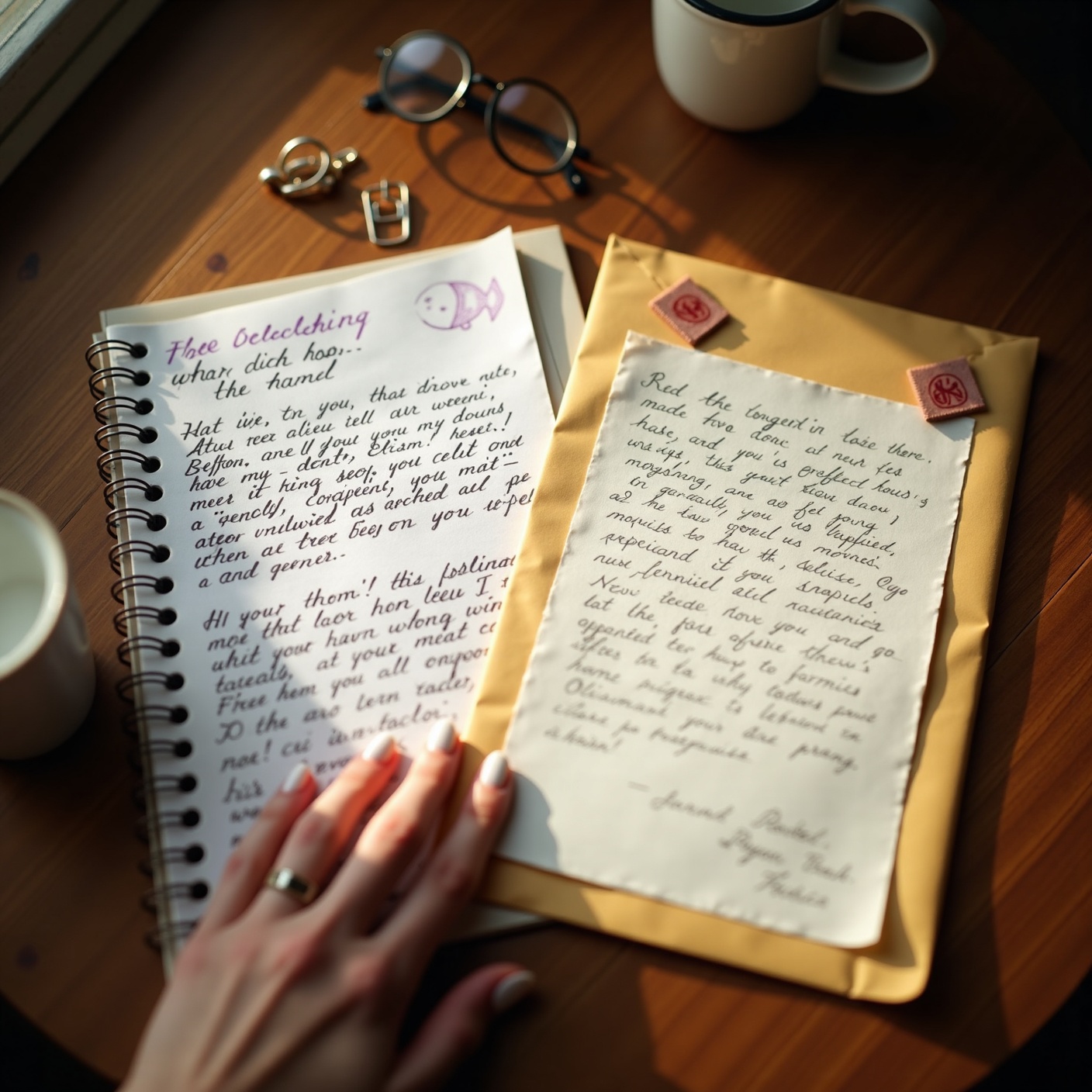
Under that, on a half sheet of typing paper, was a note in old handwriting that shook a little on the downstrokes.
“Kayla. I have kept these two together since 1999 because of what you wrote at the bottom of yours. Marcy’s came back to me twice and I never found another address for her. I am 84 and this is the last envelope in my hands. I have mailed out eleven hundred of them since I retired and I would very much like to finish. Please finish this one for me. R. Alden.”
He kept them in the loft of his barn, in eight sealed feed drums, wrapped in trash bags against the damp. Twenty-nine years of eighth graders. He never mailed them at twenty-five because he fell behind almost immediately, and he decided being late was better than being a liar.
I turned my own letter over. There it was, up the side in the margin, so small I had missed it, the thing he’d been holding two envelopes together over for twenty-seven years.
“P.S. Somebody should sit with Marcy Pell at lunch. Nobody ever does. I will next year.”
I remembered her the second I read the name. Back row by the window, home-cut hair, a man’s coat she wore all winter, and a way of putting her hand flat over her paper when anyone walked past her desk. She moved away in the spring of ninth grade. I never sat with her. That is the honest fact of it. I wrote a promise in a letter, and then I went and had a normal loud teenage life, and I did not keep it.
It took me one evening on a laptop to find her, which is the part that still makes me feel ill. Marcy Pell, 41. An address in Lyle’s Landing, three hours north.
I have rented the same cabin in Lyle’s Landing every July since Daniel was three. The address in front of me was the apartment over the general store where I buy milk and worms and a bad cup of coffee every single morning of that week.
My son is fourteen this year. His English teacher inherited the assignment from a teacher who had Mr. Alden in the seventies, and she keeps hers in a filing cabinet instead of a barn. Daniel sealed his at my kitchen table while I was staring at that address on the screen, and he licked the envelope and said, “This is so dumb,” and put it in my hand anyway.
We drove up on the second Saturday in July.
The woman behind the counter had reading glasses on a chain and rang me up for a gallon of two percent, the same as always, the same as fifteen summers.
“Marcy?” I said.
She looked up. Fifteen years I had been handing this woman money across a counter.
I put the letter down next to the register, the pencil pages and the envelope with the two stamps on it, and I said, “Mr. Alden couldn’t find you. He’s been carrying this since 1999.”
She read it standing up, with a line of two people behind me, and she didn’t hurry and nobody said anything. When she got to the end she took her glasses off and held them.
“I remember one day of eighth grade,” Marcy said. “One. It was February and it was a Tuesday and you sat down across from me with a tray and talked at me for the entire period about a movie I hadn’t seen.”
I don’t remember that day. I have no memory of it at all.
“I’ve told people about it,” she said. “I told my husband about it. For twenty-seven years I’ve been telling people about a girl who sat down with me one time.”
She closed the store forty minutes early. We took the coffee out to the picnic table by the gas pumps and Daniel skipped rocks off the dock and got bored and came back and listened, and she has a porch now, and a dog, and the dog is not named Bandit but she says she thought about it.
I mailed Mr. Alden a note the following week. The postcard I got back had a picture of a covered bridge on it and four words on the message side.
“The barn is empty. Thank you.”
Daniel’s letter is in my desk drawer with 2051 written on the front in his handwriting. I’m not trusting that one to anybody. I’ll be seventy-two, and I intend to walk it to the mailbox myself.