The videographer wanted $1,900, and Rachel can still tell you exactly where she was sitting when she read that number out loud. Carol’s kitchen, the yellow one, with the rooster clock over the stove. April of 2016. She and Tom were nine weeks out from the wedding and already about four thousand dollars past where they’d meant to be.
“Nineteen hundred,” Rachel said. “For six hours and a disc.”
Brooke had her back to them at the sink, running water over a colander of strawberries. She’s Tom’s sister, two years younger than him, and that spring she owned a camcorder she’d bought for a trip to Ireland and used maybe twice.
“Don’t pay that,” she said over her shoulder. “I’ll film it. I’ve got the good camera. Put the nineteen hundred toward the honeymoon.”
Tom looked at Rachel. Rachel looked at Carol, her mother-in-law, who was wiping a spot on the table she had already wiped.
“That’s generous of you, Brooke,” Carol said. She said it slowly, the way you set a glass down on a shelf you don’t trust.
Rachel said yes. Anybody would have said yes.
They got married on a Saturday in June. Rachel’s mother, Susan, walked her down the aisle in a lilac dress she’d hemmed herself, and she cried so hard through the vows that the woman behind her passed up a whole travel pack of tissues. Brooke was everywhere with that camera. Up the side aisle, crouched at the end of a row, backing through the reception hall while Rachel’s grandfather did his one dance move. She found the bride by the cake, flushed and pleased with herself.
“It’s all on the card,” she said, patting the camera bag. “Almost three hours. Give me two weeks.”
Two weeks turned into a month. The month turned into needing the right cable.
By their first anniversary it was, “I know exactly where it is, I just haven’t had a minute.” By the third it was the computer that died. By the fifth it was the card itself. Corrupted, she thought, but there was a guy in Dayton who could maybe pull it.
Rachel was polite. Nine years of polite. She asked at Thanksgivings in that light voice you use so nobody’s holiday gets ruined. She offered to pay the recovery guy herself. She offered to drive the card to Dayton on a Saturday. Once, in 2021, she asked Brooke to just hand her the card and let her deal with it, and Brooke said she’d have to look for it, and then she stood up and started clearing plates.
Tom quit asking before Rachel did. “She’s never going to produce it, Rach,” he said one night, and he wasn’t being cruel about his sister, just tired. “I think we have to let it be a thing we don’t have.”
So they let it be a thing they didn’t have. Thirty-one photos off a cousin’s phone and one framed 8×10 of the two of them under the arch, and that was the wedding.
In 2023 Rachel’s mother was diagnosed with dementia. It came on the way it comes on, in pieces you only recognize looking backward. The same story twice in an hour. Then the wrong street. Then her daughter’s name attached to her sister’s face. By the next spring she had mostly stopped talking, and that’s the part nobody warns you about. Not the forgetting. The quiet.
Carol died in November of 2024. She was seventy-eight, and it happened in that yellow kitchen, on a Tuesday morning, with the radio on.
The reception afterward was at her house, because Carol would have wanted people eating in her house. Somebody’s ham. Somebody’s Jell-O with the pears suspended in it. Brooke had been drinking since the cemetery, and she was out on the back porch by herself with a paper plate she wasn’t eating from when Rachel brought her a glass of water.
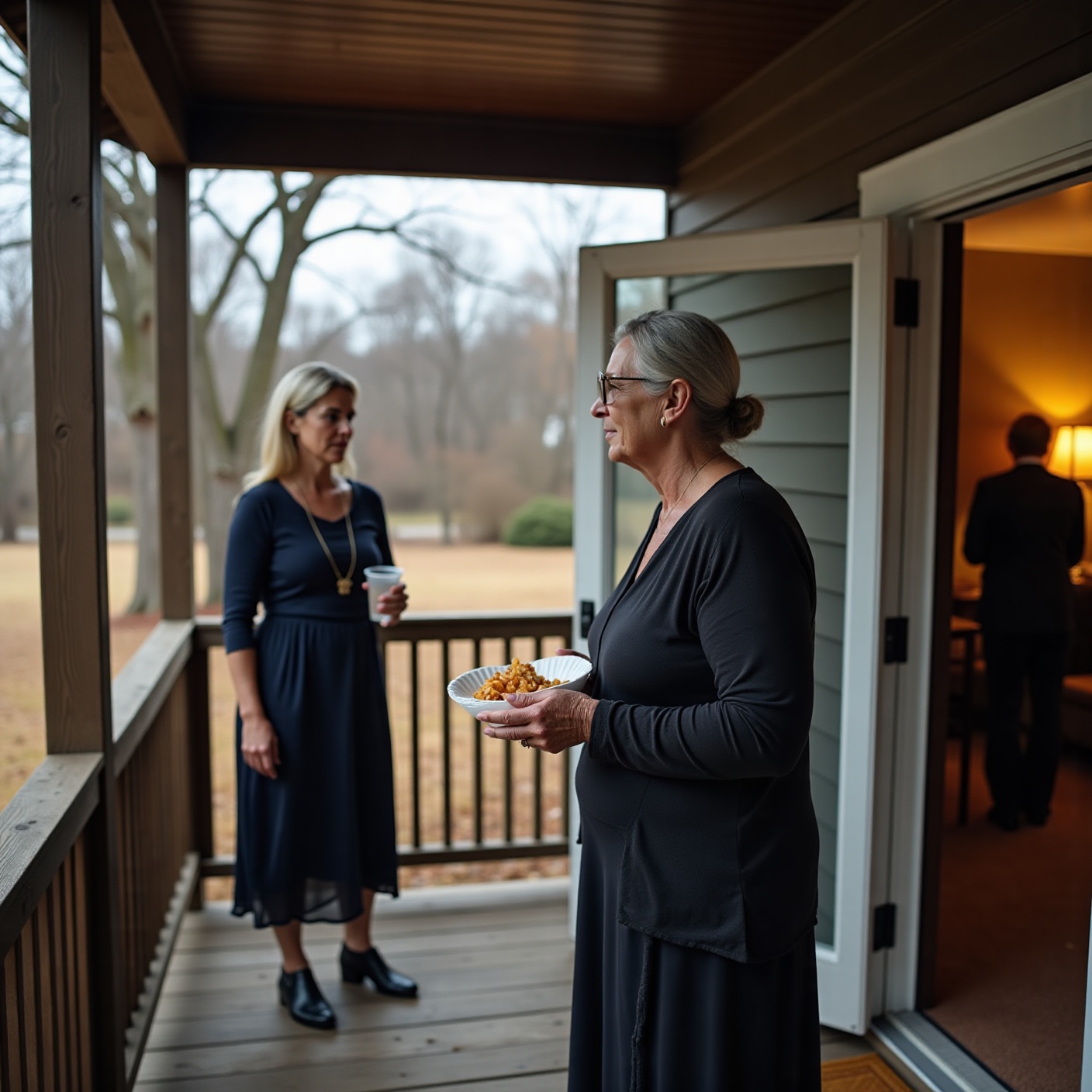
“Your mom was good to me,” Rachel said. “I wanted you to hear me say it.”
Brooke laughed, one hard breath through her nose. “Everybody was good to you.”
Rachel should have gone back inside. She didn’t. She said the thing she’d said a hundred times, and she said it gently, because it was the day they buried Brooke’s mother.
“Brooke. The card. If it’s somewhere in this house, will you let me look?”
Brooke turned around, and her whole face was different.
“You want the truth? I deleted it that same week. You had everything that year and I had nothing — I wasn’t handing you one more perfect thing.”
The storm door banged. Somebody inside laughed at something. Rachel stood there holding a glass of water for a woman who had already walked off the porch and out into the yard.
Tom found out that night in the car, because she couldn’t hold it. He didn’t yell. He pulled into a gas station and sat with both hands on the wheel for a long minute.
“Nine years,” he finally said. “She let you ask her for nine years.”
The house sat through the winter. Nobody had the stomach for it. They started clearing it out in July, Tom and Rachel and his cousin Dana, and Brooke didn’t come, which was its own kind of answer.
About a week into it, in the back of the hall closet under a box of Christmas tablecloths, Dana found a shoebox with maybe a dozen discs in it. Carol’s handwriting on every one. “Tom, 8th grade band.” “Easter ’09.” “Dad’s shop, before.”
And one that said: Rachel’s day — copy, 2016.
Rachel sat down on the hallway floor. Tom had to take it out of her hands.
They watched it that night on an old laptop Dana dug out of her trunk. It was all there. Susan crying. The grandfather’s one move. Tom’s face when his bride came up the aisle, which Rachel had never seen, because she was looking at her feet the whole way.
They pieced the rest together from the timestamps. The morning after the wedding, Carol had asked Brooke to borrow the camera so she could “watch the toasts again.” She drove the card down to the photo counter at the drugstore on Miller Road and had a kid behind the counter burn it to a disc. She had the card back in her daughter’s bag before dinner. And then she said nothing. Not to Tom, not to Rachel, not for eight years.
She knew her own child. That’s all that was. A mother who could count.
But the disc runs longer than the wedding.
After the last of the reception footage, there are forty minutes of Carol’s kitchen. Brooke had set the camcorder up on the microwave the morning before, testing the battery, and left it running. So the lens just sat there, pointed at the table, while two women peeled potatoes for the rehearsal dinner.
Carol in the apron with the strawberry on the pocket. And Susan. Rachel’s mother in 2016, reading glasses pushed up into her hair, arguing about whether you salt the water before or after, telling the story about the time she locked herself out of the house in her slip, laughing so hard she had to set the peeler down.
Forty minutes of her mother’s voice. It is the only recording of it from before.
Rachel has watched that part more times than she’s watched the ceremony. She knows where her mother coughs. She knows the exact second Carol says, “She’s going to be all right, you know, that girl of yours,” and Susan answers, “I know it. I just didn’t think it’d come this fast.”
Neither of them knew the camera was on. Two mothers at a kitchen table with a bag of potatoes and a whole wedding in front of them.
Rachel took the laptop to her mother’s on a Thursday. She didn’t expect anything. You learn not to. She set it on the tray table and turned the volume up, and her mother watched the two women at the table with the polite, faraway attention she gives most things now.
Then Carol laughed on the tape, and Susan’s face moved.
“She talks too much, that one,” her mother said.
That was all. She was quiet again a minute later and she never looked at the screen twice. But she had been in that kitchen, and for about four seconds her daughter got to stand in it with her.
Tom drove out to Brooke’s the following week and left a copy in her mailbox. He didn’t put a note in with it. He didn’t need to. His mother’s handwriting was right there on the label, which meant Brooke had to sit with the fact that her own mother looked at her in June of 2016 and quietly went and made a copy.
Brooke called Rachel twice in August. She hasn’t called back. Maybe she will. Brooke took a real thing from them, it cost her nine years of pretending, and in the end she didn’t even manage to take it.
Rachel doesn’t spend much time on Brooke anymore, and that surprises her more than anything.
Mostly she thinks about a woman just shy of seventy driving to a drugstore on a Monday morning with her daughter-in-law’s wedding in her purse. Telling nobody. Putting it in a shoebox in the hall closet where somebody would find it eventually. She saved a wedding, and she had no idea she was also saving another mother’s voice. She just figured somebody ought to keep a copy.