
A fisherman heard the sound before he saw anything.
It was a cold morning in December of 2005, out on Mosquito Lagoon on Florida’s Atlantic coast, and somewhere in the shallows something was crying. He followed it. Tangled in the ropes of a crab trap, barely able to lift her head above the water, was a baby dolphin.
She was maybe two months old. Small enough to lift in your arms. The line had wound itself tight around her body and her tail, and she had been fighting it long enough to be near the end of her strength.
He got her loose and called for help, and within hours a rescue team was racing her across the state to the Clearwater Marine Aquarium on the Gulf side of Florida.
They named her Winter.
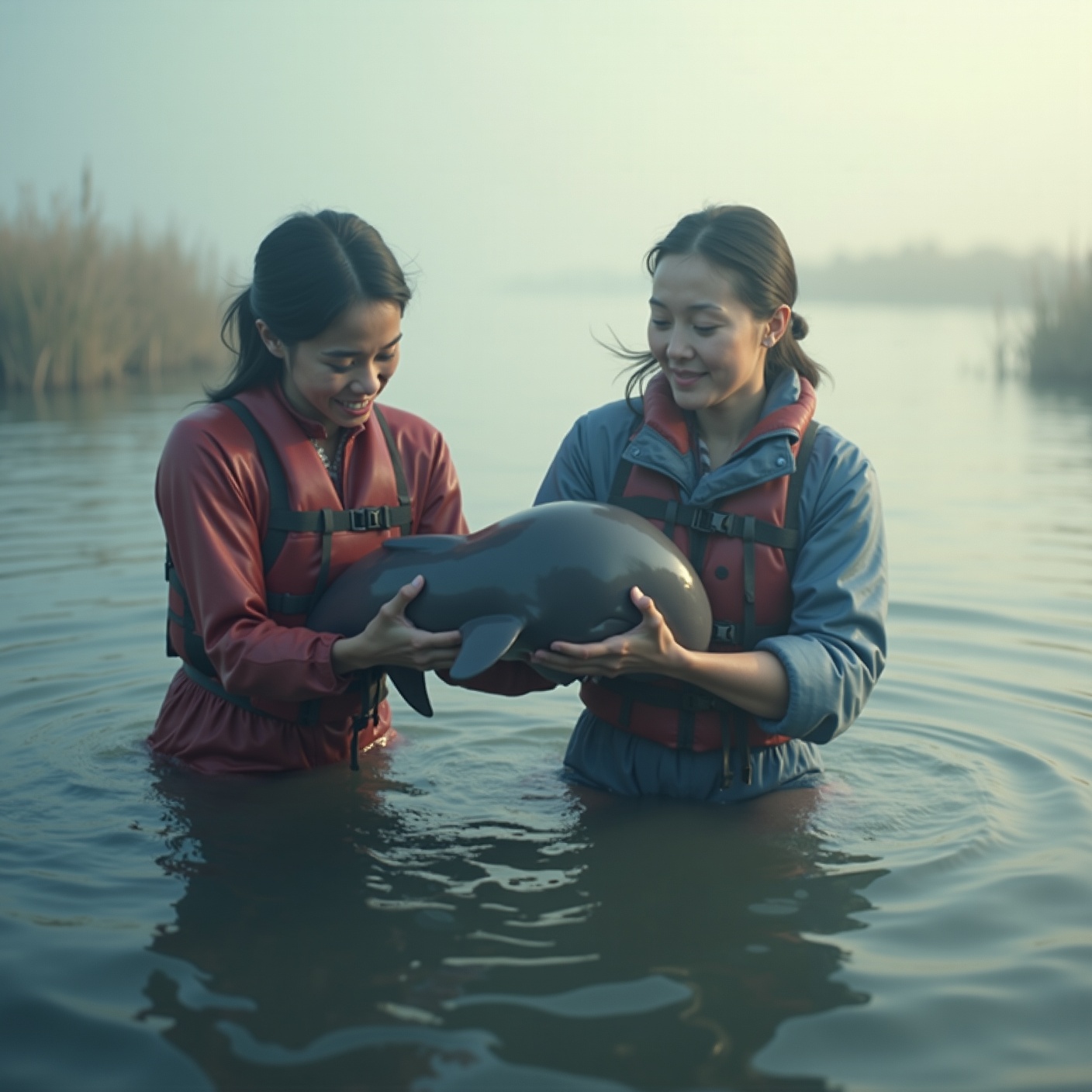
Nobody thought she would make it through the first night. An orphaned calf that young, that cold, that worn out, has almost nothing in her favor. Volunteers took shifts in the water around the clock, holding her afloat, feeding her by hand, refusing to let her go. She hung on. One night became a week. A week became a month.
But the rope had already done its damage. What it had done to her tail was too much to undo, and in the end Winter lost her fluke entirely, the two flat paddles at the end of a dolphin’s tail that power every stroke it takes.
And here is where her real trouble began.
A dolphin swims by pumping its tail up and down. Winter no longer had a tail to pump. So, being a clever animal who badly wanted to move, she taught herself a workaround. She swished side to side instead, like a fish, like a little shark. It worked. She got around her tank just fine.
The problem was what it was doing to her. That side-to-side motion was never meant for a dolphin’s spine, and her caretakers watched with growing worry as it slowly began to bend her body out of true. If she kept swimming that way, it would eventually cost her.
Winter needed a tail. A real, working, artificial one.
The trouble was that no one on earth had ever built a prosthetic tail for a dolphin. There was no manual. There was nothing to copy.
Then a man named Kevin Carroll heard her story.
Carroll had spent his whole career at a place called Hanger Clinic, fitting arms and legs for people, some of them very small children. Something about the dolphin who had lost her tail lodged in him and wouldn’t let go. He picked up the phone and offered to try.
He would say later that the hard part was never designing the tail itself. The hard part was getting it to stay on.
A dolphin’s tail delivers an astonishing amount of force with every beat, and Winter’s body was wet, smooth, and never still. The prosthetic kept slipping. Worse, the constant rubbing chafed her sensitive skin raw. Every early version failed the same way. She would wear it, swim a few strokes, and it would work loose or start to hurt.
So Carroll and his team went hunting for something that didn’t exist yet: a material soft enough to cushion the tail against her skin, and grippy enough to hold on under all that power. After a great deal of trial and error, they created a brand-new kind of silicone gel just for her. They called it WintersGel.
And slowly, patiently, over about a year and a half, Winter learned to wear it.
She learned to let the staff slip the sleeve over what remained of her tail. She learned to move it up and down again, the way a dolphin is built to, the curve easing out of her spine as she did. Some days she wore it, some days she didn’t. The point was that she could. She could swim like herself again.
That alone would have been story enough. But Winter’s tail did something none of them saw coming.
That soft gel invented to keep one dolphin comfortable turned out to work beautifully on people too. WintersGel is now used in prosthetics for human amputees, cushioning the limbs of men, women, and children who will never know they have a dolphin to thank for it.
And the children came. Word spread about the dolphin with the artificial tail, and kids who had lost arms and legs of their own started arriving at the aquarium to meet her. They pressed their hands to the glass and watched a creature who was, in the way that counted most, exactly like them. If she could learn to swim again, the thinking went, then maybe they could find their own new way of moving through the world.
A fisherman followed a cry across a cold lagoon and pulled out a dying calf with no tail. What she gave back, in the end, reached a great deal further than anyone standing on that dock could ever have guessed.