Every shelter has one dog like Chief. The one who stops trying.
At Riverbend Animal Shelter, just off the county road outside a small Ohio town, Chief had a spot. Third kennel on the left, front corner, nose pointed at the glass double doors where the people came in. He was a shepherd mix, black and tan going grey around the muzzle, maybe six years old, seventy pounds of quiet. And every morning when the lights buzzed on, he was already sitting there, facing the door, waiting for someone who wasn’t coming.
He had been at Riverbend for a year and four months. Five hundred days, give or take. Renee, the kennel tech who opened most mornings, had done the math once and then wished she hadn’t.
Chief hadn’t always lived there. He’d come in on a Tuesday in the surrender line, riding in the back seat of a hatchback with his head on a boy’s lap. The Careys. The dad had lost most of his hours at the plant that spring, and the only apartment they could afford after they lost the house didn’t take dogs over twenty-five pounds. They’d tried everything else first. You could see it on them. The mom kept her sunglasses on inside. The dad signed the forms with a hand that wasn’t steady.
And the boy. Ethan, fourteen, wouldn’t let go of the leash. He sat on the floor of the intake room with his arms around Chief’s neck and his face buried in the fur, and when Renee finally, gently, took the leash, the kid looked up at her and said the thing she still heard some nights.
“He’s gonna think we didn’t want him.”
Renee told him what you tell people. That Chief would get adopted fast, that a good dog like this wouldn’t last a week, that it was going to be okay. She believed about half of it.
Chief did not get adopted fast.
He wasn’t mean. That would have been easier to explain. He was polite the way a heartbroken thing is polite. He ate his food. He walked nice on the leash. He let the vet do what the vet needed to do. But when families came through on Saturdays, crouching down and making the kissy noises, patting their knees, calling him buddy, Chief would give them one long look and then turn his head back to the door. Like he was sorry, but they weren’t who he was waiting for.
“He interviews everybody,” Renee used to say. “And nobody passes.”
People want a dog that picks them. Kids especially. They’d stand at his kennel and Chief wouldn’t get up, and the parents would steer them gently down the row to a wiggly beagle that jumped at the gate, and Renee understood, she did, but it broke something in her every single time. She started calling him her old man. She snuck him the good treats. She wrote FRIENDLY — GIVE HIM A CHANCE on the card clipped to his door, and then, months later, she quietly took the card down, because it felt like begging and he deserved better than begging.
The seasons turned over outside the glass doors. Chief watched a full year of them go by from the third kennel on the left. Summer heat that made the parking lot shimmer. Leaves. The first snow, which he watched with his ears up like it meant something. Then green again. He was slower now. Greyer. He’d stopped standing when the doors opened. He just lifted his eyes.
Five hundred days.
On a flat grey Thursday in early spring, the kind of afternoon where nothing happens, Renee was hosing down the runs when she heard tires on the gravel out front. She almost didn’t look up. Cars pulled in and out all day.
But this one stopped crooked, half over the line, the way you park when you’re not thinking about parking. A door opened before the engine was even off.
And down the row, in the third kennel on the left, Chief stood up.
He hadn’t stood for the door in months. Renee froze with the hose still running. Through the glass she watched a kid come across the lot at almost a run, tall, sixteen maybe, all elbows and long legs, a boy stretched out of the shape of the one she remembered but not so much that she didn’t know him the second she saw his face.
Ethan.
He hit the front doors and they didn’t open fast enough for him and he pushed through sideways, and by then Chief was throwing himself against the kennel gate, not barking, just this high broken sound in his throat that Renee had never once heard him make, his whole back end swinging, claws scrabbling on the concrete.
“Chief?” Ethan’s voice cracked right down the middle. “Chief, it’s me. It’s me, buddy, I’m here.”
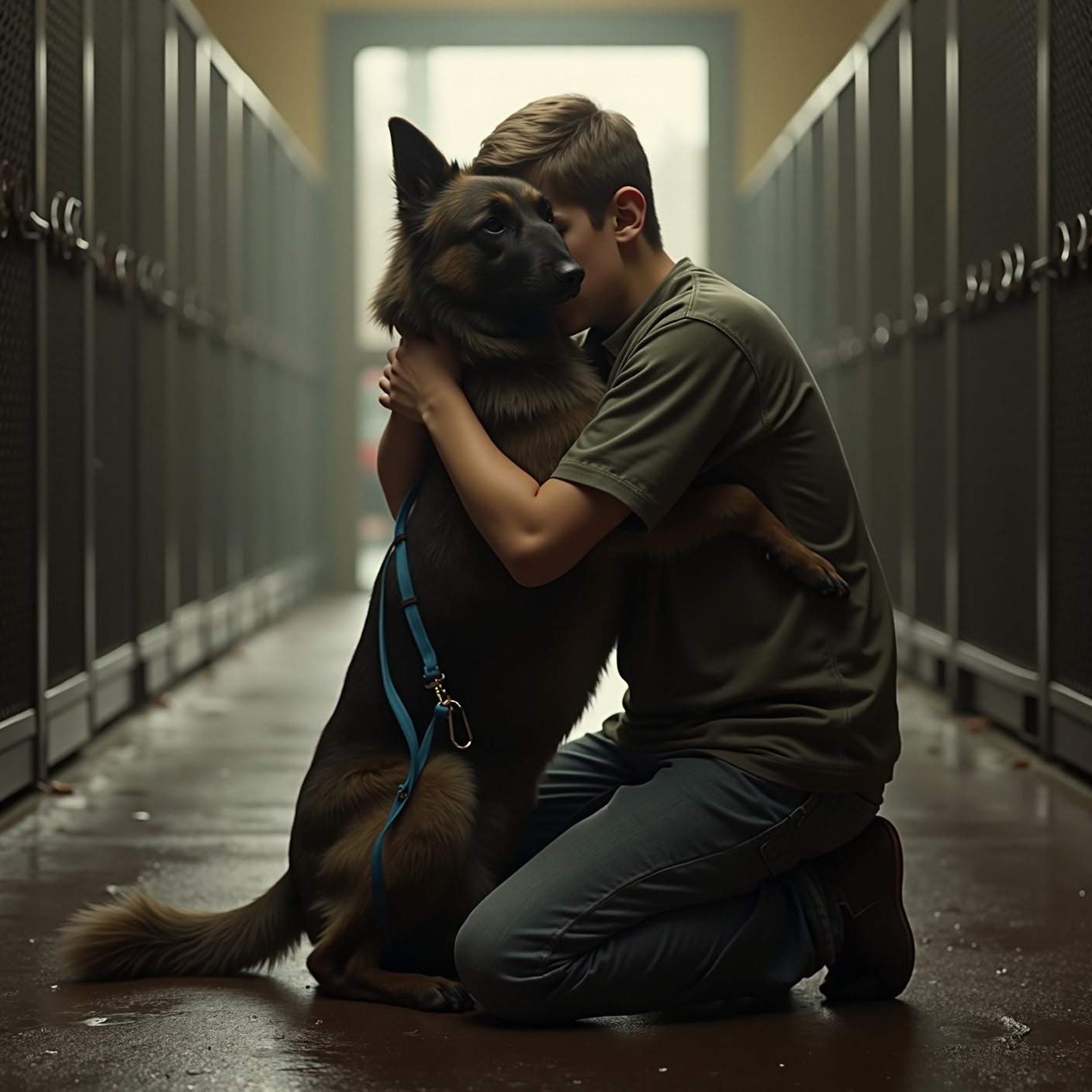
Renee got the gate open and the dog didn’t run out so much as pour out, straight up into the boy, and Ethan went down onto his knees on the wet floor and wrapped both arms around that grey neck exactly the way he had five hundred days before, and this time nobody was going to take the leash.
For a while nobody said anything that made sense. The boy was crying into the fur and the dog was pressing into him so hard he nearly knocked him over, licking his ear, his jaw, the salt off his face, making that sound.
When Ethan could talk, the story came out of him in pieces.
They’d never stopped thinking about him. That was the first thing he needed her to know. His mom had cried about it for months. But they couldn’t take a dog into that apartment, and they didn’t have the money to board one, and giving Chief a shot at a family that could keep him had felt, at the time, like the only decent thing left to do.
Then things turned, the slow way things turn. His dad picked up steadier work over the winter. They’d just moved, two weeks ago, into a little rental on the edge of town with a chain-link yard and a screen door that banged. And Ethan, sixteen now, had been bagging groceries after school since September, saving every check in a coffee can, for the adoption fee and the shots and whatever it took, telling himself the whole time that a good dog wouldn’t still be here, that somebody would have taken Chief by now, that he was going to walk in and be too late.
“I kept calling,” he said. “For a year I kept calling to ask if he got adopted. I was so scared somebody took him.” He looked up at Renee, this half-laugh, half-sob. “I was scared somebody took him.”
Nobody took him, Renee thought. He wouldn’t go.
The paperwork took twenty minutes. Chief lay across Ethan’s feet the whole time and would not be moved, one paw hooked over the boy’s sneaker like he’d sooner die than lose contact again. When it was done, Ethan clipped on a brand-new blue leash he’d bought before he even knew for sure, and stood up.
And Chief walked out the front doors of Riverbend for the first time in five hundred days.
He stopped once. Right at the threshold, in the open doorway he’d stared at for a year and four months, he turned his head and looked back down the row at the third kennel on the left, at the empty corner where he’d waited. Just for a second. Like he was making sure he was really allowed to go.
Then Ethan said, “C’mon, buddy,” and Chief didn’t look back again.
Renee stood in the doorway and watched the crooked-parked car pull out onto the county road, a grey muzzle already hanging out the back window into the wind, and she cried the way you cry when it finally, finally goes right.
He’d been waiting for the door to open.
He was right to wait.