He hugged her in front of forty people, and everybody heard what he said.
The reception was in the church hall, because Diane Prescott’s friends had insisted on doing it properly and nobody had the strength to argue. Ham and rolls. Three kinds of casserole in dishes with masking tape on the bottom so they’d find their way home. A folding table with a photo of Diane at the lake in 1998, squinting, holding a paper cup.
Erin had been standing by the coffee urn for an hour, saying thank you, saying she looks so peaceful, saying yes, an aneurysm, no, there was no warning at all. Sixty-one years old. On the Tuesday she’d called about a leaking dishwasher hose. On the Thursday she was gone.
Gary came across the room with his arms already out.
“Come here,” he said, and folded her in, and she smelled his aftershave and the church-hall coffee at the same time. Then he pulled back and held her by both shoulders so people could see him do it.
“We’re going to split it right down the middle, sweetheart. The house, all of it. Fifty-fifty. That’s what your mother would have wanted, and that’s what’s happening.”
Somebody said oh, Gary. Somebody’s mother put a hand over her heart. Erin remembers a woman from the dental office where Diane had worked for nineteen years leaning over to her friend and whispering that he was a good man, that Diane got lucky the second time around.
Erin believed it too. That’s the part she has trouble explaining now. She stood in that hall and felt the first loosening in her chest all week, because at least this wasn’t going to be one of those families.
Diane had no will.
She’d meant to. There was a folder in the file cabinet labeled ESTATE STUFF in her looping schoolteacher print, and inside it was a blank form from a stationery store, unsigned, and a business card for a lawyer in the next county. That was it. She’d been sixty-one and healthy and she’d had a dishwasher hose to worry about.
So the state did what the state does when there’s no paper. Everything went to the surviving spouse. The house on Linden Street where Erin had learned to ride a bike in the driveway and where the pencil marks on the pantry doorframe still climbed from age four to age fifteen. The savings. All of it, to Gary, who had married Diane when Erin was in high school and had always been decent enough, in a distant, television-in-the-evening kind of way.
Nobody was upset about it at the time. Fifty-fifty. He’d said so in front of the whole church hall.
The first six months, he was polite on the phone.
“It’s all tied up until the estate settles, kiddo,” he’d say. “You know how these things drag.”
She stopped calling as often, because she felt grabby asking. Grief makes you agreeable in ways you regret later. She told herself he was drowning too, alone in that house with all of Diane’s cardigans still in the closet.
At about nine months the calls started going to voicemail.
At a year, they stopped connecting at all.
She drove out there in April. The lawn had been reseeded and there was a new grill on the back patio. Her key didn’t turn. She stood on the step she’d sat on with her friends every summer of her childhood, working her mother’s key in the lock like an idiot, and understood, physically, in her hands, that the locks had been changed.
He answered eventually. Not all the way, just enough for the storm door to stay between them.
“Gary, I don’t want the money.”
“Nobody said anything about money.”
“I want Mom’s things. That’s all. The photo boxes in the crawlspace. My school albums, the ones with the blue covers. Her recipe box. That’s what I’m asking for.”
He looked past her shoulder at the street, and she watched him decide something.
“That all went out during the cleanout,” he said. “Back in the fall. Truck came and took the lot.”
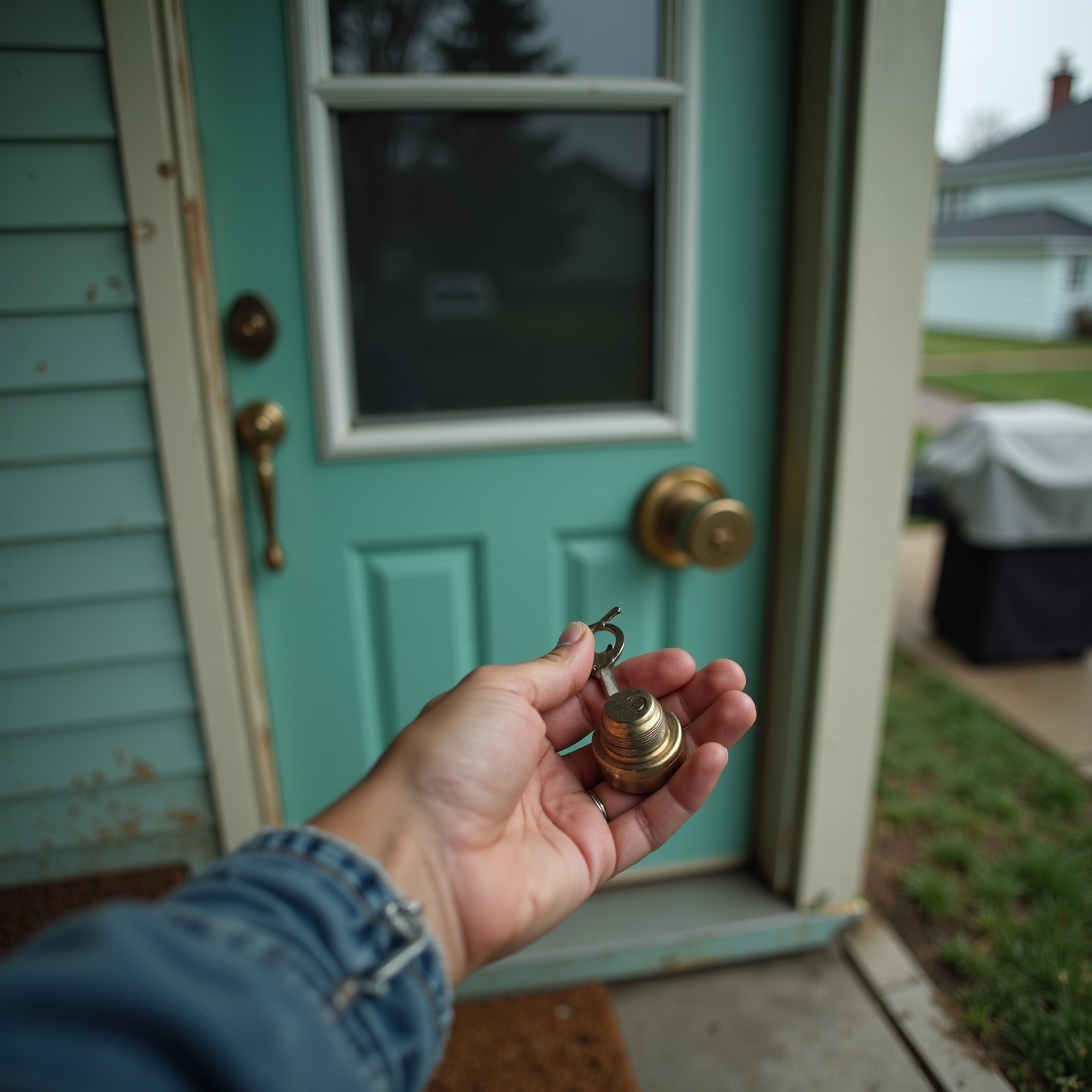
She didn’t cry in the driveway. She got in the car and drove eleven miles and pulled into a gas station and cried there, with her hands still on the wheel, because the blue albums had her mother’s handwriting under every photograph. Erin, 3, first haircut. Erin and Grandpa Walt, the barn, summer.
That should have been the end of it. A stepfather kept a house, said a thing at a funeral he didn’t mean, and threw away a dead woman’s photographs. It’s an old, ordinary kind of ugly.
Except that a few weeks later Erin was going through the copies her mother had given her years earlier, the ones Diane had handed over in a manila envelope with a rubber band around it, saying keep these somewhere, you never know. She had never opened it. It had lived in the bottom of a closet through two apartments.
Inside were her grandfather’s estate papers.
Walter Doyle had died in 2004 and sold nothing in his life except, at the very end, the seventy acres behind the barn. What was left after the nursing home went to his only daughter. And Diane, who could not keep a form straight in her life but who never forgot a promise, had put that money into a separate savings account at the credit union and told everyone in the family it was Erin’s college fund.
Everyone knew it. Erin’s cousins knew it. The dental office knew it. Diane called it “Erin’s account” at every Thanksgiving for fifteen years.
It was never titled in Erin’s name. Not once, not in any document in that envelope. There was no beneficiary line filled in. No transfer-on-death form. Nothing.
Because Diane had said it a hundred times, always in the same cheerful, dismissive way, usually while wiping down a counter: we’re family, honey. What do we need papers for?
That money had gone to Gary along with everything else. Not his family’s money. Not money he’d earned beside Diane. Money that came off Walter Doyle’s back field, that skipped a generation, that had been sitting in an account with Erin’s name spoken over it and never written on it.
She took the envelope to a lawyer, an even-tempered woman who read it twice and then set it down and was kind enough to be direct.
Three years had gone by. The account had been closed and its contents mixed into everything else long ago. There was no written trust, no signed intent, nothing but a family’s memory of a woman saying something warm at a dinner table. To fight it, Erin would spend more than she could ever recover, over years, and she would probably lose.
“I’m not going to take your money to chase this,” the lawyer said. “You’d be paying me to be angry for you.”
So Erin did the only thing left.
She sat down and wrote it out. The whole thing, plainly, no adjectives. The hug in the church hall and what he’d said with his hands on her shoulders. The locks. The blue albums. Walter’s seventy acres and the account with her name spoken over it. Four pages. She read it out loud twice to make sure she hadn’t exaggerated anything, and she took out two sentences that were unfair.
Then she sent it to everyone who had known her mother. The women from the dental office. The neighbors on Linden Street. Diane’s college roommate in Ohio. Her mother’s cousins. The choir group. Thirty-one people, most of whom had stood in that hall and heard the promise with their own ears.
Not one of them answered.
Not a call, not a card, not a line of email. Erin checked her phone for eleven days and then stopped checking.
She thought that would be the thing that finished her off. It wasn’t. Something else happened instead, quietly, sometime in the second week.
The anger that had been sitting on her chest for three years, the one that woke her up at four in the morning to relitigate a conversation in a doorway, simply got up and left.
Nothing had been fixed. She didn’t get the house. She didn’t get the money, and she is never getting the blue albums back, and Gary lives on Linden Street to this day with a new grill on the patio and Diane’s pencil marks still on the pantry doorframe, if he hasn’t painted over them.
Erin is fine with none of it. That’s not the same as being at peace with it, and she’d want you to know the difference.
But she wrote one line at the bottom of the last page, in a note to herself she never sent to anybody, and it’s the only ending this story gets.
I let it go for me. Not for him.