The scene runs about fifteen seconds, and it rewrote a career in that time.
A woman rises out of the Caribbean, water running off her shoulders, a hunting knife strapped to her hip, humming a little tune to herself. Sean Connery crouches in the rocks and watches her come. That was Honey Ryder in “Dr. No,” the 1962 film that started the whole James Bond machine, and Ursula Andress was famous before she got to the end of her first line of dialogue.
She was 26 years old, a Swiss girl from a big family outside Bern, and she had walked into film history in a homemade white bikini with a belt she had sewn on herself.
Within a year she was holding a Golden Globe for New Star of the Year. Producers wanted her. Photographers wanted her. The public wanted her. She had become the template for something that did not have a name yet, the Bond girl, and every actress who followed for the next six decades would be measured against that walk out of the water.
Here is the part that usually gets left out of the legend. The thing that made her immortal was, in a strange way, barely her at all.
Her accent was so thick that the studio dubbed almost every one of her lines in “Dr. No.” The voice audiences fell for on screen was not the voice she spoke with. The role that would define her for sixty years came down to a look, a walk, and a knife on the hip. She spent the rest of her life being recognized for a version of herself that a sound engineer had quietly polished.
She never let it stop her. She kept working through the 1960s and beyond, playing off her own image and sometimes gently mocking it. In the 1967 spoof “Casino Royale,” a wild parody of the Bond films, she played Vesper Lynd. Years later, in the 1981 fantasy “Clash of the Titans,” she was Aphrodite, the goddess of love, watching over mortals from the clouds.
It was on the “Clash of the Titans” set that her life quietly turned again. She met a young actor named Harry Hamlin, and the two had a son, Dmitri. Before Hamlin, there had been other famous names in her life, including Ryan O’Neal. But the woman who had been the most photographed face of the 1960s was, by degrees, choosing to be seen less.
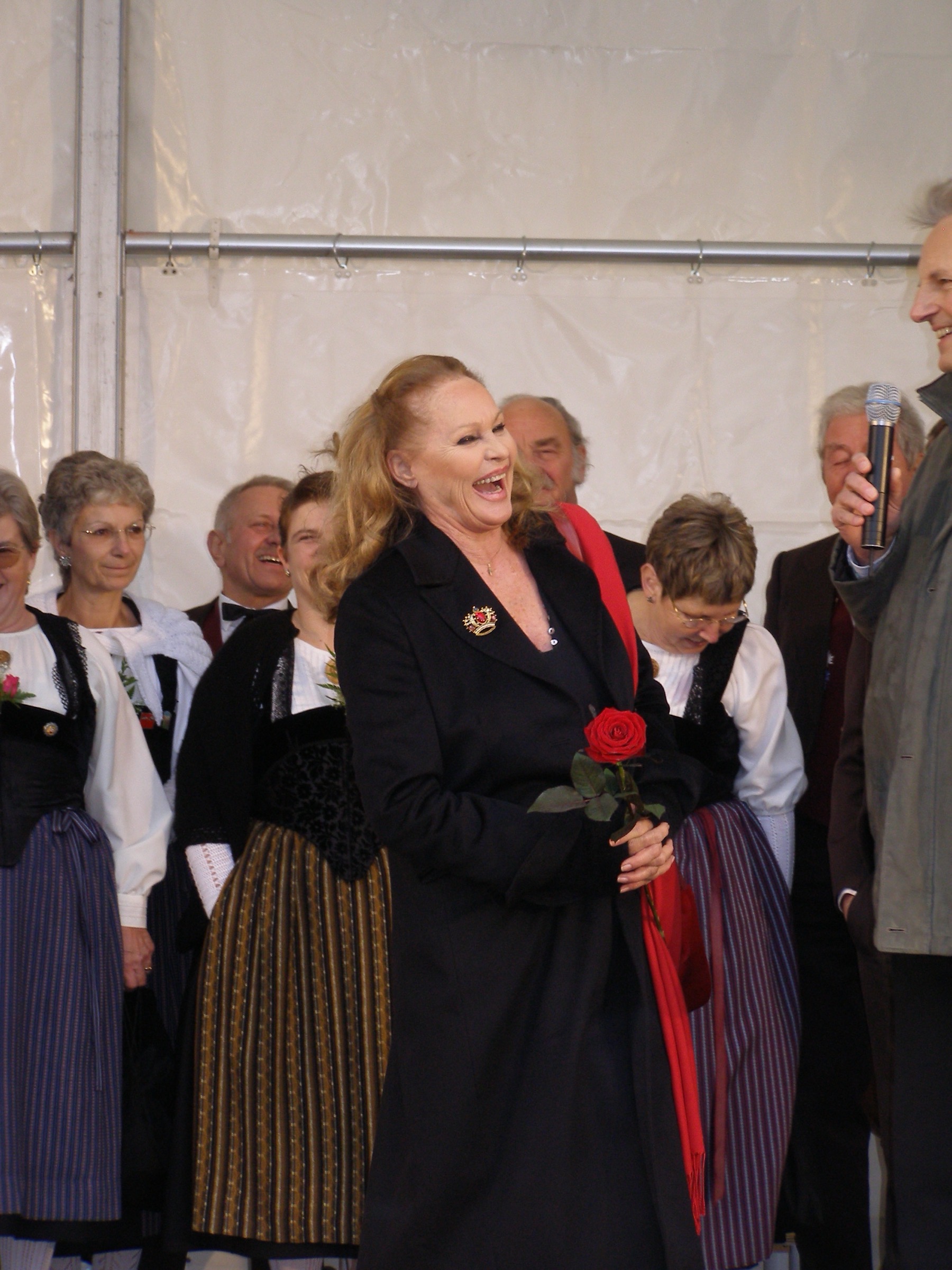
The stepping back was never dramatic. There was no farewell interview, no big goodbye to Hollywood. She simply took fewer roles, then almost none, and let the noise fade around her. The most famous Bond girl in the world went quiet on her own terms.
Today she splits her time between an apartment in Rome and the Swiss mountain town of Gstaad, to stay close to her sisters. She rarely appears in public. According to press reports, she also lost a large part of her fortune in recent years, said to have vanished through a former manager she had trusted. She has spoken about it with more calm than bitterness, a woman who has clearly learned that the applause and the money were never the point.
Which brings us back to the birthday.
She turned 90 on March 19, 2026. There was no gala, no cameras, no return to the spotlight. Instead, the day was marked by an old friend, the actress Linda Evans, whom millions once watched every week on “Dynasty.” Evans posted photographs of the two of them, past and present, with a short and tender message.
“Happy 90th Birthday, my beautiful friend Ursula Andress,” Evans wrote. “You have always been such an inspiring, radiant woman.”
That is the woman behind the fifteen seconds. Not a poster, not a bikini, not a knife on the hip. A 90-year-old who walked out of the sea once and changed the movies forever, and then spent the rest of her long life learning to walk out of the frame.
The girl the whole world watched rise from the water grew into a woman who understood, better than most, when to disappear from view. And on her ninetieth birthday, the people who mattered were still there, still calling her radiant, still calling her a friend.