
Wes Calloway did everything by the book, and that is exactly what he kept coming back to later, standing in his own yard with a folder in his hand.
He had wanted the fence for two years. Six-foot cedar, closed board, along the back and down the side. Nothing exotic. His wife Nora wanted a place where the dog could go out at seven in the morning without an escort, and Wes wanted to sit in a lawn chair on a Saturday without narrating his weekend to anyone.
He did not eyeball the line. He hired a licensed surveyor.
The man’s name was Ted Hanrahan and he showed up in a white truck on a Tuesday in April with a tripod and an assistant who barely spoke. They worked for most of the morning. When they finished, there were orange stakes running down the property line with pink ribbon snapping in the wind, and a stamped drawing in Wes’s kitchen with a seal on the corner of it.
“That’s your line,” Ted said, tapping the drawing with a knuckle. “The pins were already in the ground from the original plat. I just found them again.”
“And if I build a couple inches inside it?” Wes asked.
“Then you’re a couple inches inside it,” Ted said. “Nobody’s ever sued a man for putting his fence too far into his own yard.”
So that is what Wes did. He set the posts a hand’s width in from the ribbon. Not to the line. Inside it. He remembers being pleased with himself about that, in the small private way you are pleased about a thing nobody will ever notice.
The crew came out on a Saturday. It took them one long day, from a little after seven until the light went. Wes carried out a cooler of drinks around two. Nora made a joke about how the dog had already tried the new gate twice. Across the street, Terry Mundt watched from his driveway the way retired men watch construction, with his arms folded and his opinion ready.
And on the other side of the new fence, at the front window of the gray house, the curtain moved once and settled.
Sharon Pike had lived in that house longer than anyone else on the street. Wes had spoken to her maybe forty times in nine years, always about something. A package left at the wrong door. A car parked too long by the hydrant. The kid two doors down who drove too fast on trash day. She was not unpleasant. She was constant.
The letter came eight days later, folded in thirds, taped to the mailbox.
It was typed. It said that a portion of the recently constructed fence encroached upon her property, that she had documented the encroachment, and that she expected it to be corrected. It was signed with her full name, printed and signed both.
Wes read it twice standing at the curb, then walked down to her house and knocked.
Nobody came to the door. The porch light was on in the middle of the afternoon and he could hear a television going somewhere at the back of the house.
He knocked again. He waited a while. Then he went home.
That was the shape of the whole thing, as it turned out. She would not talk to him. Not once. Not that week, not any week after. She had written him a letter and she had no interest in the conversation the letter was supposed to start. Wes did not understand it then. It made him feel like he was arguing with a wall that occasionally slid notes under itself.
“How much?” Nora asked that night, reading the letter at the counter with her reading glasses pushed up.
“How much what?”
“How much is it over? She doesn’t say.”
Wes checked. She didn’t say.
He found out three days later from Terry Mundt, who had it secondhand from Gail Aldridge, who had heard it from Sharon herself over the fence line at the mailboxes.
“An inch,” Terry said, delighted. “She says one inch. She’s got a whole thing about it.”
“One inch.”
“One inch, Wes.”
Here is where a normal disagreement would have ended, one way or the other. Two neighbors talk, one of them says fine, whatever, and the matter dissolves the way most neighbor matters dissolve.
That is not what happened.
Sharon started building a case.
The first thing Wes learned about was the camera. She had a Ring doorbell, which everyone on that street had, and she had gone back and saved the entire footage of the install day. All of it. Every clip, from the crew’s truck arriving at 7:14 in the morning to the last of them pulling out after dark. She told Gail she had it. She wanted it known that she had it.
Then came the tape measure.
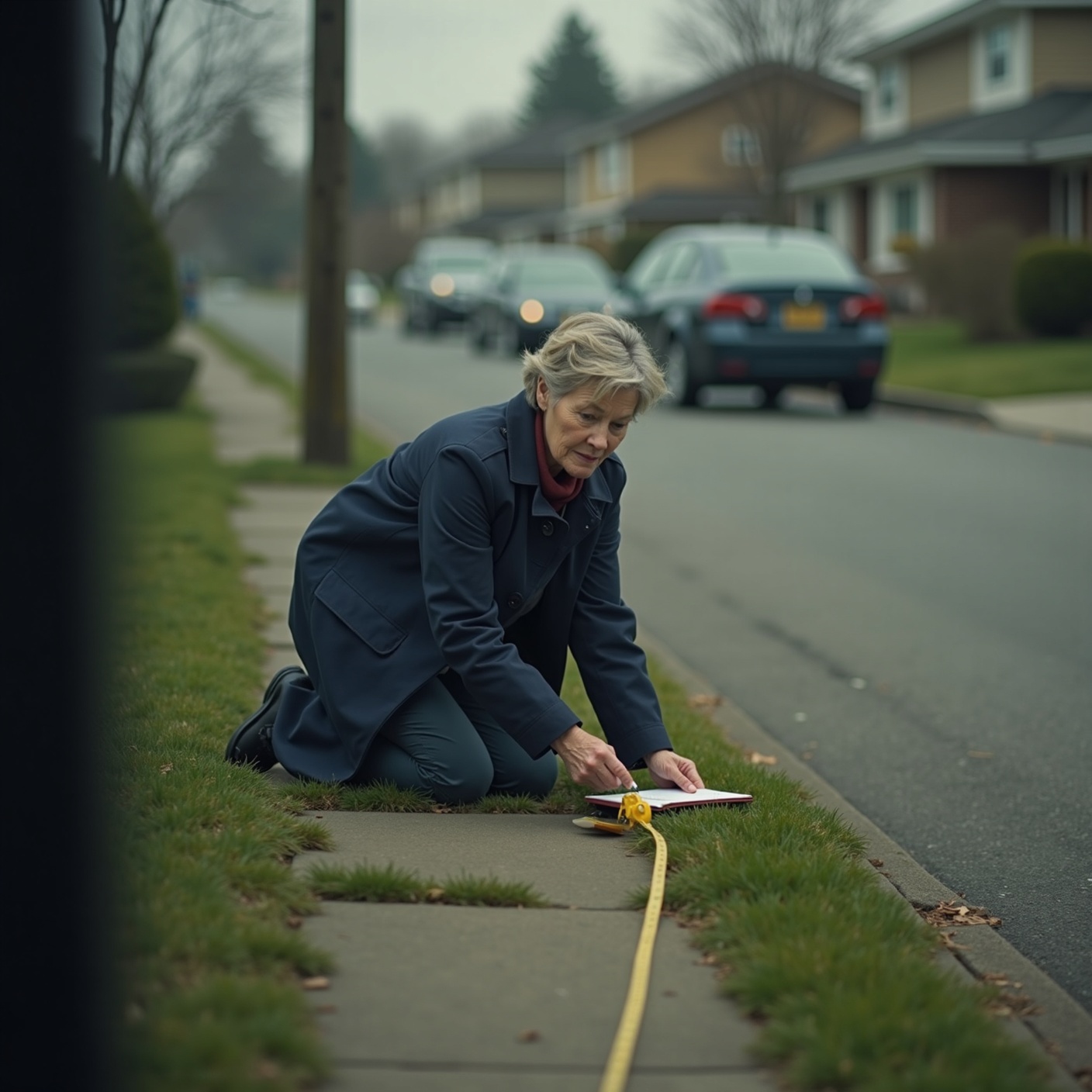
Nora saw it first, from the kitchen window, on a Thursday morning. Sharon in a windbreaker, kneeling at the edge of her own driveway with a retractable tape, running it out across the strip of grass between the sidewalk and the street. Writing something down. Getting up. Walking four houses down and doing it again.
“She’s measuring the dirt,” Nora said.
“She’s what?”
“Come look. She’s measuring the dirt in front of the Aldridges’ house. That isn’t even our fence.”
Wes came and looked. She was. She spent most of that morning on it, working her way down one side of the street and then starting back up the other, and at no point did she come near his fence at all.
The doors came after that.
Gail Aldridge told them about it apologetically, standing at the end of the driveway with her arms full of grocery bags because she did not want to come all the way in and make it a whole visit.
“She had a paper,” Gail said. “Like a typed statement. She wanted me to sign it.”
“Saying what?” Wes asked.
“Saying I’d noticed the fence had gone up past where it should have,” Gail said. “Wes, I don’t even know where it should have. I told her I couldn’t sign something I don’t know about.”
“What did she say to that?”
Gail shifted the bags. “She said she was surprised at me,” she said. “That’s the part that got me. Not mad. Surprised.”
Terry got the same visit. So did the family in the corner house who had moved in eighteen months earlier and who, as far as anyone knew, had never had a conversation with Sharon Pike in their lives. Nobody signed. That did not appear to slow her down.
And somewhere in the middle of all that, Nora remembered the shed.
They were eating dinner when it landed on her. She put her fork down.
“Wes,” she said. “The grass behind the shed.”
He didn’t follow.
“Behind the shed,” Nora said. “That strip. It’s a foot and a half wide and you can’t get the mower back there, and it never grows over.”
Wes sat with it for a second and then felt the floor tilt slightly.
Their shed sat two feet off the property line. The gap behind it was too narrow for a mower and too awkward to bother with, and for nine years that gap had stayed neat. He had noticed it exactly the way you notice a light that is always on. Which is to say never, until it goes out.
“She’s been coming over,” he said.
“She’s been coming over,” Nora agreed. “For years. With the little trimmer. Because it looked untidy from her side.”
Neither of them said anything for a minute.
“She never asked,” Wes said finally.
“No,” said Nora. “She wouldn’t have thought to.”
The next morning Wes called a second surveyor. A different firm, one town over, nobody who had ever heard of Ted Hanrahan or of him. He asked for a full independent boundary survey and he did not tell them why, because he did not want a single thing about it to be friendly.
They came out the following Wednesday.
Wes stood on his back step with a cup of coffee going cold in his hand and watched two strangers walk his property line with a tripod, and forty feet away, behind the gray house’s front window, the curtain was open all the way.
Sharon Pike stood in it with her phone up, filming, and did not lower it once the entire time they worked.
The results took nine days.
When the envelope came, Wes opened it standing in the driveway, and the drawing inside said what he already knew it would say. The fence was correct. Every post was inside his line, exactly where Ted Hanrahan’s stakes had put them, a hand’s width in from a boundary that had not moved since the subdivision was platted in 1974.
He should have felt something. Vindication, at least. Mostly he felt tired.
He carried the folder inside and set it on the counter and stood there looking at it, and that is when the actual answer arrived, and it had nothing at all to do with an inch.
Nine years. The packages. The hydrant. The kid who drove too fast on trash day. The strip of grass behind a shed that was not hers, trimmed for free, for years, by a woman who never once mentioned doing it.
Sharon Pike had a job on that street. Nobody had given it to her and nobody could take it away, and she had done it every single day for longer than most of them had lived there. She kept an eye on things. That was the whole architecture of her life, and it worked because the street was open. Line of sight from her front window all the way down to the corner, and around the back, straight across the grass to the shed and the yard behind it.
Then a man built a six-foot cedar fence, entirely legally, entirely on his own land.
And a section of the world she had been minding for a decade went dark.
She never had an argument about an inch. She had an inch because she needed a reason, and the inch was the only thing she could find that had a number attached to it, and a number is something you can measure, and measuring was the last part of the job she still had left.
Wes thought about that for two days.
Then he did the only thing he could think of that was neither cruel nor an invitation.
He made a copy of the second survey. The whole thing, seal and all, with the fence line marked. He put it in a clear plastic sleeve, the kind that keeps rain off a page, and he carried it out to his own side of the fence.
He taped it at eye level, facing out, on the panel nearest her house. Right in the frame of her camera.
Then he went inside.
She filmed it. Of course she did. Wes watched her do it from the kitchen, phone up, standing on the strip of grass between the sidewalk and the street, holding the shot a long time.
She did not knock. She did not write again.
And Wes did not respond, then or ever, to any of it. Not to the second letter that never came, not to the measuring, not to the curtain. He mowed his lawn. He sat in his chair on Saturdays. The dog went out at seven in the morning without an escort.
The strip behind the shed grew wild that summer for the first time in nine years, tall and ragged and leaning against the fence.
Nora asked once whether he should cut it.
“No,” Wes said. “Leave it.”