The adoption event was in a church parking lot in Virginia, on one of those early June mornings that starts out pleasant and has clearly decided not to stay that way.
Folding tables. A card reader that kept losing signal. Volunteers from Friends of Campbell County Animal Control, out of Rustburg, doing what shelter volunteers do at these things, which is mostly stand in the sun for six hours hoping somebody falls in love.
They had brought a handful of dogs. One of them was Sienna.
Sienna was four years old, a labradoodle and pit bull mix, and nobody could tell you anything about the first part of her life because nobody knew it. She had come in as a stray. That is the whole file. Somebody found her, somebody picked her up, and after that she lived at the shelter and waited, the way they all wait.
She was good at events. Friendly, steady, not a barker. The volunteers liked her because she made their job easy. She would sit with whoever was in front of her and let herself be scratched behind the ears and look up with the particular hopefulness that only a shelter dog seems able to produce on demand.
That morning she was doing exactly that, in the middle of a small knot of people, when she stopped.
She stood up. She walked out of the group.
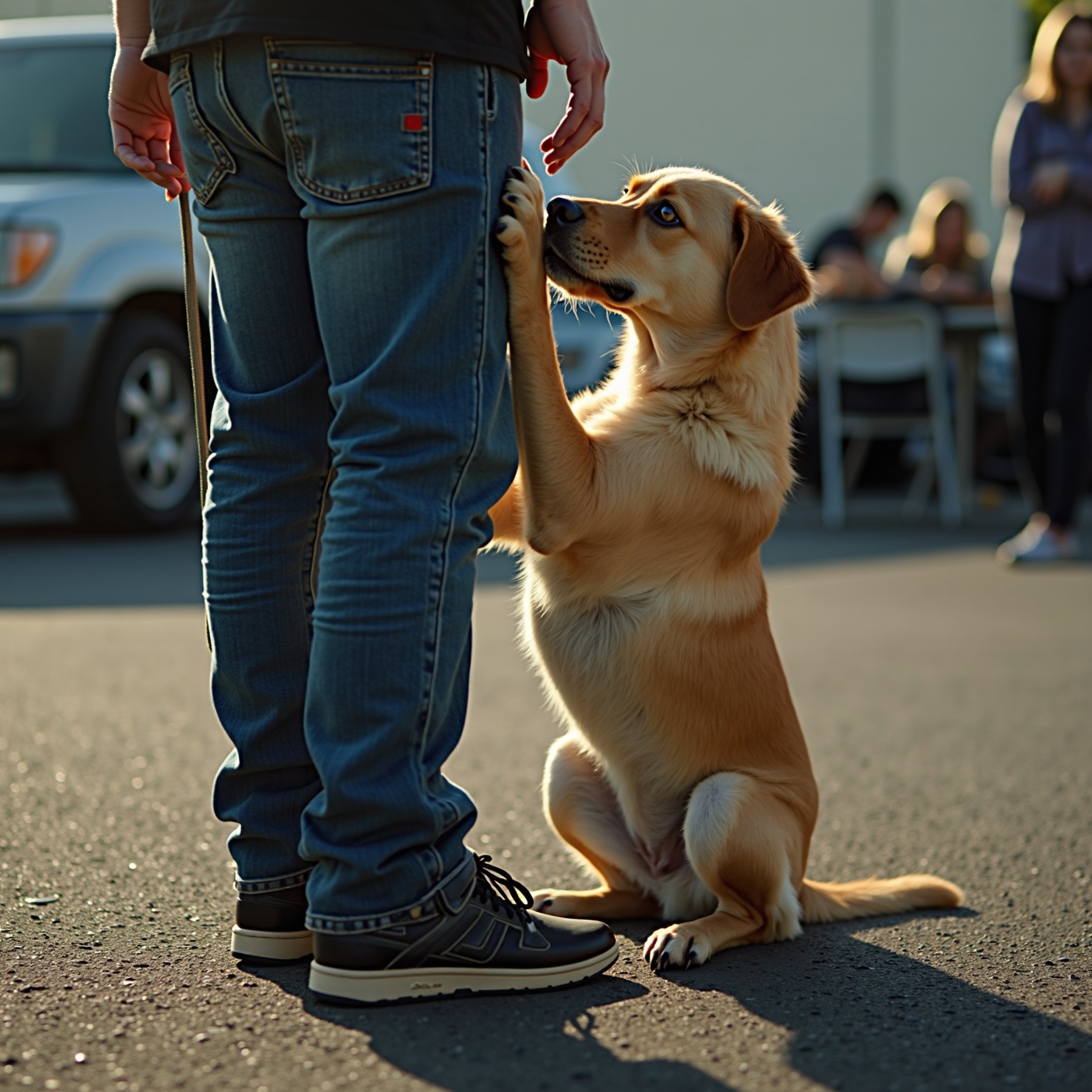
Not toward anything anyone could see. She went past the people petting her, past the volunteer holding her lead loosely at the wrist, out across the open pavement, and she walked up to a man standing off to the side who had never touched her in his life.
Then she sat down at his feet.
His name was Josh Davis. He was there with his wife Kristen. He had not been looking at the dogs. He had not called her over, or crouched down, or made any of the noises people make at a dog they want to come closer. He was just standing there, and now there was a dog sitting on his shoes.
He laughed about it, the way you do. Somebody made the obvious joke about how she had picked her person. He reached down and gave her a scratch and expected her to wander off again.
She didn’t wander off.
She stayed. She would not move. And when he shifted his weight slightly to get out from under her, Sienna lifted one front paw and put it on his knee, and looked up at him, and held it there.
That was the part people remembered afterward. Not the walking over. The paw.
Kristen noticed the dog before she noticed her husband, and then she noticed her husband.
She had been married to Josh long enough to know what she was looking at. He has epilepsy. Not the kind you see in a movie. The kind that announces itself in small ways first, in a hand that jumps once on its own, in a stillness that arrives in the face a few seconds before anything else happens. Kristen had learned to read those signs the way you learn to read a change in the weather off your own porch.
Josh had been running late that morning. He had gotten out the door without his medication.
She got to him fast. He came through the myoclonic episode with his wife on one side of him and a shelter dog he had met four minutes earlier planted against his leg on the other, and Sienna did not leave that spot for a second of it.
Nobody had trained her to do any of this.
That has to be said plainly, because people hear a story like this one and assume there was a program somewhere, a vest, a certificate. There wasn’t. Sienna was a stray of unknown history sitting in a county shelter in rural Virginia with no more training than any other dog on the lead that day. Whatever she picked up in the seconds before it happened, a change in scent, a shift in how a stranger was standing, she picked up on her own and she acted on it on her own.
She chose the one person in a parking lot full of people who was about to need her.
The story got out, as these stories do. First locally, then further, and by the time it had made its way around, everybody wanted to know the same thing. What happened to the dog.
Here is what happened to the dog.
A family in Roanoke saw it. Two parents, two sons, one of whom lives with epilepsy himself, and they read about a stray in Rustburg who had walked out of a group of people to sit down at the feet of a man mid-warning.
They drove out to meet her.
Sienna went home with them, and according to the shelter she settled it herself almost immediately. She did the same thing she had done in the parking lot. She looked around a room full of people and picked one, and after that she was his.
The volunteers who had spent that whole hot June morning standing behind a folding table, hoping somebody would fall in love, had watched it happen twice without recognizing it either time.
Because that first morning was never an adoption event for Sienna.
It was an interview, and she was the one conducting it.