
Picture yourself standing on a beach.
There is sand under your boots, though it is not sand. There is a sea in front of you, though nothing in it is water. There is weather. Clouds move. It rains here, and the rain fills rivers, and the rivers run down to the sea and pool there in bays and inlets you could put on a map.
Every one of those things is true, and none of them are happening on Earth.
Titan is the biggest of Saturn’s moons and it is larger than the planet Mercury. It is also the only other place we know of, anywhere, with stable liquid standing on its surface. Not ice locked underground. Not vapor. Actual pooled liquid with a shoreline and a horizon, that evaporates, forms clouds, falls back as rain, and drains downhill through carved valleys the same way water does at home.
The catch is what the liquid is made of. Titan’s seas are methane and ethane. Natural gas, chilled until it puddles.
That happens because the surface sits at about minus 179 degrees Celsius, which is minus 290 Fahrenheit. At that temperature the chemistry we take for granted swaps places with itself. Methane, a gas on Earth, becomes the local liquid. Water, our liquid, freezes so hard it stops behaving like ice at all and starts behaving like stone. Titan’s mountains and canyon walls are water ice. It is the bedrock. You could quarry it.
And the dark dunes that wrap around the moon’s equator, huge ones, hundreds of miles long, are not mineral sand. They are made of soot. Organic particles that form high in the atmosphere, drift down, and get herded into ridges by the wind.
So the beach is grit made of soot, the cliffs behind you are frozen water hard as granite, and the sea rolling in is fuel.
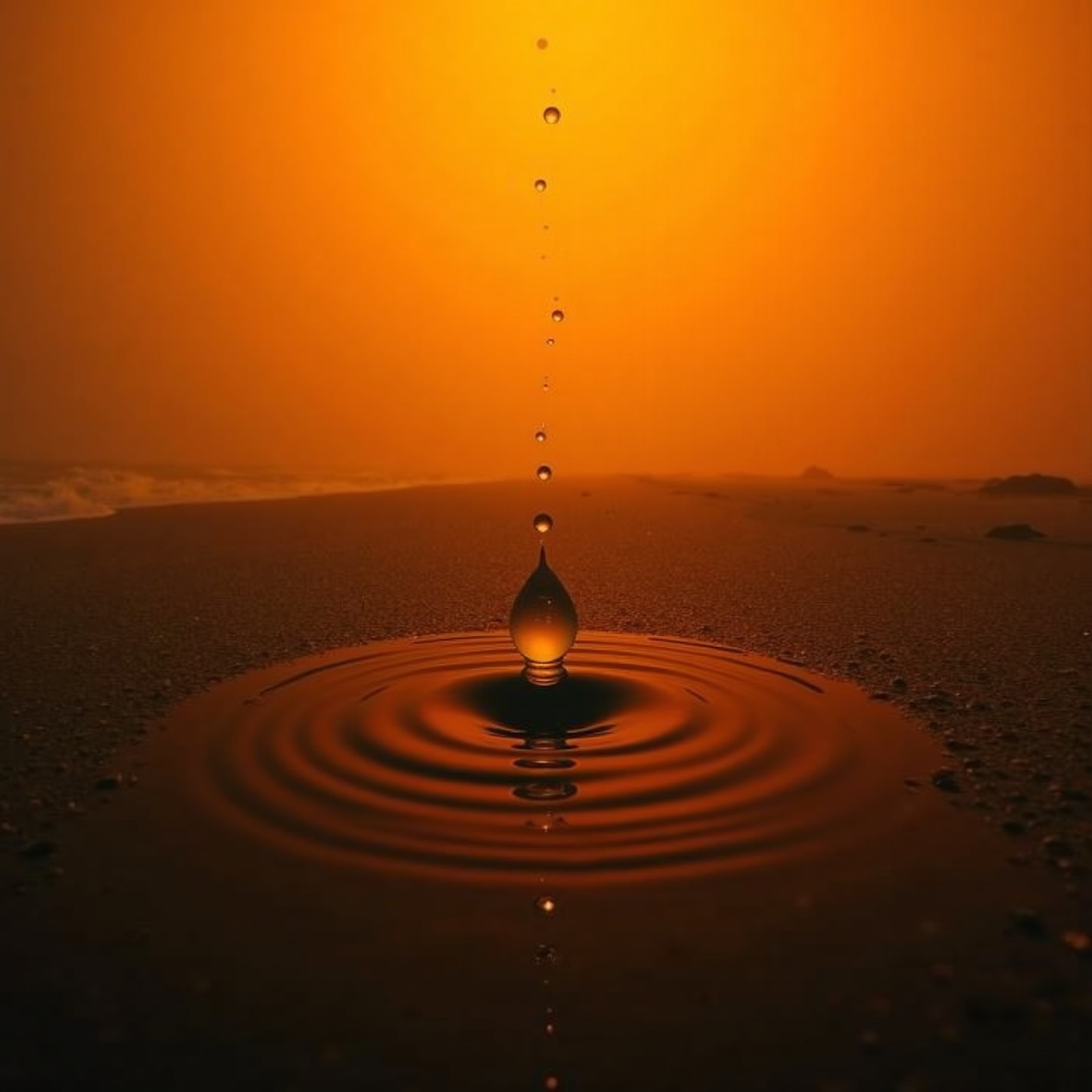
Now stand there and look up.
The sky is orange. Not blue with an orange tint, but a thick amber haze that goes all the way to the ground, because Titan is the only moon in the solar system with a real atmosphere, and it is a heavy one. Roughly 95 percent nitrogen, about 5 percent methane, and denser at the surface than the air you are breathing right now. Saturn hangs somewhere above you, enormous, and you would never once see it. The haze does not permit it.
The light is dim. Noon on Titan is closer to the way Earth looks about ten minutes after the sun goes down. Everything readable, nothing bright, the whole world in permanent late dusk.
And you would wait a long time for that dusk to change, because Titan is tidally locked to Saturn. One day there runs about 15 Earth days and 22 hours. You would work two full weeks of one afternoon.
Here is the part that gets people. Titan’s gravity is roughly a seventh of Earth’s, and the air is dense. Put those two numbers together and the arithmetic gets strange. A person with a pair of wings strapped to their arms could take off. Flap, and go. Not metaphorically. Physically, in that air, at that gravity, a human being could fly.
You would need the suit, obviously. Not for pressure, since the pressure there is close enough to ours, but for the cold, which would take you apart in minutes, and for the fact that there is nothing to breathe.
Then the weather comes in, and it is unlike anything in your memory.
A methane raindrop on Titan can be about a centimeter across, far bigger than the drops that hit your windshield, and it falls at somewhere near walking speed. You could watch an individual drop come down. Track it with your eyes from the cloud base to the ground. Storms are rare in most places, so you might stand on that shore for a very long time and never see one. But when it arrives, it arrives slow, fat, and silent.
For a while all of that was inference. We had the maps from the Cassini mission, we had the radar showing seas at the north pole with names like Kraken Mare and Ligeia Mare, and we had one small European probe called Huygens that dropped through the haze in 2005 and landed on ground that looked, in its own photographs, like a dry riverbed strewn with rounded pebbles. Pebbles rounded by liquid.
What we did not have was the cycle caught in the act.
That changed in 2025. Astronomers using the James Webb Space Telescope together with the Keck Observatory in Hawaii watched clouds form over Titan’s northern seas and rise, convecting upward the way a thunderhead builds over a warm lake on a July afternoon. It was the first direct confirmation that the methane cycle there runs the way our water cycle runs. Evaporation, lift, cloud, rain, return.
Which means Titan is not a frozen curiosity with some liquid sitting on it. It is a working world. It has a season and a sky and a hydrology, all of it built out of the wrong ingredients, all of it running anyway.
The odd comfort in that is how familiar it looks from a distance. Take a Cassini radar map of Titan’s north, strip the labels off, and hand it to someone. They will see lakes. Bays. A river delta. Somewhere between a fjord coast and the top of Canada.
It just happens to be sitting 800 million miles away, in the dark, in the cold, filling up with something you could set on fire.