
The drawer always stuck. Fifteen years, and Daniel never got around to fixing it.
He was only looking for a stapler. Their daughter needed a permission slip clipped to a health form by Wednesday, Kayla was over at her sister’s, and the stapler lived in the junk drawer under takeout menus for restaurants that had closed years ago.
He found the envelope instead. A credit union he’d never heard of. Addressed to his wife, at her sister’s place in Fort Collins. Already opened.
He should have put it back. He knew that while his thumb was going under the flap.
Balance: $28,412.
He sat down on the kitchen floor with his back against the dishwasher and read it again. Two hundred dollars. On the third of every month, for two years, never once missed. Fifteen years of marriage and he couldn’t have told you what she’d eaten for lunch that day, but here it was in a tidy column, every deposit, in a bank he wasn’t allowed to know about.
He knew what that kind of account was. Everybody does. His own sister had one. Her friends called it a “just in case” fund and said it the way you say the name of a medication.
A get-out fund.
He waited up for her. He put the statement on the table, face up, squared to the edge, and he sat there while the kitchen clock got loud.
Kayla came in at nine forty with her coat still buttoned. She saw the paper. She didn’t ask what it was. She didn’t even slow down.
“Fifteen years,” Daniel said. His voice came out flat and strange. “Fifteen years, and you’ve been sitting on twenty-eight grand where I can’t see it. So let’s hear it. How long have you been planning to—”
She was already reaching into her bag.
She set a folder down on the table and pushed it toward him with two fingers, and she waited until he looked at it.
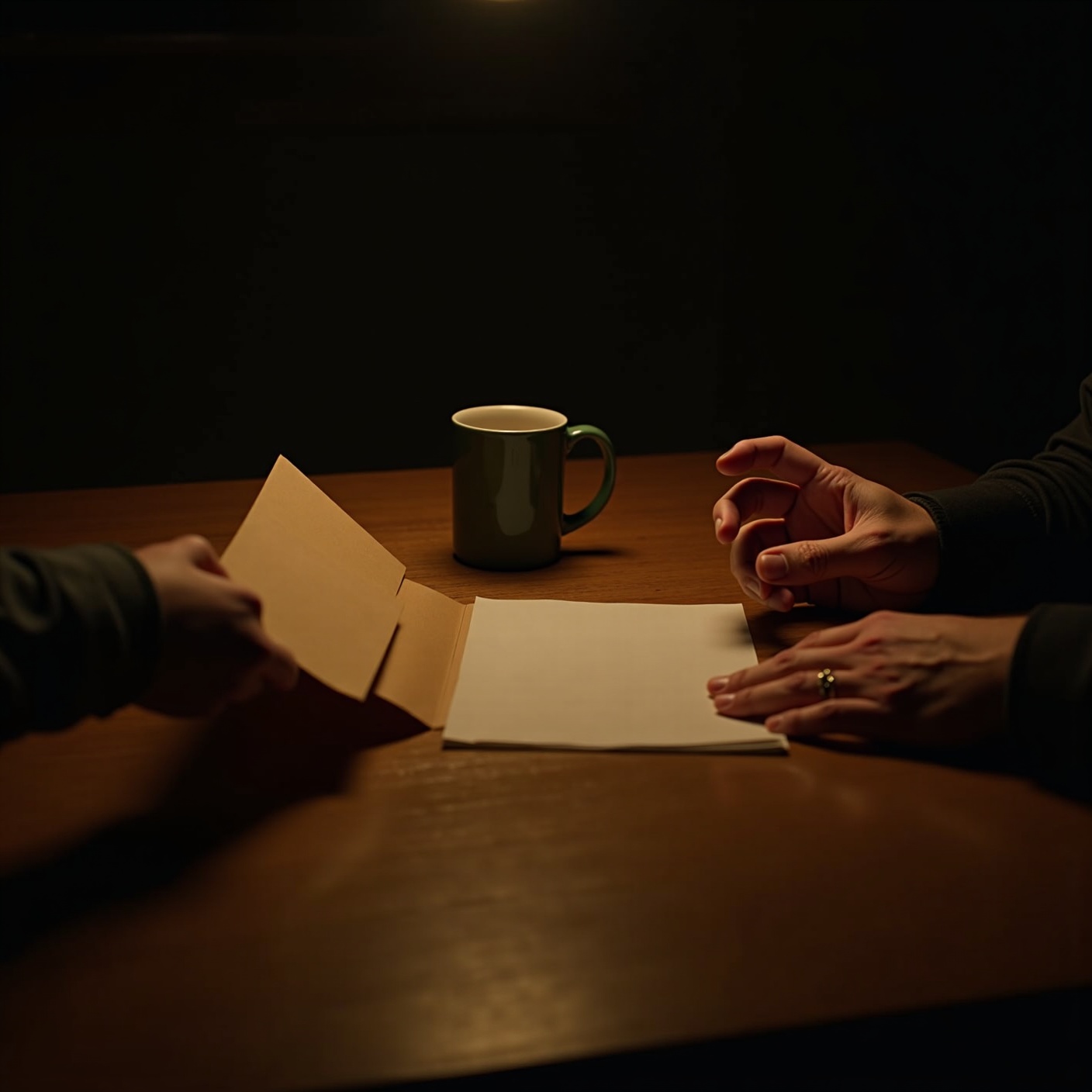
He opened it.
The first page was a printout from an app. He recognized the logo before he recognized his own name on it. Under the logo, a list. Dates, amounts, a running column that went down and down and down.
March. Four hundred. April. Twelve hundred. A Sunday in October, three deposits inside two hours, and Daniel remembered that Sunday. He’d told her he was at his brother’s watching the game.
There were eleven pages.
“Kayla.”
“Keep going,” she said. She sat down across from him. She still hadn’t taken her coat off.
The last page wasn’t from the app. It was a savings statement from their joint account, from four years ago, the one he’d emptied and refilled and emptied again and told her was a mix-up at the bank. She’d highlighted the withdrawals in yellow. Two columns, neat, patient, the handwriting of a woman who had done this at the kitchen table after everyone was asleep.
“How long,” he said.
“Two years and one month,” said Kayla. “You emptied it in April. You emptied it again in June. In August I sat in the car outside the pharmacy and I couldn’t make myself go in, because I didn’t know if the card would work, and I couldn’t handle finding out in front of the pharmacist.”
“You never said anything.”
“No.”
“Two years. You knew for two years and you never once—” He stopped. He was gripping the folder hard enough to bend it.
“What was I supposed to say, Daniel?” Her voice didn’t rise. That was somehow worse. “You looked me in the face and told me the bank made a mistake. You were so calm about it. And I sat there thinking, if I say the word out loud, right now, he’s going to say it isn’t true, and then I’ll have to decide what I do about that. And I wasn’t ready to decide.”
He couldn’t look at her.
“So I opened the account,” she said. “The next Monday. Two hundred dollars, because two hundred is what I could take out of the grocery money without you noticing. And every month I put it in, and every month I waited to see if you’d stop on your own.”
“You were building an exit.”
Kayla laughed. There was nothing in it.
“An exit.” She pulled the folder back across the table, closed it, and set her hand flat on top. “Daniel. That money is the mortgage. That money is Ellie’s braces and the property tax in November and the deductible if one of us breaks an arm. That money is the reason that when you empty something for the third time, this family doesn’t go under.”
He opened his mouth. Nothing came.
“I wasn’t leaving you,” she said. “I was staying. That’s what the two hundred was for.”
The clock kept doing its thing on the wall. Somewhere upstairs Ellie turned over in bed and the ceiling creaked, and both of them looked up, and both of them went quiet the way parents do.
“You should have told me you knew,” Daniel said finally.
“Yes,” said Kayla. “And you should have told me the first time. We can trade those all night if you want, or you can look at page four.”
Page four was a phone number. She’d written it herself, in pen, at the bottom of an app statement, the way you’d write a grocery item you didn’t want to forget. A counselor in Longmont who ran a Tuesday group. Kayla had called the office three times over two years and hung up every time, because it wasn’t hers to call.
“I’ve had that number since October,” she said. “I kept thinking you’d find the account and we’d have this fight, and I wanted to be ready with something better than a fight.”
Daniel sat with his hands on the table. Fifteen years he’d known this woman. He’d watched her get up at five to make it to a shift, watched her hold their daughter through a night of croup, and he had never once, in fifteen years, seen her look at him the way she was looking at him now. Not angry. Braced. Like someone standing in a doorway in a storm, holding it open anyway.
“I don’t know how to start this conversation,” he said.
“You already did,” she said. “You waited up for me.”
He went on a Tuesday. He went the next Tuesday too, and the one after that, and there was a stretch in February when he didn’t go and she didn’t ask and they both felt it in the house like a draft, and then he went again.
The account is still open. It has both their names on it now. She could have closed it, and he told her once, in the hard early weeks, that she could, that she should, that keeping it felt like she was waiting for him to fail.
Kayla shook her head. “It’s not a bet against you,” she said. “It’s a floor. Everybody should have a floor.”
She still puts in two hundred on the third of every month. So does he.