
I want to be clear about something before I tell this. I’m not a good man. I’m a forty-three-year-old guy who fixes commercial HVAC units, eats standing over the sink, and hasn’t called his own mother since Easter. Whatever you’re picturing, lower it.
It started at Halloran’s, the grocery store two blocks off Cedar, on an ordinary Thursday in February.
I was standing in the cereal aisle doing math on a box of store-brand bran, and I heard Ruth Bellamy’s voice on the other side of the shelf. I knew it right away. Ruth lives in 4B, directly across the hall from me. Seventy-one years old, small, always in a cardigan with a tissue balled up in the sleeve. Her husband Harold died fourteen months ago in the back bedroom of that apartment, and I know that because I helped the guys from the funeral home get the gurney around the corner by the radiator. That’s the sum total of what I’d done for her. I turned a gurney.
She was talking to Marisol, one of the cashiers who’d come out to restock the endcap. Their voices were low, the way people talk when they don’t think it carries.
“I’m all right, honey,” Ruth said. “Truly. It’s just this month is a little tight.”
“Miss Ruth, you’ve got two things in that whole basket,” Marisol said.
There was a pause. I could hear the wheels of the cart squeaking.
“Well,” Ruth said, and she laughed the way people laugh when they’d rather not be having the conversation. “If I skip lunches, the rent comes together by the twenty-eighth. It always comes together. Breakfast is the one I like anyway. You don’t need three meals sitting still in an apartment all day.”
Marisol said something soft I couldn’t hear. Ruth said, “Don’t you dare tell anybody that. I’m fine.”
I stood there holding that box of bran like an idiot. Something went through me that I don’t have a good word for. Not pity. Pity is comfortable. This was closer to shame, the specific kind you feel when you realize a person has been quietly drowning eight feet from your front door for over a year while you complained about the parking.
I put the bran back. I got a cart.
I filled it without a plan. Eggs, milk, a rotisserie chicken, coffee, bread, a bag of apples, rice, two cans of soup, butter, a block of cheddar, oatmeal, a pound of ground beef, a jar of peanut butter, a box of tea. Ninety-one dollars and change. I remember because I stared at the receipt in the parking lot for a while, engine off, wondering what exactly I thought I was doing.
Because here’s the part I understood even then. If I knocked on her door and handed her those bags, she would never take them. Ruth Bellamy is the kind of woman who irons a blouse to go to the pharmacy. She would thank me, and refuse, and then she would be embarrassed in her own hallway every single time she saw me for the rest of her life. I’d have taken the last thing she had, which was the ability to say she was fine.
So I waited until 10:20 that night. I pulled my hood up like a man about to commit a crime, carried two bags across nine feet of hallway carpet, set them down against her door, and knocked twice. Then I went back into my apartment and stood behind my own door in the dark like a lunatic, listening.
It took her almost two minutes to open it. I heard the chain slide. I heard her say, “Hello?” into the empty hall, and then nothing for a long moment.
Then I heard her start to cry. Standing in her doorway at ten thirty at night, over eggs and bread.
I slid down my door and sat on the floor of my own entryway with my hood still up until I heard her drag the bags inside.
That was February. I have not missed a Sunday since.
The routine got its own rules, and I never wrote them down but I follow them like scripture. Ninety to a hundred dollars, no more, because more would frighten her. Nothing that looks like charity food. No dented cans, no clearance stickers, nothing with the reduced-price tag left on. Real coffee, the kind in the red can, not the store brand. Always something that isn’t strictly necessary, because necessary is what a food bank gives you, and this isn’t that. A little carton of half-and-half. Good strawberries in the spring, even when they’re four dollars. Once, in March, a small bunch of yellow tulips wrapped in cellophane, laid across the top of the bag.
She kept the tulips in her window for two weeks. I could see them from the parking lot when I came home from work. That was a strange month.
And then in April I learned about the cookies.
We were in the mail room, which is a closet in the basement with sixteen brass boxes and a light that hums. She was struggling with her key. I opened her box for her the way you do for a neighbor, and she made small talk about the weather, and I made small talk back, and then, because I am not as clever as I think I am, I said something I’d been sitting on for weeks.
“Somebody at work brought in cookies,” I told her. “Got me thinking. You ever bake, Miss Ruth?”
Her whole face changed. Not sad, exactly. Lit from a long way back.
“Oh, I never had to,” she said. “Harold did all of it. Forty-six years, that man would not let me near a mixing bowl.”
“Harold baked?”
“Every Sunday afternoon of his life,” she said. “Molasses crinkles. The soft kind, rolled in the sugar so they crack on top. He put too much ginger in them. I told him for forty-six years it was too much ginger.” She stopped and adjusted the mail in her hands and laughed a small laugh at the floor. “I would give anything for one of those cookies with too much ginger in it, Dale. Anything at all.”
Then she said it was nice talking to me and she went up the stairs, and I stood in that basement for a while under the humming light.
Here’s the thing about Halloran’s. They have a bakery counter, and they do sell a molasses cookie. Soft, cracked on top, rolled in sugar. Four for three dollars in a little paper sleeve.
That Sunday, at 10:20, there were three bags at her door instead of two.
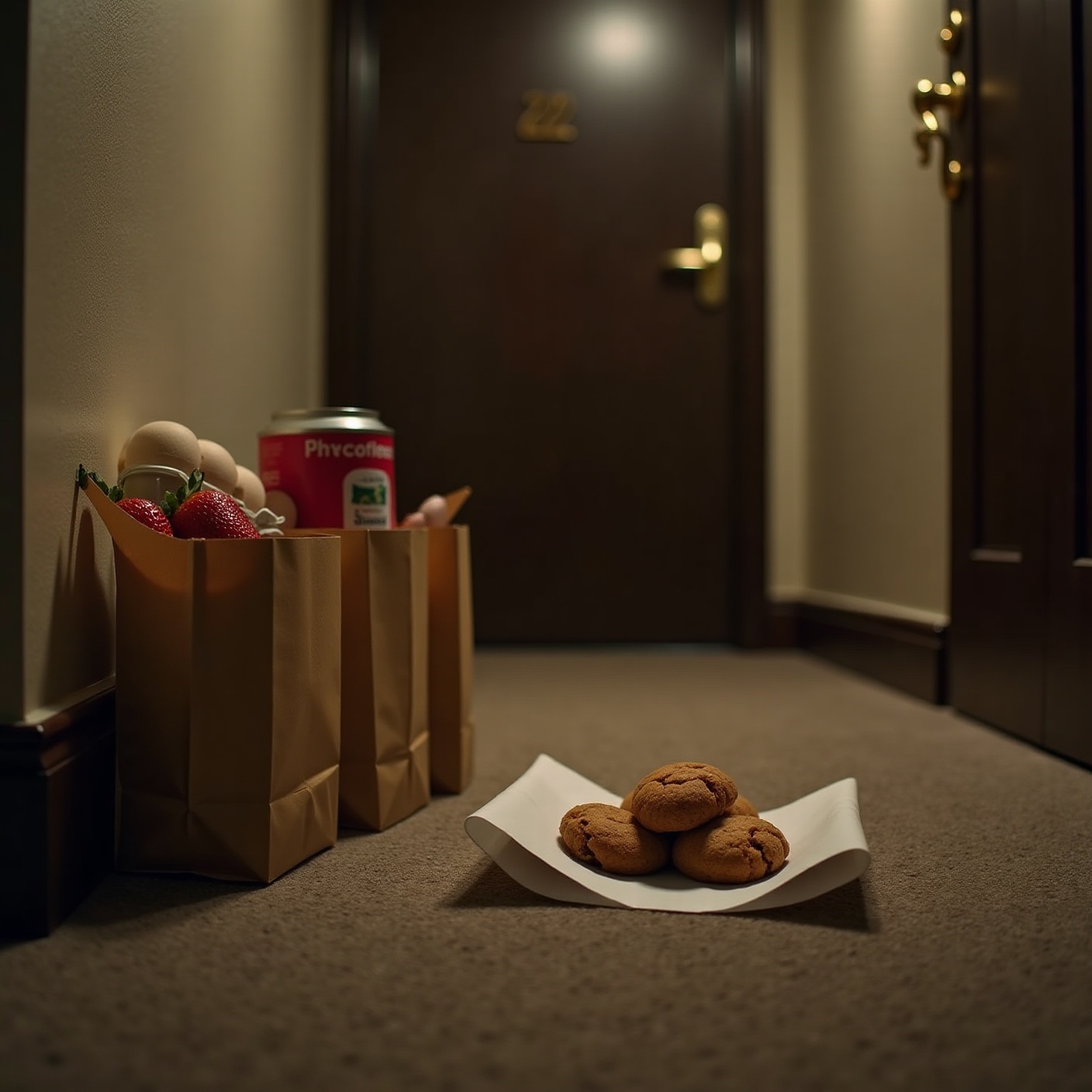
I don’t know what I expected. Nothing, probably. But the next morning there was a piece of paper taped to the inside of the building’s front door, right at eye level, in handwriting that shook a little.
It said: To whoever you are. The cookies. Thank you. You could not have known.
I read it four times on my way to the truck. Then I sat in the truck.
After that I couldn’t stop. Every Sunday, four molasses crinkles from the bakery counter at Halloran’s. I asked the kid behind the counter once, casually, whether they used a lot of ginger. He said he had no idea, he just moved the trays. I bought them anyway. May, June, July. The bags got lighter in summer when the produce was good and heavier in October when I started worrying about her heat bill and put a bag of coffee in there every single week.
She never caught me. She came close in June, when her door opened while I was still in the hall and I had to take the stairs down two at a time in my socks like a teenager, but she never caught me.
And I never told a soul. Not the guys at work. Not my brother in Toledo. It isn’t humility. I want to be honest with you here. Part of it is that if I said it out loud, it would become a thing I did, a story I told about myself, and then it would be about me instead of about her. And part of it, the truer part, is that those nine feet of hallway carpet on a Sunday night are the only ten seconds in my week when I am completely certain I’m doing the right thing. I wasn’t going to let anybody take that and turn it into a compliment.
Then came the Tuesday in November.
I was coming up the back stairwell from the laundry room with a basket on my hip. The stairwell door on the fourth floor doesn’t latch. It’s been broken since I moved in. And through that gap I could hear Ruth on the landing with Denise from 3B, the woman with the two boys and the stroller that never fits in the elevator.
I stopped. I don’t know why I stopped. Something in Ruth’s voice had a shine on it.
“Denise, honey,” she was saying, “let me tell you what’s been happening to me.”
And I stood there on the third-floor landing, holding a basket of my own damp shirts, and I listened.
“Every Sunday night,” Ruth said. “Every single Sunday since February. Groceries at my door. Bags of them. Good things, Denise. Real coffee. Strawberries in the springtime. And I have never once caught who it is.”
Denise said something about the church, maybe somebody from the church.
“It isn’t the church,” Ruth said. “The church sends a box at Christmas with a card in it so you know who to thank. This is different. This one doesn’t want the thank-you.” She was quiet a second. “You know what I’ve decided, and you can laugh at me if you want to. I’ve decided God sends somebody to watch over you when you can’t do it yourself anymore. That’s what I’ve decided. I call him my grocery angel.”
My grocery angel.
I want to explain that I am not a religious man. My mother tried. It didn’t take. I’ve stood at two funerals and felt nothing but the ache in my back from standing.
“The cookies, though,” Ruth said, and her voice went thin. “That’s how I know it’s real, Denise. Molasses crinkles. Every week. Nobody living knows about those cookies but me and Harold, and Harold is fourteen months in the ground. Nobody knows. So you tell me who’s doing that.”
She laughed, and Denise laughed, and I heard Denise say she’d keep an eye out.
“Don’t,” Ruth said. “Don’t you dare go looking. Some things you’re not supposed to look at directly.”
I got down the stairs somehow. I made it through the lobby and out the side door and across the lot and into my truck, and I sat there in the cab with a laundry basket on the passenger seat and I cried for ten minutes. Ugly. Both hands on the wheel. A guy who fixes air conditioners, forty-three years old, sobbing in a parking lot at eight fifteen on a Tuesday night in November.
She thinks Harold sent someone.
She’s fourteen months alone in an apartment where he died, eating breakfast and calling it enough, and she has decided that the universe assigned somebody to look after her, and the proof is a three-dollar paper sleeve of cookies from the bakery counter at Halloran’s that I bought because I couldn’t think of anything else to do with what she told me under a humming light in a basement.
I am not going to tell her. Not this year. Not ever, probably. She’d have to thank me. And whatever I am to her in her head, standing in her kitchen at ten thirty on a Sunday night, is worth a hundred times more than a middle-aged neighbor in a hoodie who felt bad in the cereal aisle. Let her keep the angel. The angel’s better.
Last Sunday it snowed, the first real one. I stood in my socks at 10:20 with two bags and a paper sleeve of molasses crinkles, and I set them against her door, and I knocked twice, and I got back inside before the chain slid.
I stood behind my own door in the dark and listened to her open hers.
She didn’t say hello into the hall anymore. She hasn’t for months.
She just said, very quietly, “Thank you, sweetheart.”
And then, after a moment: “Harold, I got the cookies again.”