Margaret Whitfield was buried on a gray Tuesday in October, and by Friday her family was already sitting in a lawyer’s office, waiting to hear what she had left behind.
They had come from three states away. Her nephew Dennis drove in from Columbus in a car that still smelled of the dealership. Her sister Carol wore black and dabbed at eyes that were, if you watched closely, quite dry. And at the end of the long table sat Walter, seventy-four years old, Margaret’s husband of forty-one years, turning his wedding ring around and around on a finger that had gone thin with age.
He did not want anything. He wanted his wife back, and since that was not on offer, he mostly wanted to go home.
The attorney, a soft-spoken man named Mr. Alvarez, slid his glasses up his nose and began to read.
To Carol, her sister, Margaret left the good jewelry and the china that had come down from their mother. Carol nodded, satisfied, as though a debt were finally being paid.
To Dennis, her nephew, she left the house on Sycamore Street, the maple furniture, and the certificate of deposit at First National. Dennis leaned back in his chair and let out a slow breath through his nose, the sound a man makes when a bet finally comes in.
Then Mr. Alvarez turned to the last line on the page. He paused, as if he wanted to be sure he read it correctly.
“And to my husband, Walter,” he said quietly, “I leave my brown wool coat. The one I mended.”
For a moment no one spoke.
Then Dennis laughed. It was not a cruel laugh, exactly, but it filled the room and it did not stop when it should have. He looked around the table for someone to share it with.
“A coat,” Dennis said. “Forty-one years, and she left him a coat.” He shook his head, grinning. “Uncle Walter, you want, I’ll buy you a new one. Something without holes in it.”
Carol pressed her lips together to keep from smiling. Walter said nothing. He reached out and took the coat, which Mr. Alvarez had brought in a paper shopping bag, folded neat as a letter. It was heavier than he remembered. He held it in his lap the way you hold a sleeping child, and he did not look up until the laughing had died down on its own.
“Thank you,” Walter said to the lawyer. That was all.
He drove home alone. The house on Sycamore was Dennis’s now, so Walter went back to the little rented apartment above the hardware store, where he and Margaret had moved two years earlier when the stairs got to be too much for her. He set the coat on the kitchen table and made himself a cup of coffee he did not drink.
He knew that coat. Lord, he knew it. Margaret had worn it every winter for as long as he could remember, brown wool gone soft and pilled at the cuffs, a coat she refused to replace no matter how many times he offered. She had worked thirty years at Dot’s Diner out on Route 9, on her feet from five in the morning, and she wore that coat over her uniform through every January wind coming off the fields. He used to tease her about it. She used to tell him to mind his own business.
He ran his hand down the front of it now, remembering.
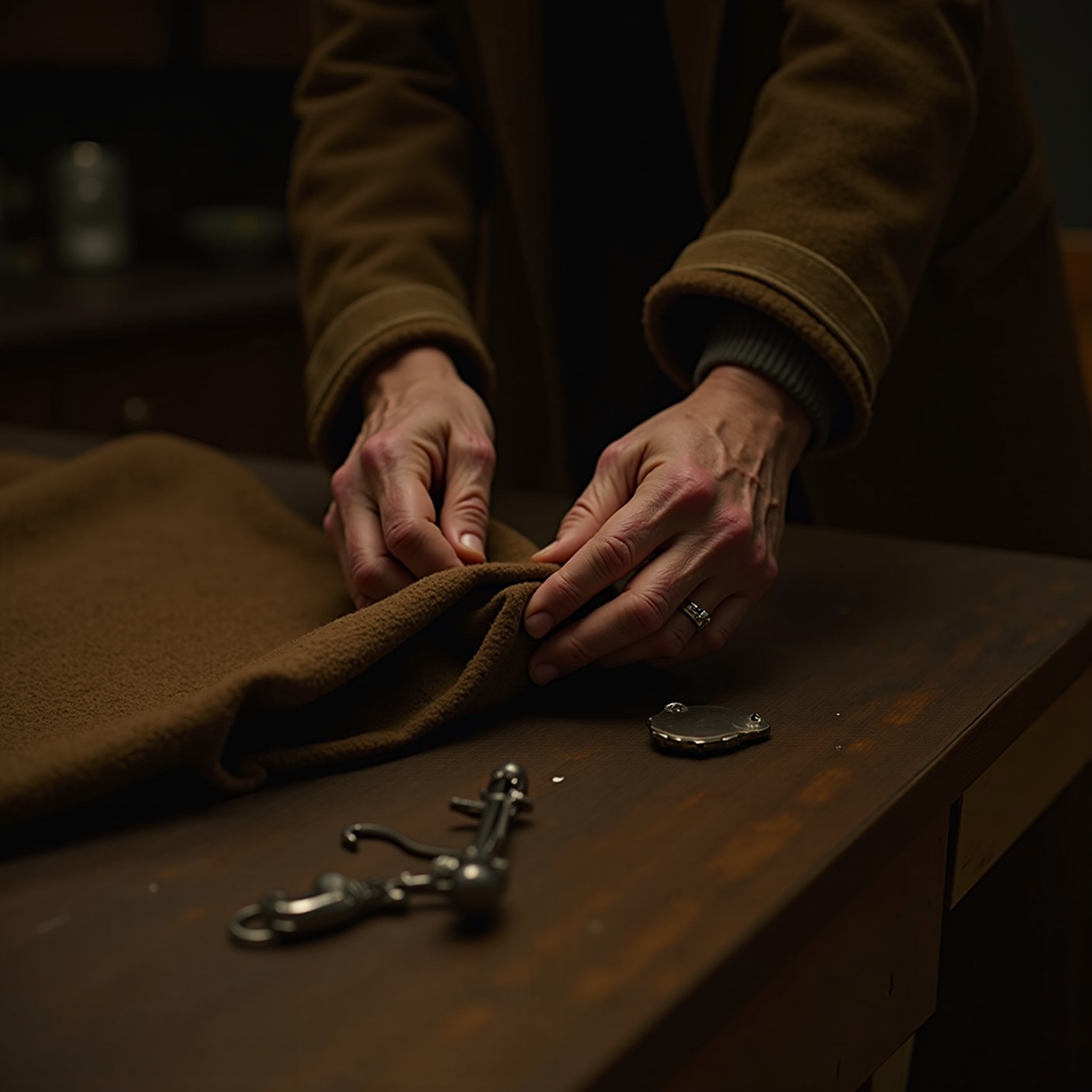
That was when he felt it. Something stiff along the bottom hem, where the lining met the wool. Not a coin. Not a button. A flat, hard edge, the length of his hand, sewn in where no pocket was.
Walter frowned. He turned the coat inside out under the kitchen light. The lining there had been opened and closed again, and the stitches were not Margaret’s usual neat work. These were small and careful and slow, the stitches of someone doing a thing in secret, a little at a time, over a long while.
His hands were not steady. He found the sewing scissors in the drawer, the ones with the stork-shaped handles she’d had since before they married, and he worked the blade under the thread and began, very gently, to cut.
The lining opened like an envelope.
And inside the coat, tucked flat against the wool where a wife’s love had hidden it away, was a sealed envelope with his name written across the front in Margaret’s hand.
Walter, it said. For when I’m gone.
He sat down. He had to.
For a long time he only looked at it. Then he slid his thumb under the flap, and the old glue gave without a fight, and he took out what was inside.
There was a letter, three pages, in her small backward-slanting script. And folded inside the letter was a thick sheaf of United States savings bonds, dozens of them, the earliest dated the first winter they were married, the most recent from the spring before she got sick. A bond bought nearly every single month for forty-one years, out of tips carried home from Dot’s Diner in the pocket of that same brown coat.
He read the letter with his glasses fogging.
“My Walter,” she had written. “You always said I should buy myself a decent coat. I never did, because every dollar I didn’t spend on wool, I sewed into it instead. You never went looking in the one place a poor woman keeps what matters. Neither did anyone else. That was rather the point.
“The house, the china, the fuss at the bank, let them have it. Dennis will feel like a rich man for a year and then he’ll sell it. But you kept me warm for forty-one years, so I have spent forty-one years keeping something warm for you. It’s all in here. It always was.
“Wear the coat, you stubborn old fool. It suits you.”
Walter Whitfield put his face in his hands, in a kitchen above a hardware store, and he laughed and he wept at the same time, which is a thing a person can do when they are seventy-four and have just been loved out loud one last time.
He never told Dennis. He never had to.
But on the first cold morning that November, the neighbors saw the old man walk to the diner for breakfast in a brown wool coat two sizes too small, worn open over his shoulders like a blanket, and they say he was smiling the whole way there.