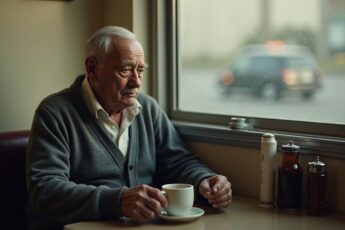
My sister moved into Mom’s house “just for a few weeks.” Three months later, my key didn’t fit the lock.
My mother, Eleanor, was buried on a Thursday, and by the following Wednesday my sister and I were sitting in a lawyer’s office learning what she’d left behind. It wasn’t much. A savings account with a little over nine thousand dollars in it. Her wedding ring. And the house on Larkspur Lane, the one we grew up in, a small single-story with a covered porch and a kitchen that still smelled like her even after she was gone.
The lawyer, a soft-spoken man named Mr. Alvarez, read the important line twice so there wouldn’t be any confusion.
“The residence at 14 Larkspur Lane passes equally to both daughters,” he said. “Fifty-fifty. Claire and Diane, jointly.”
Diane nodded like that was exactly what she expected. I nodded because I couldn’t feel my face yet. Mom had been gone six days. Splitting anything felt obscene.
I should tell you where things stood before all this. For the last four years of Mom’s life, I was the one twenty minutes away. I drove her to dialysis three mornings a week. I sat in the pharmacy line, I refilled the pill organizer, I learned the names of every nurse on her floor. Diane lived in Phoenix. She called on holidays and on Mom’s birthday, and she meant well, I think, but “meaning well” from two thousand miles away is a different thing than showing up. I don’t say that to make myself the hero. I say it because it matters to what came later.
In the parking lot after the will reading, Diane asked me for a favor.
“Give me a few weeks in the house,” she said. “Just to go through her things. You’ve done everything, Claire. Let me do this part. I owe her that much.”
And what was I going to say? No, you can’t grieve our mother in our mother’s house? I told her of course. Take the time she needed. We’d figure out the rest of it later, when it didn’t feel like standing on Mom’s grave to talk about money.
A few weeks. I keep coming back to those words.
The first month, I stayed away on purpose. I figured she needed room. When I did drive by, I noticed the porch light was new, one of those bronze fixtures from the hardware store. Fine. The old one was cracked anyway.
The second month, I stopped in with a casserole and found the kitchen painted a pale sage green. Mom’s yellow was gone. Diane had hung new curtains, white ones with little embroidered leaves, and there was a coffee maker on the counter I didn’t recognize.
“I couldn’t look at that yellow anymore,” Diane said, wiping her hands on a dish towel. “It was so dated. Doesn’t it feel lighter in here?”
“It’s Mom’s kitchen,” I said.
“It’s our kitchen,” she corrected me, smiling, and something in my chest went very quiet.
By the third month, I started getting a strange feeling every time I pulled up to that curb, the feeling you get walking into a room where people just stopped talking about you. Diane had planted a garden along the front walk. She’d had her mail forwarded. When I asked, gently, whether we should call a real estate agent and get the house appraised, she looked at me like I’d suggested we sell one of the kids.
“Why are you in such a hurry?” she said. “She’s barely cold, Claire. I can’t believe you’re already thinking about the money.”
That word, money, in her mouth, aimed at me. Me, who paid Mom’s utility bills the last winter when the pension didn’t stretch. I didn’t say any of that. I just said we’d talk about it soon and I drove home and sat in my own driveway for twenty minutes.
Here’s the thing I hadn’t let myself see. Diane wasn’t sorting Mom’s things. Diane had moved in.
My husband Greg saw it before I did. “She’s not a guest anymore,” he said one night. “She’s a resident. There’s a difference, and the difference is legal.”
I told him to stop. I told him she was my sister and we’d handle it like sisters.
Then came the Saturday that ended the pretending.
I drove over with a box of Mom’s old photo albums that had been in my garage, thinking I’d finally sit down with Diane and go through them together, that maybe if we grieved side by side we could talk about the house without it turning into a fight. I had my key. I’d had that key for fifteen years. Mom gave it to me the day Diane moved to Arizona, and she’d said, only half joking, “Someone in this family should always be able to get in.”
I put the key in the lock. It didn’t turn. I jiggled it, thinking it was the old deadbolt sticking the way it always had. It wasn’t sticking. It wasn’t going in all the way. The lock was new. Bright brass, no scratches. She’d had the locks changed and hadn’t told me.
I stood there on the porch holding a box of our childhood, and I knocked on the door of the house I half owned.
Diane opened it a few inches. She had a dish towel over her shoulder and reading glasses pushed up in her hair. She didn’t open the door the rest of the way.
“You should really call before you come by,” she said. “This is my home. I can’t have people just showing up.”
I don’t remember driving home. I remember Greg taking the box out of my hands in the kitchen and me finally saying the sentence out loud: “She changed the locks on our mother’s house.”
We called a lawyer that Monday. Her name was Paula Reyes, and she was kind about it, but she didn’t sugarcoat anything.
“Here’s the situation,” Paula said, sliding the deed across her desk. “You and your sister each own half. Neither of you can force the other out, and neither of you can sell without the other’s signature. She can live there. You can live there too, technically. But if she won’t sell and won’t buy you out, there’s really only one tool that ends it.”
“Which is?”
“A partition action,” Paula said. “You ask a judge to order the property sold and the proceeds divided. It’s how the law splits a house two people can’t agree on. It’s not fast and it’s not cheap, and it will feel like war. But it works.”
I sat with that word, partition, for a long time. It sounded like something you did to a country, not a family. Suing my own sister over the house we learned to walk in. I asked Paula if there was another way, any other way, and she said the same thing everyone said. “There’s always the way where you let her keep it and you walk away with nothing. Some people choose that. Only you can say what your half is worth to you.”
My half was worth thirty-eight thousand dollars, per the appraisal Paula ordered. Not a fortune. But Greg and I had a daughter starting college in two years and a roof that needed replacing, and thirty-eight thousand dollars was the difference between drowning slowly and keeping our heads up. And past the money, honestly, it was the principle. I had earned my place in that house with four years of dialysis parking lots. I would not be told to call ahead.
I asked Paula to send Diane a letter, one last try before we filed anything. A calm letter. Sell the house, split it fairly, or buy me out at half the appraisal. I signed it and I cried a little and I told myself I was doing the right thing.
Diane’s answer came eleven days later, and it did not come from Diane. It came from a lawyer in Phoenix, on letterhead, and it said that my sister intended to contest the estate. That our mother had “expressed her clear wish, on multiple occasions, that Diane should have the family home.” That there were witnesses. That we should be prepared for a fight.
Witnesses. Mom had told the neighbors, apparently. Told her hairdresser. Said things like “Diane always loved this house best” at some point over some coffee, and now those offhand words were being loaded into a gun and pointed at the piece of paper Mr. Alvarez had read to us both, out loud, in that office. The will said fifty-fifty. Diane was betting a judge would care more about what Mom supposedly whispered than what she actually signed.
We filed the partition action. I remember the date because it was Mom’s birthday, and I hated that, and I did it anyway.
The months after that were the worst of my life, and I’ve buried both my parents. Diane and I stopped speaking entirely. She sent me a text on my birthday that just said “I hope it was worth it.” At Thanksgiving there were two tables in our family that year, and cousins who had to choose. Greg kept saying we were in the right, and we were, and being in the right felt like absolutely nothing at two in the morning.
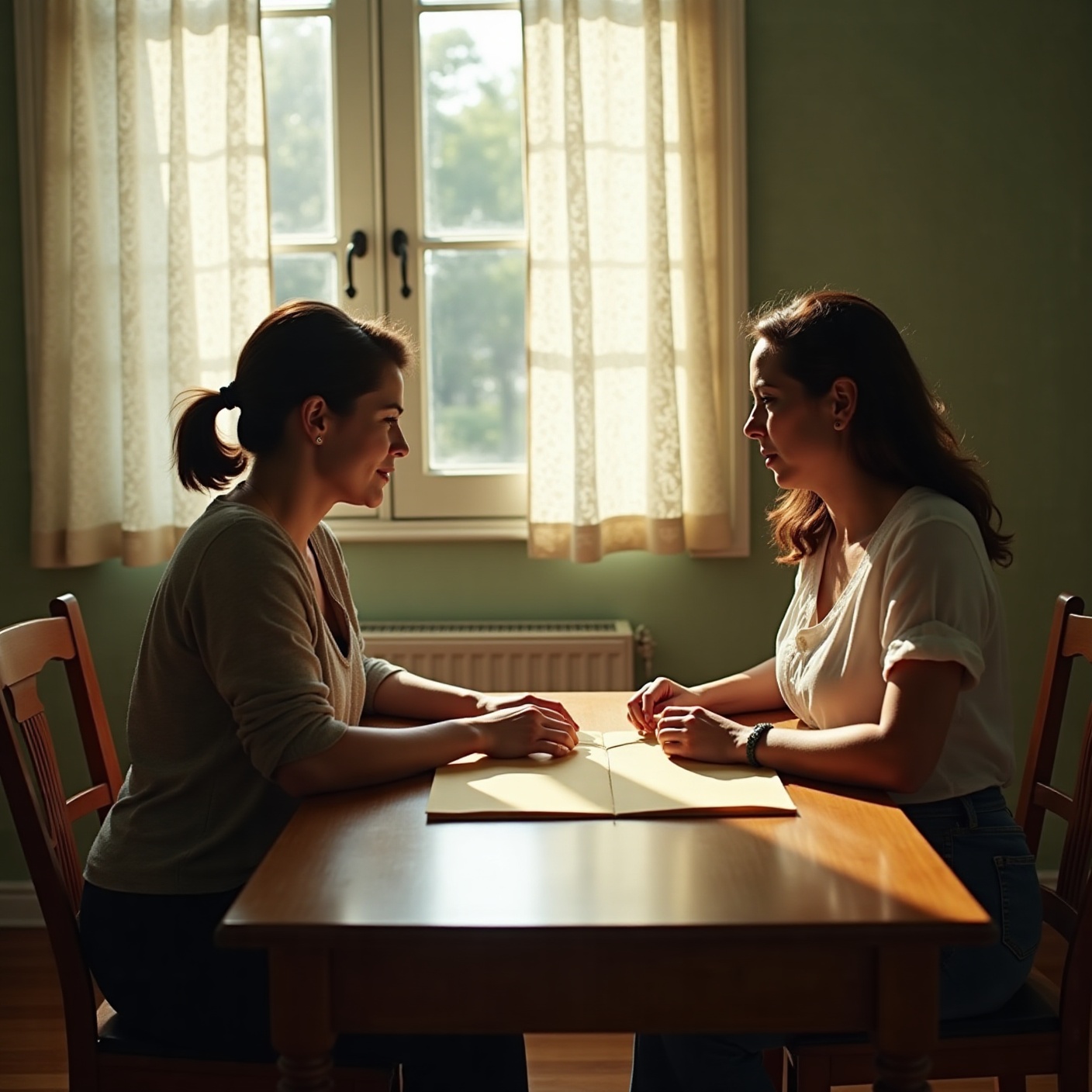
Then the court ordered mediation, one last room before a judge would decide everything for us. A neutral office, a long table, Diane and her lawyer on one side, me and Paula on the other. Diane looked terrible. Thinner than I’d ever seen her. Her hands shook when she reached for the water glass, and I noticed, because you notice those things about someone you spent your whole childhood next to, even when you’re supposed to be at war with them.
The mediator asked Diane to explain, in her own words, why she wanted the house so badly that she’d tear the family apart over it. And my sister, who had not looked me in the eye in four months, put her face in her hands and started to talk.
She’d lost her own house eighteen months before Mom died. A business that failed, a husband who left in the middle of the wreckage, a stack of debt she never told any of us about because Diane was the older sister, the one who had it together, the one who was too proud to call home and say she’d lost everything. When Mom died, the house on Larkspur Lane wasn’t a piece of an estate to her. It was the only door in the world that would still open for her. It was a place to not be homeless. And she couldn’t say that, not to me, not to anyone, so instead she changed the locks and she painted the kitchen and she told herself a story about what Mom would have wanted, because the truth, that she had nowhere else to go, was the one thing she could not get her mouth to say.
“I didn’t know how to ask you,” she said, still not looking up. “You did everything for Mom, and I did nothing, and I couldn’t come to you with my hand out on top of it. It was easier to make you the villain than to tell you I was scared.”
Nobody said anything for a while. The mediator let it sit.
Here is what we agreed to, in the end. We sold the house. It went to a young couple with a baby, which felt right, a house should have a child growing up in it. We split the proceeds down the middle, fair and clean, and out of my half I did something Greg and I talked about for a long night first. I gave Diane six months of rent on an apartment across town, so she’d have a soft place to land instead of a curb. Not because she deserved it. Because she was my sister, and because I finally understood that the woman who’d told me to call ahead wasn’t defending a house. She was defending the only thing standing between her and the bottom.
We’re not fully mended. I don’t know if we ever will be. But she calls now, and not just on holidays. And when the new owners let us walk through one last time before closing, the two of us stood in that pale green kitchen that used to be yellow, and Diane reached over and took my hand, and neither of us said a word, because there wasn’t one big enough.
If you’d told me at Mom’s funeral that we’d end up suing each other over her house, I’d have said you didn’t know my family. Turns out I didn’t either. Grief does strange things to good people. And sometimes the person fighting you the hardest is just someone who’s out of other ways to say help me.