
Hank Doyle repossessed things for a living, and he was good at it because he’d stopped letting himself feel bad about it a long time ago.
He drove a black tow truck with the shocks worn soft, and every morning he took a printed list off the seat and worked his way down it — a boat here, a work van there, a sedan somebody had stopped paying for the day the overtime dried up. People cried. People swore. Once a man came out swinging a garden rake. Hank had learned to keep his face flat as a shut door. You didn’t survive this job by looking at anybody too long.
He was fifty-nine years old, and there were exactly two things he never talked about: his wife, Carol, who had died eleven springs ago, and his daughter, Paige, who had stopped answering his calls not long after the funeral. He told himself both silences were mutual. That was easier than the truth.
The Tuesday it started was gray and low, the kind of sky that presses the whole county flat. His list had one line left on it — a rusted pickup out on Larkspur Road, plate registered to a man named Daniel Reyes, three payments behind and no answer on the phone.
The house, when he found it, was small and tired, the paint gone chalky. There was a chalk hopscotch grid faded on the driveway and a plastic dinosaur tipped over in the yellow grass. Hank noted these the way he noted everything — as things that made a job take longer, not as anything that meant a person.
He backed the truck up to the pickup and was reaching for his gloves when he saw the boy.
The kid was maybe eight, sitting on the front step with a cardboard shoebox balanced on his knees like it was made of glass. Skinny. Buzz cut growing out uneven. He was wearing a grown man’s flannel shirt with the sleeves rolled up so many times they made fat doughnuts at his elbows.
“You here about the cards?” the boy called out. His voice cracked hopeful right down the middle.
“The what?” Hank said.
The boy stood, holding the box out in front of him with both arms. “The baseball cards. I put them online. It said somebody might come look at them today.” He lifted the lid so Hank could see. Inside, sleeved in careful plastic, were rows of old cards, the corners soft with handling. “They’re real ones. My dad kept them since he was a kid. This one—” he slid one out with two fingers, reverent, “—this one’s an Eddie Vale rookie. My dad said it’s the good one. He said someday it’d be worth something.”
Hank looked at the box, then at the truck he’d come to take, then at the dark windows of the house. “Where’s your dad, son?”
Something went out of the boy’s face. “He died. In March.” He said it the way kids say things they’ve had to say too many times, fast, to get it over with. “It’s just me and my mom now. And Buster.”
“Buster.”
As if he’d been waiting for his cue, a dog came around the side of the house — a golden retriever mix, broad in the chest, muzzle gone white, moving slow and careful like every step cost him something. He crossed the yard and leaned his whole weight against the boy’s leg, and the boy’s free hand dropped to the dog’s head automatically, the way you touch something you can’t imagine not touching.
“He’s got a bad heart,” the boy said, quieter now. “The vet listened to it and her face got funny. She said he needs an operation or he’s not gonna—” He stopped. Swallowed. “It’s three thousand dollars. We don’t have three thousand dollars. We don’t even have—” His eyes went to the pickup, and then to Hank’s truck, and then to the chain coiled on Hank’s hip, and Hank watched the boy understand, all at once, exactly what kind of man had come up the driveway.
The boy’s arms tightened around the shoebox.
“That’s why I’m selling the cards,” he said, and his chin was doing that terrible trembling thing that kids do right before the dam breaks. “It’s okay. My dad would want— he’d want me to save Buster. Buster was his dog first. So it’s okay.” He held the box out again, further this time, pushing it at Hank like an offering. “You can have all of them. Even the Eddie Vale one. Just — please. Please, mister. He’s the only one who still—”
He didn’t finish it.
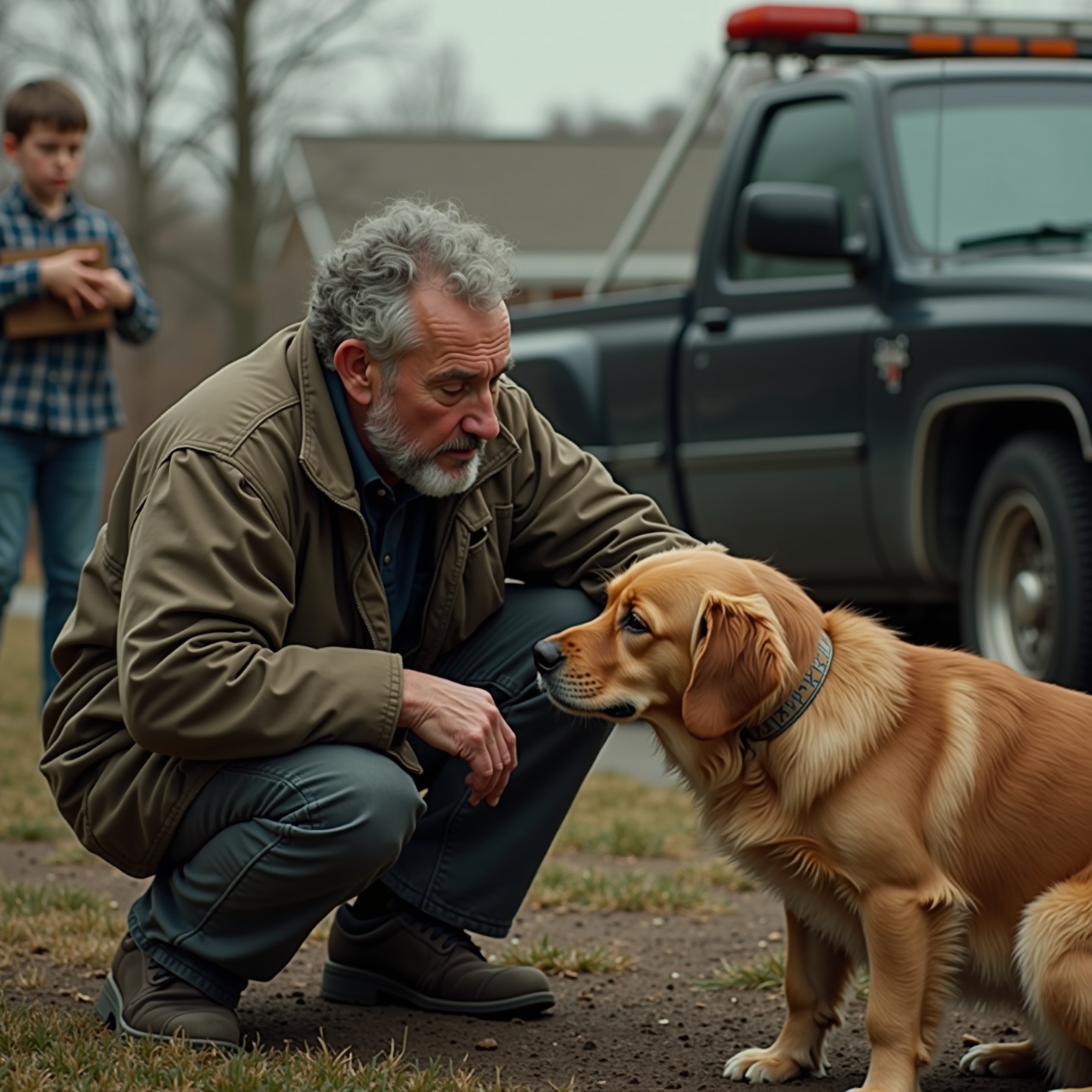
Hank Doyle had spent nine years perfecting a face that didn’t move. He’d taken cars out from under nurses coming off double shifts. He’d hooked up a van while a woman knelt in the road with her arms around the bumper. He had a rule, and the rule had kept him fed and kept him hard: it’s not your life. You just move the metal.
But he was looking at a boy holding out the only thing his dead father had left him, offering it up to a repo man to buy nine more months with an old dog, and something Hank had spent eleven years bricking over cracked straight down the middle.
Because he knew this. He knew exactly this. He knew what it was to be handed a dying thing you loved and told there was a number on it you couldn’t reach. He’d been handed that number in a hospital hallway eleven springs ago, standing across from his own daughter, and he had done the unforgivable thing — he had turned around and gone to work. And then he had gone to a bar. He’d told himself he was being useful, being strong, keeping the lights on. What he’d really been doing was running, and his daughter had watched him run, sixteen years old and holding her mother’s hand alone, and she had never once looked at him the same way again.
“Put the box down, son,” Hank said. His voice came out rougher than he meant it to.
The boy flinched like he’d been slapped. He thought it was a no. He started to pull the shoebox back against his chest, blinking hard, already turning away — and Hank heard himself say the next words before he’d decided to say them.
“I’m not taking your cards. Put ’em somewhere safe. Your dad was right — that Eddie Vale’s worth more than you know, and you don’t sell a thing like that on a bad day.” He crouched down, knees popping, until he was level with the dog. Buster looked at him with cloudy, trusting eyes and thumped his tail twice against the grass. “What’d the vet say his name was? The heart thing.”
“You’re — you’re not taking the truck?”
“I’m asking about the dog.”
The boy’s mother came out then — Sarah, thirty-four, still in the scrubs from the shift she’d rushed home from when she saw a tow truck on the security camera. She stopped on the porch with her keys in her fist, braced for another loss in a long year of them. “Whatever it is,” she started, “we’ll figure out the payments, just don’t—”
“Ma’am,” Hank said, standing back up, “I need to use your kitchen table for about ten minutes. And I’m gonna need to make a phone call.”
That was the turn. That was where the old life ended and the harder, better one began, though Hank didn’t know it yet. He only knew that he was tired, more tired than three thousand dollars’ worth, of being the man who took things away.
He didn’t just write a check. A check would have been easy, and Hank had learned the hard way that easy was another word for running. Instead he sat at Sarah Reyes’s kitchen table and he called in every marker he had. He knew the guy who ran the auction house two counties over; he’d repossessed enough of that man’s clients’ toys to earn a favor. He knew a vet tech whose car he’d once quietly left in the driveway instead of hooking it up. By the end of the week Buster was on a surgical table, and the golden retriever mix with the tired heart came off it wagging.
The surgery cost three thousand and forty dollars. Hank paid it and told the boy it was a loan, because he understood that a proud kid needs a debt more than he needs charity — a debt says you’re worth investing in.
But the cards were the thing that changed everybody’s life, and it happened almost by accident. Hank took the Eddie Vale rookie to his auction-house friend just to get it appraised, to prove to Toby it was safe — and the man went pale and quiet and named a number that made Hank sit down. The whole collection, catalogued and sold right, brought in a sum that dwarfed a dog’s surgery. Daniel Reyes, it turned out, had left his son something after all.
Sarah wept when she saw the check. Then she wiped her face and did the thing that told Hank exactly what kind of woman she was. “This isn’t just ours,” she said. “There’s a hundred families in this county one bad Tuesday away from where we were. I’m not sitting on it.”
So they built something. Hank left the repo company and put his severance and his stubbornness into a scrapyard he renamed Iron Lantern Recovery — an honest yard, run clean, with real oversight and a set of rules pinned to the office wall. And out of the last of Daniel Reyes’s baseball cards, they bought a van, painted blue with a single stripe down the side, and they called what it did The Angel Run. It carried people who had no ride to the appointments that decide everything — dialysis, chemo, the job interview you can’t afford to miss. Every dollar of it moved through what Toby insisted they name the Buster Fund, spent by vote, by rule, so it would outlast anybody’s good mood.
The hardest repair took the longest, and it wasn’t the dog.
Hank called Paige on a Sunday. She didn’t answer. He called again the next Sunday, and the one after that, leaving the same short message every time: no excuses in it, no self-pity, just — I was wrong to leave the way I left. I know it. I’m not asking you for anything. I just wanted you to hear me say it out loud. It was March, then April. On a Sunday in May, in her mid-thirties, with her mother eleven years gone, Paige finally picked up. She didn’t forgive him. Forgiveness like that doesn’t come in a phone call. But she listened, and at the end she said, “Tell me about the dog,” and Hank understood he was being given a door held open exactly one inch — and that one inch, from a daughter he’d taught to expect nothing from him, was more than he had any right to.
She came out to the yard in June. Cautious. Arms crossed. She met Buster, who was old and slow and gloriously alive, and she watched an eight-year-old named Toby show her exactly how the Buster Fund logbook worked, every ride recorded, and she looked at her father over the boy’s head with an expression Hank hadn’t seen from her since she was small — not love, not yet, but the beginning of a question. Maybe you’re not who I decided you were.
A year to the week after Hank Doyle drove a black tow truck up a tired driveway to take away a dead man’s pickup, the county threw a small ceremony to dedicate the blue van. Not a big crowd. Sarah and Toby. Luis and Wade, the two men who ran the yard with Hank and kept it honest. Buster, gray-faced and dignified, asleep in a patch of sun. And Paige, who had driven three hours and stood at the back and did not leave.
They were not a perfect family. They were a patched-together one — a repo man who’d stopped running, a widow, a boy, an old dog, two workers, and a daughter deciding one inch at a time whether to come the rest of the way. Hank had spent his whole life taking things away from people. It turned out the only thing that ever fixed him was learning, finally and far too late, how to give one back.
Toby still has the Eddie Vale rookie card. It’s in a frame on his wall now, next to a photo of a golden retriever with a white muzzle and a heart that a stranger decided, on a gray Tuesday, was worth saving.