The rains had come early that year, and they had come angry.
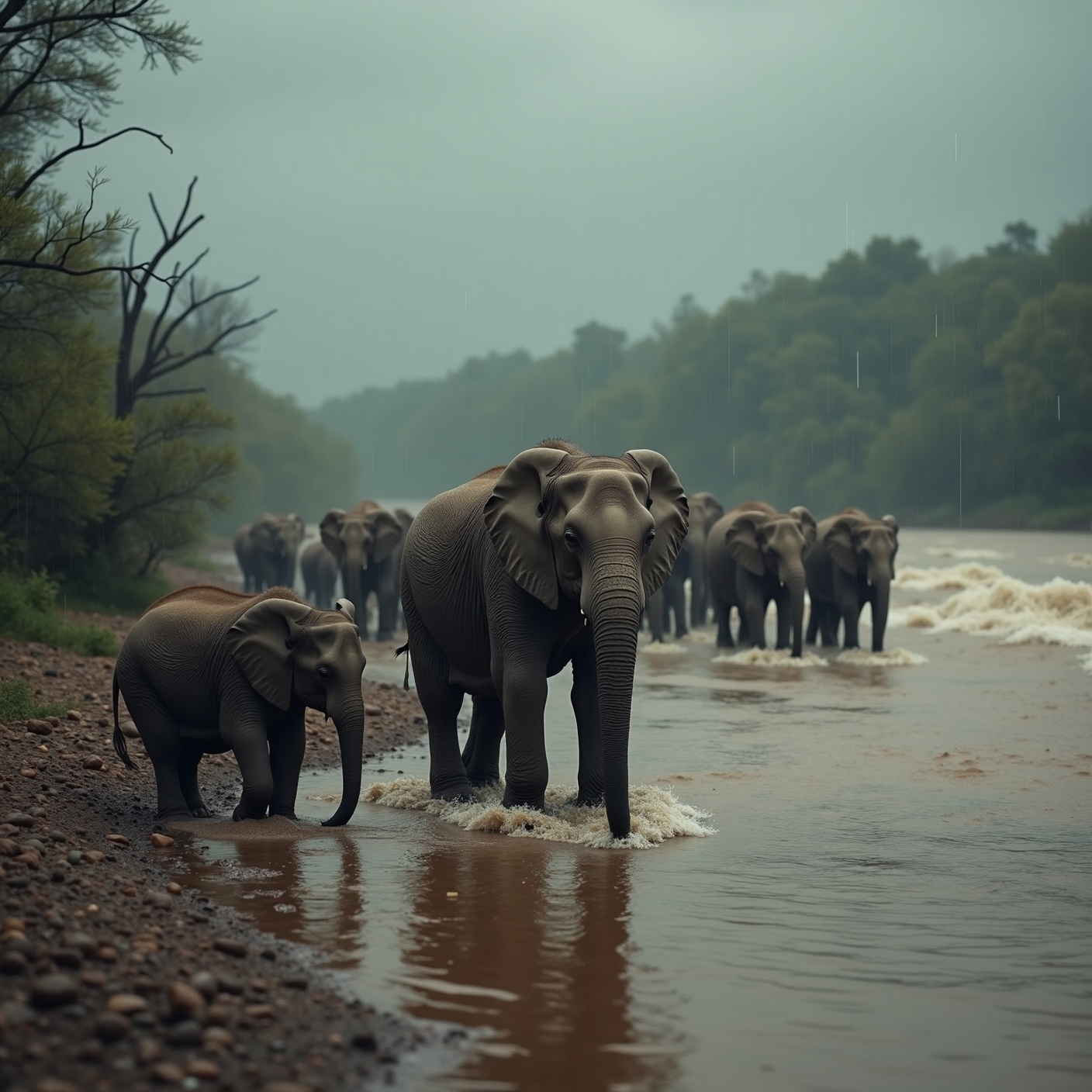
For three days the sky over the river valley never fully opened its eyes — just a low, bruised grey that leaked water from morning to night, until the little brown river that the elephants crossed every dry season had swollen into something wide and muscular and the color of milky coffee. The rangers at the reserve station called it “the tea running high.” That morning it wasn’t tea anymore. It was a road of moving water, and it had teeth.
Della knew the crossing. She had known it for thirty-one years — longer than any ranger on the station, longer than the acacia that leaned over the far bank. She was the matriarch, the one the others followed, and she wore that job in the slow, deliberate way she set down each foot, testing the ground before she trusted it. The herd read her like a weather vane. When Della’s ears went still and forward, the young ones stopped their playing. When Della lifted her trunk to taste the wind, twelve other trunks lifted with her.
And close against her front legs, never more than a body’s length away, was the reason she tasted the wind so carefully now. Her calf. Six months old, all knees and eyelashes and a trunk he hadn’t quite figured out how to steer, so that he was forever tripping over it and tucking it into his mouth like a child sucking a thumb. The keepers had started calling him Nuru — a word an old ranger said meant “light” — because he had been born just before dawn, and because he had a habit of leaning his whole small weight against your leg the moment you stood still, as if he’d decided you were his and that was that.
Della had lost a calf once, years before, in a dry season that took too many of them. The rangers who had watched her that long-ago week said she had stood over the small still shape for two days and would not move, would not eat, would not let the others near. She had never forgotten how to grieve. And so she had never, for one hour of Nuru’s short life, let him wander farther than her shadow.
That was why, when the herd reached the crossing that grey morning and Della felt the river through the soles of her feet — a deep, wrong, dragging hum in the earth — she stopped. She swung her great head sideways, put out her trunk, and pressed it flat against the calf’s back, holding him still. Not yet. The other elephants gathered behind her, restless, the water on the far side smelling of the sweet new grass they’d been walking toward for days.
But a river in flood does not wait for a matriarch to make up her mind.
It was the far edge of the herd that moved first — two half-grown youngsters, giddy with hunger and the smell of that grass, splashing into the shallows before the older cows could block them. The water there looked calm. It always does, at the edge. Nuru, who followed everything that ran, who thought the whole world was a game invented for him to chase, tore out from under his mother’s trunk and plunged in after them, ears flapping, delighted.
He got four steps.
Then the river took him.
There was no drama to it, and that was the worst part — no wave, no roar, just a smooth brown shoulder of current that slid under the calf and lifted him off his feet as easily as a hand lifting a leaf off a table. One moment his round little back was above the surface, his trunk reaching up and curling for air. The next the water folded over him, and where Nuru had been there was only the flat coffee-colored river, moving fast, moving on, taking him with it downstream toward the place where the bank dropped away and the water went deep and dark and silent.
And Della screamed.
The rangers up at the station — half a kilometer off, drinking their tea under a tin roof — came out of their chairs before they knew why. Samuel Okoye, the head ranger, had worked the reserve for twenty-two years, and he would say afterward that he had heard elephants trumpet in anger and bellow in fear and rumble in that low earth-language they use to talk across the miles. He had never heard the sound Della made that morning.
“It wasn’t a trumpet,” Samuel told the young volunteers later, and even telling it his voice went unsteady. “It was a mother. That’s the only word I have. It was a mother, and I have children of my own, and I knew — I knew before I could see the river — that somewhere down there a little one was in the water.”
He was already running. Grace Adeyemi, twenty-three and three weeks into the job, ran with him, and behind them two more rangers with the long rescue ropes coiled over their shoulders, the ropes they had never once, in all the reserve’s history, had to use for this.
By the time they crested the rise and the river opened out below them, the whole herd had come apart into panic — thirteen elephants wheeling along the bank, trunks up, calling, calling. And ahead of all of them, chest-deep and driving forward into a current that would have knocked a truck sideways, was Della.
She was not looking for a safe way in. She had gone straight off the bank into the deep channel after her son, and the river was already trying to take her too, swinging her huge body downstream, and still she pushed on, trunk sweeping the surface in wide desperate arcs, feeling for something she could not see.
“Stop — stop, she’ll drown herself, she can’t see him in that,” Grace said, gripping Samuel’s arm. “Where is he? Samuel, where is he —”
And then they saw. Forty meters downstream, at the bend where the far bank had collapsed into a tangle of half-drowned thorn trees, a small grey shape surfaced for half a heartbeat — a trunk, a flash of one frightened eye — and was pulled under again.
“There!” Samuel roared, pointing, and the rangers were already sprinting the bank, uncoiling the ropes. “The thorn trees — he’s snagged in the thorn trees — GO, go, go —”
What happened next, none of them could have planned, and all of them would spend years trying to describe.
The herd heard Samuel’s shout, or perhaps they simply understood the river better than any human ever would — because as the rangers ran, the elephants ran with them, and then the elephants did something that stopped Samuel Okoye dead in his tracks. Three of the big cows — Della’s sisters, her daughters, the old aunts of the herd — waded into the river above the bend and lined up shoulder to shoulder, broadside to the current, and stood. A living wall of grey. And behind that wall, in the calmer water their bodies made, the killing force of the river suddenly eased.
“They built him a harbor,” Samuel said afterward, shaking his head slowly, as if he still didn’t believe his own eyes. “Those three cows turned themselves into a wall and broke the current with their own bodies, so the little one wouldn’t be swept past the trees. I have watched these animals for twenty-two years. I did not know they could do that. I did not know anyone knew they could do that.”
In the slack water behind the wall, Della reached the thorn trees. Her trunk found the calf’s tangled leg — Grace saw it happen, saw the great trunk close around that thin small ankle where it was hooked in the drowned branches — and Della pulled, and the branches held, and she pulled again, screaming that same terrible mother-sound, and Samuel was in the water now too, up to his chest, hacking at the thorns with a machete, roaring at Grace to feed the rope.
“Under his belly — get the rope under his belly, we lift together, on three —” Samuel shouted, water in his mouth. “Della, girl, easy, EASY, we’ve got him, we’ve got him, let me — THREE —”
And the branch snapped, and the rope bit, and the mother heaved, and all at once the river gave him back.
Nuru came up out of the water limp and streaming and impossibly small, and for one endless moment nobody breathed — not the rangers chest-deep in the flood, not Grace on the bank with both hands pressed to her mouth, not the three great cows still holding their line against the current. The calf hung in his mother’s trunk, still as a wet rope.
Then he coughed.
He coughed, and the river came out of him in a rush, and he dragged in a huge shuddering breath and let out a thin, furious, absolutely ordinary little squeal — the outraged squeal of a baby who has been frightened half to death and would very much like his mother now, please, immediately — and Grace Adeyemi sat straight down in the mud on the bank and burst into tears, and laughed, and cried, all at the same time.
“He yelled,” she said, over and over, laughing through it. “He yelled at us. You don’t yell if you’re — he’s all right. He’s yelling. He’s all right.”
Della carried her son up out of the river herself. She would not let the rangers take him, though they walked close beside her the whole way, ready. She set him down on the high grass in a patch of thin, watery sunlight that had finally, that afternoon, broken through the three-day grey — and the whole herd folded in around the two of them, thirteen elephants making a warm grey wall against the world, rumbling that deep chest-song they sing when the family is whole again.
Nuru found his feet inside the hour. By evening he was nursing, tail flicking, one ear cocked, already — already — leaning his whole small weight against his mother’s leg as if the morning had been nothing at all, as if he had not, for four minutes of a grey and terrible day, been swallowed by a river.
Della stood over him while he fed, and she did not eat, and she did not move, the way she had once stood over a calf she could not save. But this time it was different. This time she was not grieving. This time she was standing guard over something she had reached down into a flood and pulled back into the light — and she stayed there, unmoving, until the last of that thin sun went down behind the acacia, and the water in the river below at last began, quietly, to fall.