The offices of Ellison & Reyes smelled of lemon polish and old paper, the kind of hush that money buys and keeps. Rain slid down the tall windows in long, patient lines, and outside, the gray Connecticut afternoon pressed against the glass like it wanted in.
Ruth Danvers sat in the last chair against the wall, a little apart from the others, her hands folded in her lap. She was somewhere past sixty, with soft gray hair pinned up in a way that had gone out of style twenty years ago, and she wore a navy cardigan that had been washed until it went thin at the elbows. On her feet were flat canvas shoes from a discount bin — the kind that cost eleven dollars and squeaked on a wet floor. She had wiped them on the mat twice on her way in, embarrassed by the sound.
Across the room, the Prescott family took up the good chairs, the leather ones nearest the desk, as if seating were a matter of blood.
“I still don’t understand why she’s here,” Cynthia Prescott murmured, not quite quietly enough. She was Bradley’s wife, all sharp perfume and sharper eyes, a diamond on her hand the size of a molar. “Bradley, did you invite the housekeeper?”
“I didn’t invite anybody,” Bradley said, thumbing his phone. He was Walter’s nephew, a man who wore his impatience like an expensive watch. “Ellison’s office sent the letters. Maybe Uncle Walter left her a set of dishes. Let her have the dishes.”
Denise, Walter’s niece, laughed under her breath — a small, cruel sound. “Look at those shoes,” she said to her brother. “God. Some people.”
Ruth heard all of it. She had spent a lifetime being the person nobody thought was listening, and she had learned that the quiet way to survive a room like this was to keep your eyes on your own hands and let the words pass over you like weather. So she looked at her hands. She did not look up.
She thought about Walter instead.
She thought about the first Thursday she had ever wheeled the book cart into the sunroom at Cedar Hollow — the assisted-living home out on Route 9 where she had volunteered every week for the better part of nine years. There had been a man by the window that day, ramrod straight in his chair, glaring at the rain like it owed him an apology.
“I don’t want a book,” he’d told her flatly. “I want to be left alone.”
“That’s all right,” Ruth had said, and she’d sat down in the empty chair beside him anyway, and opened the newspaper, and started reading the crossword clues out loud to nobody in particular. By the third clue, he had answered one. By the fifth, he was arguing with her about the sixth. His name, she learned that day, was Walter. He did not tell her his last name for two more months, and he never once mentioned that it was a name printed on the side of half the office buildings between Hartford and New Haven.
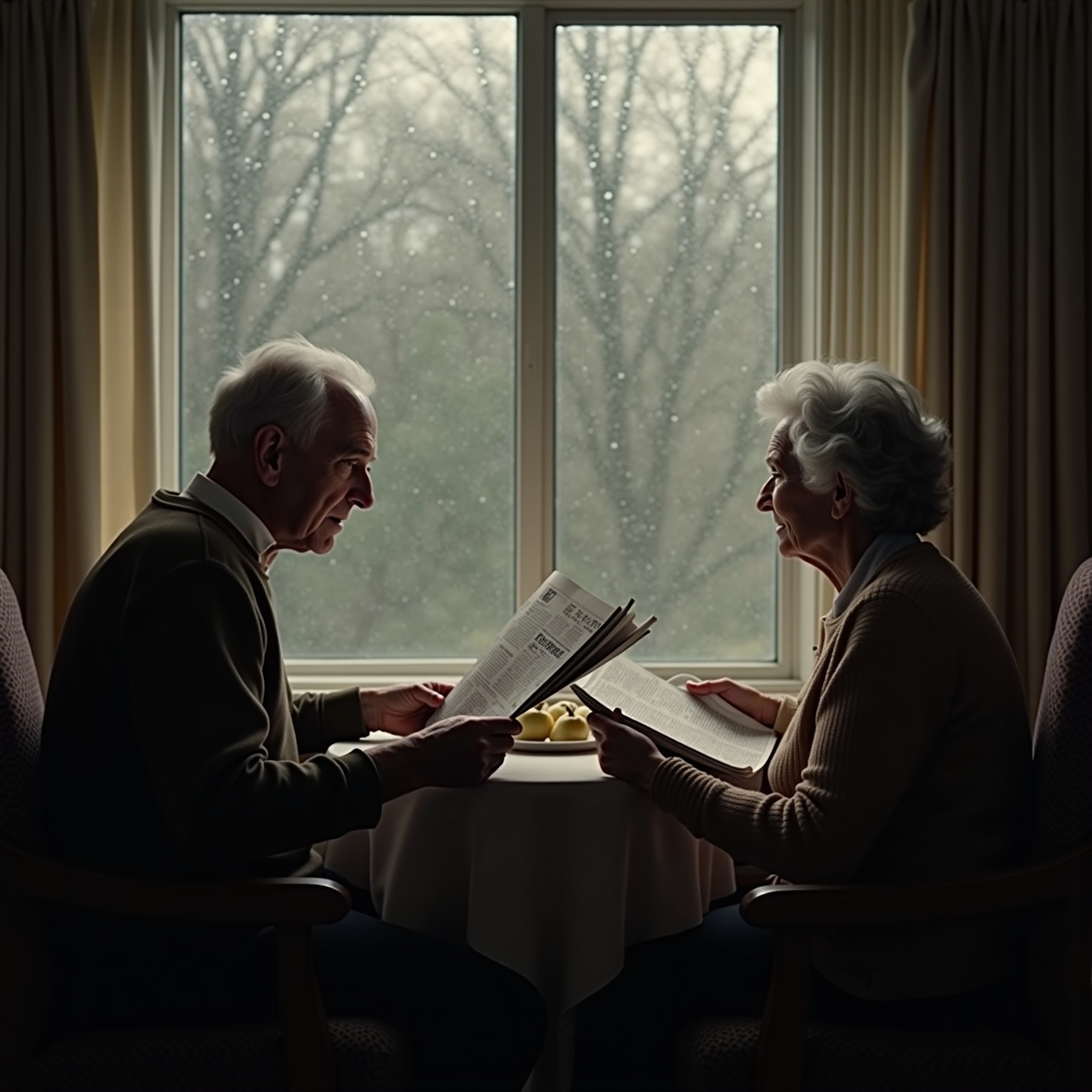
To Ruth, he had simply been Walter — a prickly, lonely old man who liked pears cut in quarters and hated when the nurses called him “sweetheart,” and who, somewhere in that second winter, had started saving the window seat for her.
“You came,” he’d said one Thursday, when a snowstorm had shut down half the county and she’d walked the last mile on foot because the buses weren’t running.
“Of course I came,” Ruth had answered, stamping the snow off those same cheap shoes. “It’s Thursday, isn’t it?”
He had looked at her for a long moment then, this man who owned more than most towns, and his eyes had gone bright and wet in a way he’d have died before admitting. “My family doesn’t come on Thursdays,” he’d said quietly. “My family doesn’t come at all, unless there’s a form to sign.”
Ruth had never asked him what he meant. It wasn’t her business. She’d just handed him the crossword and said, “Fourteen across. Six letters. ‘Loyal companion.'” And Walter had smiled — a real one — and said, “That’s easy,” and filled it in himself.
She had gone to his funeral eleven days ago in the same navy cardigan. She had stood in the back, said her goodbye, and gone home to her small rented rooms above the laundromat, and she had assumed that was the end of it. Then the letter had come from Ellison & Reyes, thick and formal, requesting her presence, and she had almost not come at all.
“Ms. Danvers?”
Ruth blinked. The lawyer, Mr. Ellison, was looking at her over his glasses — a tidy man with a gray mustache and a voice like a closing drawer. The room had gone still. The Prescotts had stopped whispering.
“You are Ruth Danvers?” Ellison asked again, gently.
“Yes, sir,” Ruth said. Her voice came out smaller than she wanted. “I’m sorry. I’m not sure I’m supposed to be here. There must be some mistake.”
“There’s no mistake,” Mr. Ellison said.
He picked up a single sheet of heavy cream paper, and he settled his glasses more firmly on his nose, and he began to read the disposition of the estate of Walter James Prescott — the accounts, the property on the shore, the holdings, the whole staggering weight of a life’s fortune. Bradley leaned forward, elbows on his knees. Cynthia’s tongue touched her lips. Denise sat up straight and folded her manicured hands, ready.
“‘I leave the entirety of my estate,'” Mr. Ellison read, “‘the house, the land, the accounts, and all that remains after my debts are settled — to the one person in my life who ever gave me a single hour without wanting something back.'”
He paused, and turned the page, and the whole room leaned toward him like a field of grass in the wind.
“‘To—'”
“‘—Ruth Danvers,'” Mr. Ellison read. “‘Of Cedar Hollow. Every Thursday, for nine years.'”
For one full heartbeat, no one moved. The rain ticked against the glass. Then the room came apart.
“That’s insane,” Bradley said, on his feet before he knew it. “That’s — she’s the reading lady. She read him crosswords. You can’t be serious.”
“Sit down, Mr. Prescott,” Ellison said, without heat.
“He wasn’t in his right mind,” Cynthia snapped. “She manipulated him. An old man, alone — she saw an opportunity and she took it. We’ll contest. We’ll—”
“You are free to contest,” Mr. Ellison said. “But I would encourage you to hear the rest first. Mr. Prescott left a letter, and he was very specific that it be read aloud in this room, to all of you, before anyone said a word about lawyers.”
He set down the will and picked up an envelope, and Ruth saw the handwriting on the front of it and felt her chest go tight, because she knew that cramped, stubborn hand. She had watched it fill in fourteen across a hundred times.
Mr. Ellison opened it and read.
“‘To my nephew Bradley, my niece Denise, and the rest of my blood who are sitting in that room right now doing the math — hello. I know exactly who came to the reading, and I know exactly why. You came for the same reason you came to my birthdays: to see what was in it for you.'”
Denise’s face had gone the color of the rain.
“‘For the last two years of my life,'” Ellison read on, “‘I lived at a place called Cedar Hollow. Not one of you visited more than twice, and both times you brought papers to sign. I don’t blame you anymore. I raised you to see me as a bank, and a bank is all I ever let you see. That was my mistake, not yours.'”
The lawyer’s voice was steady, but Ruth had begun to cry, silently, the way she did everything.
“‘There was a woman who came every Thursday,'” the letter went on. “‘She didn’t know I had money — I made sure of it, because I wanted, just once before the end, to know what it felt like to be worth someone’s time for nothing at all. She brought me pears. She read me the paper. She walked a mile through a blizzard because it was Thursday and she’d said she would come. She never asked me for one thing. Not one.'”
Bradley had sat back down. He was staring at the floor.
“‘You will look at her cheap shoes,'” Ellison read, “‘and you will think she is nothing. Let me tell you what I found out about those shoes. She wears them because for nine years she has given away every spare dollar she had — to the home, to the residents who had no one, to a boy at the shelter whose name I doubt she’d even tell you. She is the richest person I have ever met, and she never once knew it. So I am fixing that. Everything I have goes to Ruth Danvers. Do with your outrage what you like. I finally know the difference between family and blood, and I would rather leave my fortune to an hour of kindness than to a room full of people waiting for me to die.'”
Mr. Ellison folded the letter.
The silence afterward was a different kind — heavier, and ashamed. Cynthia would not look up. Denise’s mouth opened and closed and found nothing to say. Bradley pressed the heel of his hand hard against his eyes.
“Ms. Danvers,” Ellison said, and his gray-mustached face had softened into something almost tender. “Do you understand what’s just been read to you?”
Ruth shook her head slowly. “No,” she whispered. “I don’t. I just — I read him the crossword. Anybody would have.”
“No, ma’am,” the lawyer said quietly. “They wouldn’t have. That was rather the whole point.”
Ruth Danvers pressed her worn hands to her mouth, and in her cheap eleven-dollar shoes, in her thin navy cardigan, she wept — not for the house, or the land, or the money she could not even imagine yet, but for a prickly old man by a window who had, all along, been saving her a seat.
Outside, the rain finally began to ease. And fourteen across, six letters, had been right there the entire time.
Loyal companion.