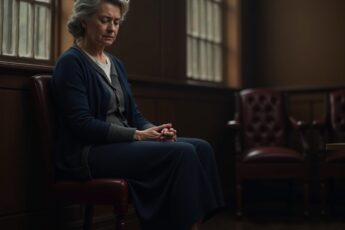
The private room at Bellamy’s Supper Club smelled like white roses and warm bread, and Eleanor Whitfield had spent three weeks making sure of it. She’d picked the roses herself, driven out to the florist on Delaware Avenue twice to get the shade right — not bridal white, but the soft cream of an old photograph. Fifty years of marriage, she’d decided, deserved a room that looked like a memory.
She was seventy-two now. Her hands weren’t as steady as they’d been the June morning in 1974 when she married Raymond Whitfield in the little brick chapel off Route 23, but they still knew how to fold a napkin into a crisp triangle, and she folded twenty of them that afternoon before the family arrived.
“Ma, you didn’t have to do all this,” her younger son, Marcus, said when he walked in, loosening his tie. He was forty-five and still had the habit of kissing the top of her head like a boy.
“I wanted to,” Eleanor said. “You only get one fiftieth.”
Her older son, Douglas — Doug to everyone — came in behind him with his wife and barely looked up from his phone. “Smells like a funeral home in here,” he said, and laughed at his own joke. Nobody else did, but Doug had stopped waiting for other people to laugh with him a long time ago.
Raymond arrived last, which was how Raymond arrived everywhere. Seventy-four, silver at the temples, wearing the navy blazer Eleanor had pressed for him that morning because his hands shook too much for the iron now. He shook Marcus’s hand. He clapped Doug on the shoulder. He did not kiss his wife. He hadn’t, not really, in a good many years, and Eleanor had learned to stop keeping count the way you stop counting the stairs in a house you’ve lived in your whole life.
They ordered the prime rib. The waiter poured a Cabernet that Doug had insisted on, and for a little while the room was warm and loud and almost like the family Eleanor remembered from when the boys were small — before the hardware store swallowed the years, before Raymond started calling her “the wife” instead of “Nell,” before the silences got long enough to move furniture into.
Then Raymond stood up, wine glass in hand, and tapped it with his fork.
Eleanor smiled up at him. Fifty years. She thought, for one soft second, that he was going to say something kind.
“I’ve been doing a lot of thinking lately,” Raymond began, and his voice had that flat, rehearsed quality it got when he was reading numbers off a spreadsheet. “A man gets to a certain age and he asks himself what he’s got left. How he wants to spend it.”
“Here we go,” Doug said, grinning, and raised his glass an inch.
“I’ve given fifty years to this family,” Raymond went on. “Fifty years to that store. And I’ve decided I’m not going to give the rest of them to a marriage that’s been over in every way that counts for longer than I care to admit.” He looked down at Eleanor then — not cruel, exactly, just finished, the way you look at a car you’ve decided to trade in. “Eleanor, I want a divorce. I wanted to say it here, with the boys, so there’d be no drama about it later. I’m done. I’m going to go live my life.”
For a moment there was only the hum of the air conditioning and the small wet sound of the ice settling in the water pitcher.
And then Doug laughed — a real laugh, a whoop — and lifted his glass all the way up. “About damn time, Dad!” he said. “Honest to God. Somebody had to say it.”
Marcus hesitated. But Doug was already reaching across the table to clink glasses with his father, and Raymond was smiling now, loosened, relieved, and the younger man’s arm rose too, slow and ashamed but rising all the same, and the two sons and their father touched their glasses together over the white roses their mother had chosen, and someone said “To freedom,” and someone laughed again.
Eleanor sat very still at the end of the table.
She looked at the napkin in her lap, the one she’d folded into a crisp triangle an hour before, and she smoothed it flat with both hands. Nobody was looking at her. That was the part that would stay with her longest — not the words, but how easily the three men she’d fed and raised and covered for had turned away from her, as if she were already gone.
She reached down for her handbag.
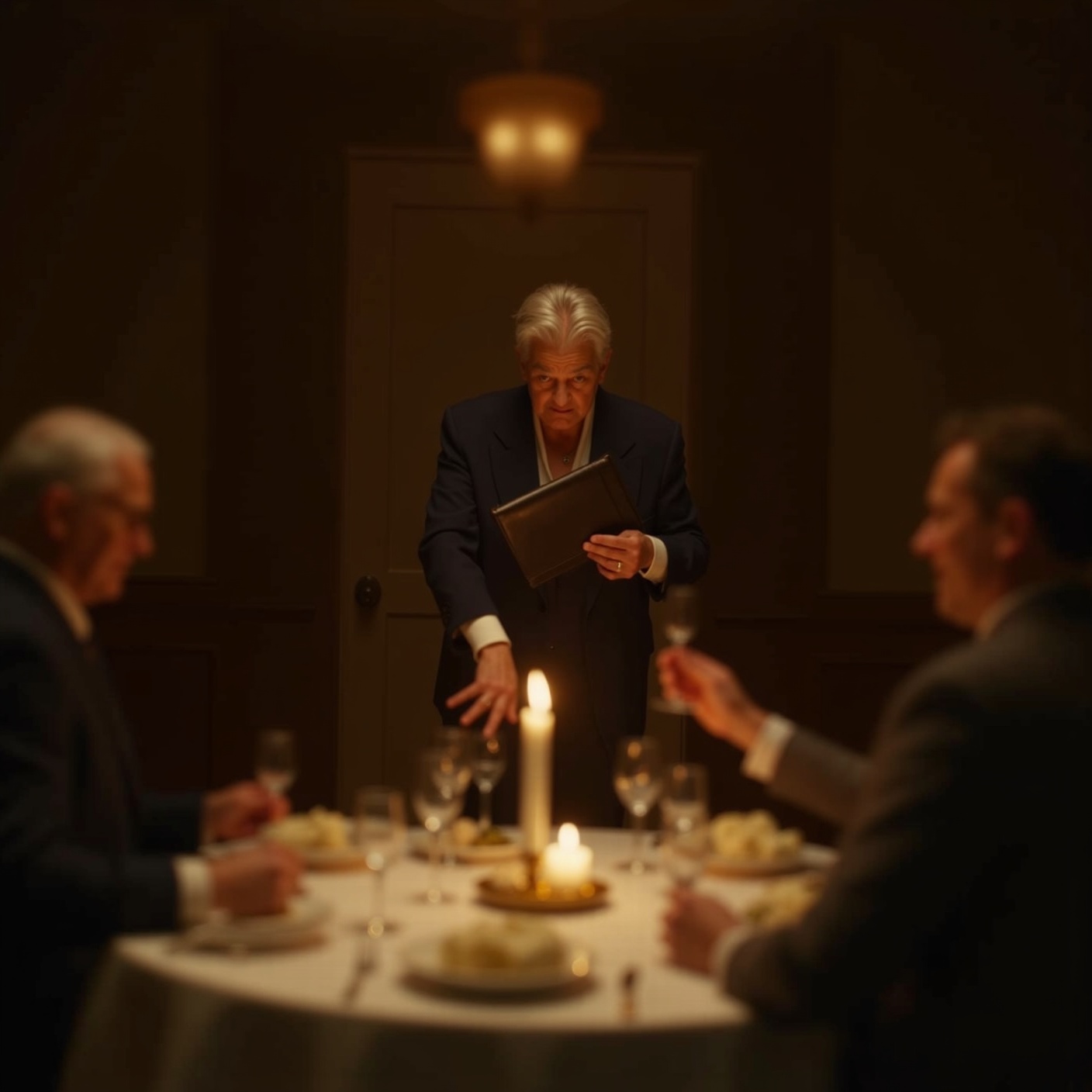
Eleanor stood up.
She didn’t raise her voice. She had never once in fifty years needed to raise her voice, and she wasn’t going to start at Bellamy’s over the prime rib. She simply stood, and something in the way she stood — unhurried, certain — made the laughter die in Doug’s throat.
“Raymond,” she said. “Thank you for being so clear. I’d hate for there to be any confusion. So let me be clear too.”
She set a thin leather folder on the tablecloth. She’d brought it, she would admit later, not because she’d known — she hadn’t, not the words, not the toast — but because a part of her had been getting ready for this dinner for a very long time.
“The house on Marston Lane,” she said, “the one you’re planning to go live your life out of — is deeded in my name. It always has been. My father, Walter, put the down payment on it in 1974 as a wedding gift, and he put it in mine. You signed the papers yourself, Ray. You just never read them.”
Raymond’s smile didn’t move, but something behind it did.
“Whitfield Hardware and Supply,” Eleanor went on, and now her voice was very quiet and very even, “was incorporated in 1974 with eleven thousand dollars of my father’s money, because the bank wouldn’t lend to a twenty-four-year-old with no collateral and a new wife. The company was chartered in my name to satisfy the loan. I never changed it, because there was never any reason to. I did the books every night at this kitchen table for forty-nine years. I know exactly what that store is worth, down to the dollar, and I know exactly who owns it.”
Doug had set his glass down. “Ma,” he said. “Wait. That’s — that’s just how it was set up. On paper. It doesn’t —”
“It’s entirely on paper, Douglas,” his mother said, and turned to him with a look so calm it was worse than any anger. “The way the loan I co-signed for your first house is on paper. The way the tuition I paid when your father said we couldn’t afford it is on paper. The way the two years I nursed your grandmother in the back bedroom, so the two of you could finish school without her illness touching you — that was never on any paper at all.”
The room had gone completely silent. Marcus had his hand over his mouth.
“For fifty years,” Eleanor said, “I was told I didn’t work. That I ‘just kept the house.’ I kept a great deal more than the house, gentlemen. I kept the business solvent through two recessions. I kept your father’s hands out of the till in ’91 when he wanted to bet the store on a warehouse we couldn’t afford, and I was right, and he never once said thank you. I kept this family stitched together at every holiday one of you forgot to call. And I did it quietly, because that’s what my mother taught me a wife does.”
She picked up the leather folder and held it against her chest, unopened, like something she’d finally decided she got to keep.
“But you’ve all made it very clear tonight what you think that’s worth,” she said. “So here is my anniversary gift to myself. Raymond, you may absolutely have your divorce. I’ll have my lawyer draw it up Monday — she’s very good; I’ve kept her on retainer for six years, which should tell you how long I’ve been ready. You’ll leave with your clothes, your car, and your pension, all of which are truly yours. But the house is mine. The store is mine. And the family — ” she looked, for a long moment, at each of her sons in turn — “the family is whatever the three of you decide to make of it now, because I am done carrying it by myself.”
Raymond finally found his voice. “Eleanor,” he said, and it came out smaller than he meant it to. “Nell. Come on. Sit down. We can talk about this at home.”
“We could have talked about it at home,” Eleanor said gently. “For fifty years, we could have talked about it at home. You chose to talk about it here.” She picked up her handbag and slid the folder into it. “So I’m going to answer you here.”
She turned to the waiter, who had frozen in the doorway with a tray of coffee, and gave him the same warm smile she’d given the florist on Delaware Avenue.
“He’ll take the check,” she said, nodding at Raymond. “It’s the last thing that’ll ever be in his name in this family. Let him enjoy it.”
And Eleanor Whitfield picked up her cream-colored roses — she’d paid for them, after all — and walked out of the private room at Bellamy’s with her back straight and her chin level, seventy-two years old and, for the first time in five decades, entirely her own.
Behind her, three men sat in the wreckage of a toast they’d made too soon, staring at an empty chair and a folded napkin, finally quiet enough to hear what she’d been telling them all along.