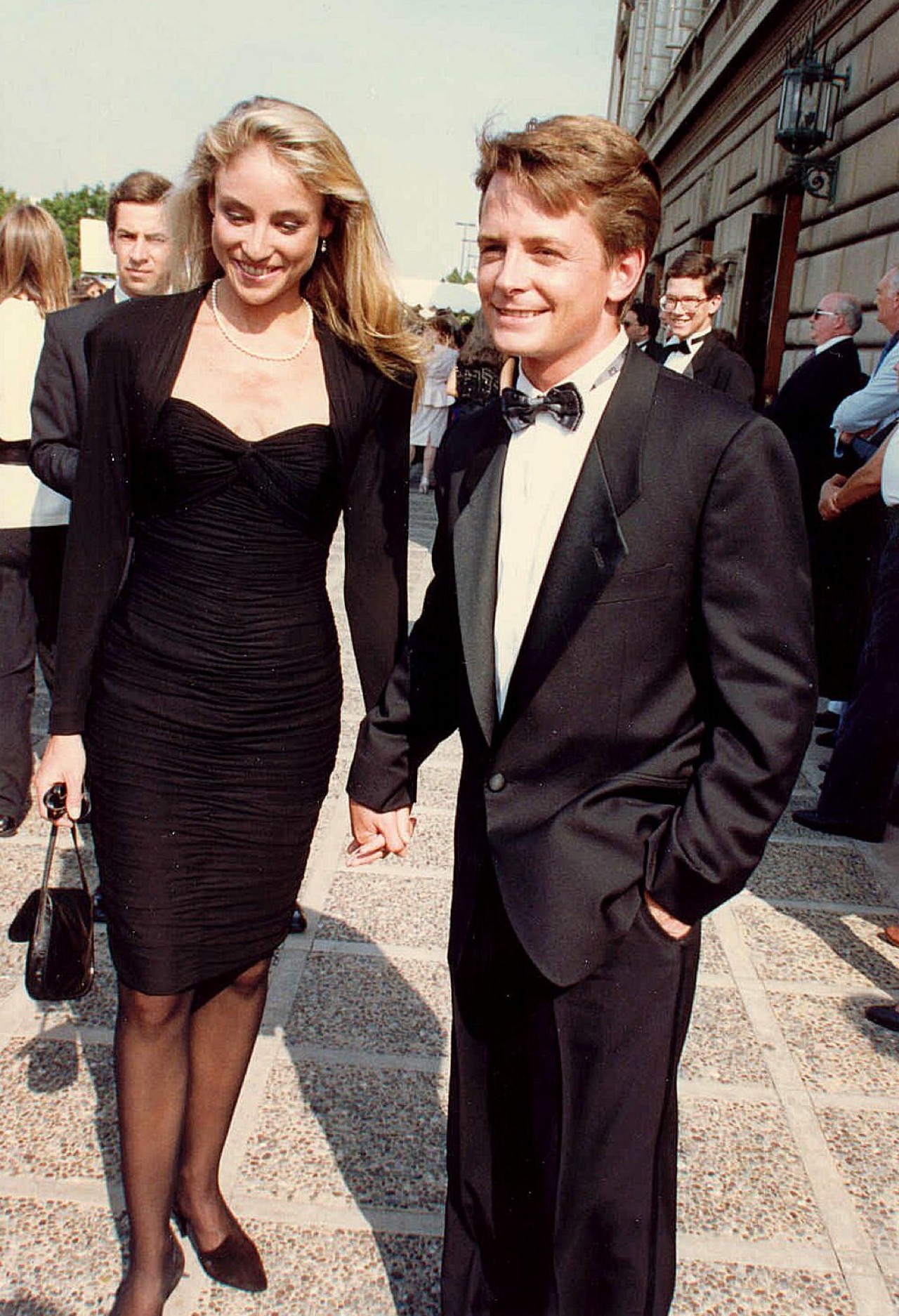
Look at the photo again. Summer of 1988, the steps outside the Emmys, a few weeks after the wedding. He’s in a tuxedo with one hand in his pocket, grinning like the whole evening is a private joke. She’s beside him in black, holding his hand, laughing at something out of frame. He was twenty-seven years old and about as famous as an American can get.
If you’d stopped anyone in that crowd and asked which of these two had the easy road ahead, nobody would have hesitated. He had the Golden Globe. He had three “Back to the Future” movies with his name over the title. He had the network, the ratings, the whole decade.
Three years later he was sitting in a doctor’s office at twenty-nine, being told he had young-onset Parkinson’s disease.
The sitcom girlfriend
They met in 1985 on the set of “Family Ties.” Tracy Pollan came in to play Ellen Reed, the girlfriend of his character, Alex P. Keaton. She stayed on the show through 1987. For two seasons a camera crew watched them pretend to fall in love on a soundstage in Los Angeles, and then the storyline ended and she left and that, professionally, was that.
Except it wasn’t. On July 16, 1988, they got married for real.
Their son Sam arrived the next year. Then twin daughters in 1995, Aquinnah Kathleen and Schuyler Frances. Then Esmé Annabelle in 2001. Four kids, one marriage, no reboots.
1991
He noticed it in his hand first. A finger doing something that had nothing to do with him.
He was twenty-nine, at the absolute peak of his industry, and the diagnosis he came home with had no cure and no clock on it. Nobody could tell him what year he’d stop working. Nobody could tell him what next Christmas would look like.
He didn’t tell the public. Not that year. Not the next one. For seven years he went to work, learned to keep the busy hand where the camera could see it and the other one occupied, and let the whole country keep believing it was watching the luckiest man in show business. He finally went public in 1998.
Tracy knew from the first night. She was the room he brought it into. However that conversation went in their kitchen in 1991, whatever she said back, she never afterward spent a press cycle describing herself as a saint about it. When she’s talked about how they manage, the phrase she keeps coming back to is almost aggressively unremarkable: one day at a time.
That’s it. That’s the whole system. A marriage that has now run thirty-eight years, built out of days.
The foundation
In 2000, two years after going public, he started The Michael J. Fox Foundation for Parkinson’s Research. Not a ribbon. Not a benefit gala with his face on the program.
It is now the largest private funder of Parkinson’s research on the planet, and this year it marks twenty-five years. Every dollar of it traces back to a twenty-nine-year-old who got the worst news of his life and, eventually, decided to aim it at something.
March
On the first of March, 2026, he stood up in front of a room full of actors at the Actor Awards. His people. The ones who knew exactly what the last three decades had cost him and exactly how much of it he’d done anyway.
He talked about “Family Ties.” He said the show changed his life, and everyone in the room understood he wasn’t talking about the ratings. He was talking about a woman who walked onto that soundstage in 1985 to play his girlfriend for a few episodes.
He called her his greatest gift.
Game 4
A few months later, Madison Square Garden. Game 4 of the NBA Finals, the loudest building in America, twenty thousand people on their feet.
And in the middle of it, two people in their sixties sitting side by side, watching a basketball game. He’s still the guy in the bow tie who’s in on the joke. She’s still the one holding his hand.
Thirty-eight years, and the picture hasn’t really changed. Only the staircase.