The woman in seat 22C boarded last, and she boarded quietly.
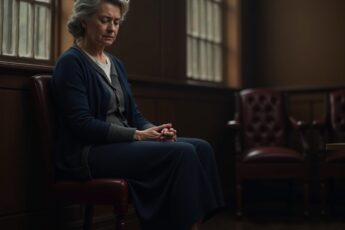
She was somewhere in her late fifties, with silver-grey hair pinned up in a loose bun that a few strands had already escaped. She wore a navy cardigan gone soft at the elbows, a pair of sneakers that had clearly walked a lot of miles, and reading glasses on a beaded cord around her neck. Over one shoulder she carried a canvas tote, and she held it against her side the way you hold something that matters more than it looks.
“Excuse me,” she said softly to the man on the aisle’s other side, easing past him toward the middle of the row. “So sorry. Thank you.”
Grant Weller did not move his knees. He was thirty-eight, in a charcoal suit with the jacket still on, a laptop open on the tray table before the doors had even closed. He glanced up at her, then down at her tote, then back at his screen, and let out the smallest sigh a person can make and still mean for it to be heard.
“They really will let anybody up front these days,” he murmured, not quite to her, not quite to himself.
Across the aisle, a young woman named Bexley heard it and laughed through her nose. She had her phone up already, camera on, filming a slow pan of the cabin for the little audience that followed her days. She let the lens drift, casually, over the woman in the worn cardigan settling into 22C.
“Okay but the vibe of this flight,” Bexley whispered into the phone, biting back a grin. “Somebody’s grandma got lost on her way to the bake sale.”
A few people around her smiled. Nobody told her to stop.
The woman in 22C didn’t seem to notice, or if she noticed she’d long ago learned not to let it show. She slid the tote under the seat in front of her, buckled her belt low and tight the way the safety card tells you to and almost nobody does, and folded her hands in her lap. Her nails were short and clean. On the back of her right hand ran a thin, pale scar, the kind that has had years to fade.
The flight attendant, Rosa, came down the aisle doing her count. She paused at row 22, and something in the older woman’s face made her slow down.
“Can I get you anything before we push back, ma’am?” Rosa asked. “Water? A blanket?”
“I’m just fine, thank you, honey,” the woman said, and she smiled, and it was a good smile — tired at the edges, but warm all the way through. “You’ve got enough to do.”
Rosa smiled back and moved on, and Grant leaned toward Bexley across the aisle and rolled his eyes. “Bet she’s got hard candies in that bag,” he said under his breath. Bexley snorted.
Behind them, a lawyer in seat 23B named Claire looked up from her briefs, took in the whole little scene — the suit, the phone, the quiet woman — and decided it wasn’t her business. She put her earbuds in. That was the mercy she offered: she simply looked away.
The plane pushed back. The engines spun up. Somewhere over the ocean, dinner came and went, the lights dimmed, and the cabin settled into that gray, humming half-sleep that long flights fall into.
That’s when the woman in 22C reached into her tote and took out a photograph.
It was old and soft-cornered, folded once down the middle so many times the crease had gone white. She smoothed it flat against her knee with two fingers and looked at it for a long moment, and her lips moved, just barely, the way people’s lips move when they’re saying a name they’ve said a thousand times in the dark.
Bexley, bored, filming again, zoomed in on it over the woman’s shoulder. “She’s been staring at that same photo for an hour,” she narrated softly, smirking. “Livestream of the saddest flight in America.”
The woman folded the photo, tucked it away, and closed her eyes.
It was maybe forty minutes later that the ride changed.
Not the air — the air was smooth as glass. It was the sound of things. Up in the galley, a phone rang, an actual cockpit-to-cabin chime, and Rosa answered it and went very still. She set the receiver down slowly. She looked down the length of the cabin, and her eyes found row 22, and stopped there.
Then Grant, half-asleep against the window, muttered, “The heck is that,” and pressed his face to the glass.
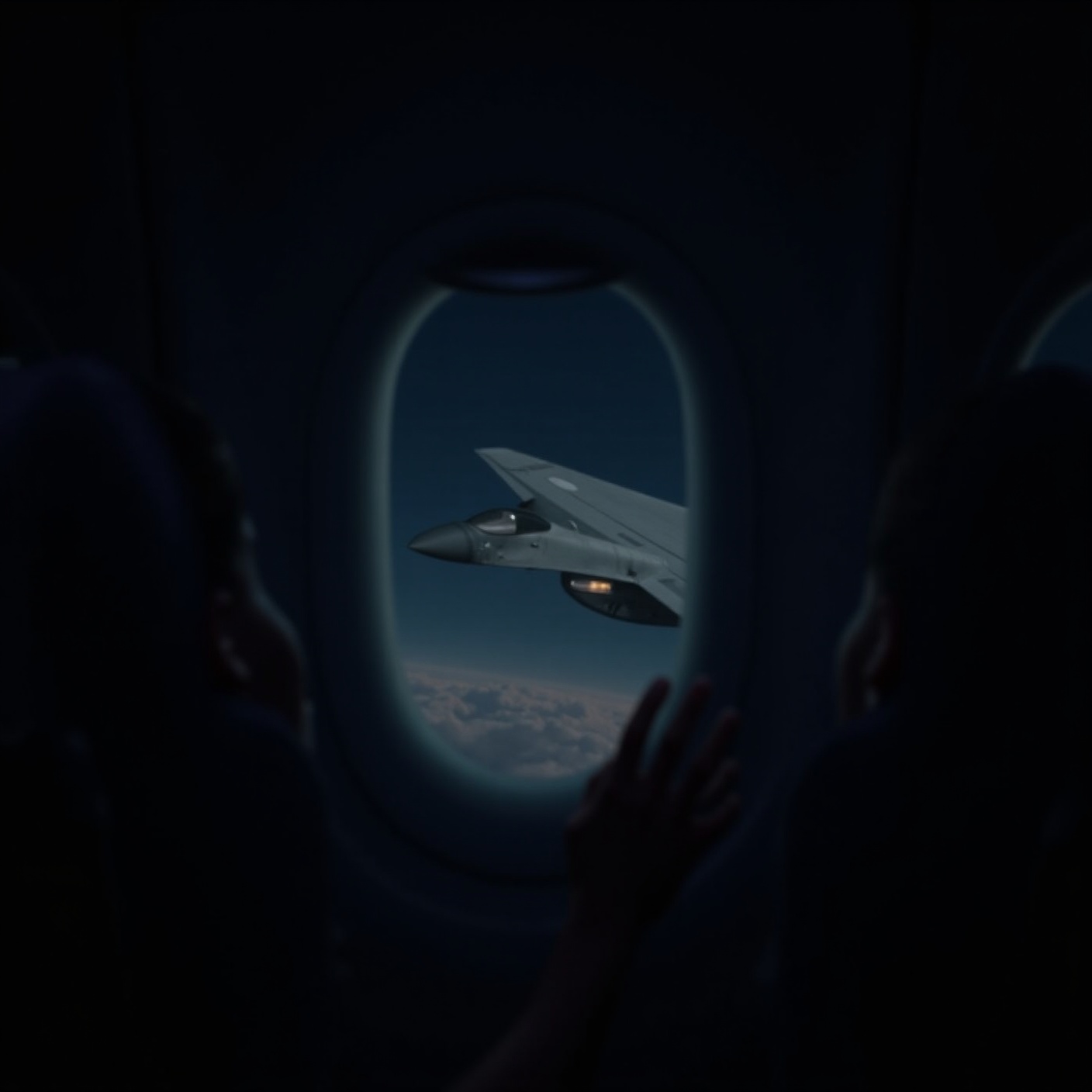
Off the right wing, close enough to see the rivets, close enough to see the helmet turn, was a fighter jet. Sleek, gray, holding formation like it had been welded there. And a beat later a gasp rolled up the other side of the plane, because there was a second one off the left wing, perfectly matched, wingtip to wingtip with the airliner in the dark.
Phones came up all over the cabin. Bexley was on her feet in the aisle. “Are you seeing this?” she said, and for once there was no smirk in it, only a kind of scared wonder. “Why are there — those are fighter jets, why are there fighter jets—”
The overhead speakers crackled. The captain’s voice came on, and it was not the flat, practiced voice that had told them the cruising altitude hours ago. It was thick. It was a voice working hard to hold itself level.
“Ladies and gentlemen, this is your captain speaking. I need a moment of your attention, and I promise you there is nothing wrong with this aircraft. We are safe, we are on course, and we are exactly where we are supposed to be.”
A pause. You could hear him breathe.
“The two aircraft off our wings are a ceremonial escort from the United States Air Force. They are not here for me. They are here for a passenger traveling with us tonight — in seat 22C.”
Every head in the cabin turned. Grant turned. Bexley turned, phone forgotten and drifting in her hand. The woman in the navy cardigan sat very still, her eyes open now, looking straight ahead at the seatback in front of her, and two tears slid down without her making a sound.
“Some of you may not know the name,” the captain went on. “Seven years ago, a transport aircraft carrying a hundred and seventy-eight people lost hydraulics and most of its electrical systems over open water in the middle of the night. By everything we understand about flying, that airplane should not have made it to land. It made it to land. Every single soul aboard walked away. The pilot who flew it down by hand, in the dark, with almost nothing left to fly it with, stayed at the controls until the last person was off — and was so badly hurt that for three days the whole country believed she had died with her airplane.”
The captain’s voice broke, and he let it, and came back.
“Her name is Captain Eleanor Ridgeway. Her call sign is Kestrel. She didn’t die. She just went home, and she got quiet, and she let the world forget her. Tonight she’s flying to Washington, because tomorrow morning her country is finally going to say thank you out loud — and my crew and I could not let her cross that ocean in an ordinary seat without you all knowing exactly who has been sitting among you.”
Silence. The engines. The two jets holding steady in the black.
And then the captain said one more thing, and his voice was barely there.
“Captain Ridgeway — ma’am — I was nineteen years old, in seat 14F, the night you brought us home. I’m a pilot today because of what I watched you do. It is the honor of my life to fly you tonight. On behalf of everyone who got to grow up because of you: welcome aboard.”
For a second nobody moved. And then, somewhere near the back, an old man stood up.
He was small and stooped, in a faded ball cap that read VETERAN across the front, and he came up the aisle one seat-back at a time, and when he reached row 22 he straightened his spine as far as it would go and raised his trembling right hand to his brow, and he held the salute, and he did not lower it.
One by one, people rose. Not for a photo. Not for the show of it. They stood because they didn’t know what else a body could do with a feeling that big.
Bexley was crying. She looked down at the phone still recording in her hand — at the cruel little caption she’d typed an hour ago, saddest flight in America — and her thumb found it and deleted it, the video, the caption, all of it, and she pressed the phone to her chest like it burned.
Grant Weller closed his laptop. He’d had a speech running in his head about upgrades and the kind of people who belong up front, and he was so ashamed of it now that his face had gone red in the dark. He unbuckled, and he stood, and he turned to the woman he’d sighed at, and he couldn’t find a single word big enough, so he just said, “Ma’am. I’m — I am so sorry. I’m so sorry.”
Eleanor Ridgeway looked up at him. And there was no ice in her face, no triumph, nothing you could call getting even. Just a tiredness that had made room, long ago, for kindness.
“It’s all right, son,” she said gently. “You didn’t know.”
She reached into her tote and drew out the folded photograph again, and this time she held it so Rosa, kneeling now in the aisle beside her with wet eyes, could see it. Eight young faces in flight suits squinted back at the camera, arms slung over each other’s shoulders, grinning on some sunlit tarmac a lifetime ago.
“My crew,” Eleanor said softly. “The night it happened, I made them all a promise that everybody was getting off that airplane.” She touched a face at the end of the row, a young man with an easy smile. “This one stayed with me till the last passenger was clear. Didn’t have to. He was the reason I stayed too.” She smoothed the crease flat. “I don’t fly to Washington for me. I fly for them. So they get their thank-you too.”
Rosa reached out and covered the older woman’s scarred hand with her own.
Out the windows, the two jets held their line all the way to the coast, two silent sentinels in the dark, and when the runway lights of Washington finally rose up gold beneath the wings, the fighters tipped their wings once — a slow, deliberate dip, left then right — the sky’s own way of saying we see you, we’ve always seen you — and peeled away into the night.
The cabin landed to no applause, because applause was too small. People filed off quietly, the way you leave a church. Grant carried the older woman’s tote up the jet bridge without being asked and set it down gently at the top and stepped back. Bexley waited by the door and, when Eleanor passed, said only, “Thank you for what you did,” and meant every letter of it.
At the very end, in the empty jet bridge, the captain was waiting — young, and crying openly now, and he didn’t say a word. He just came to attention and saluted the small silver-haired woman in the worn navy cardigan, and held it, the way the old veteran had, until she reached up and gently guided his hand down and pulled him into a hug instead.
“You flew a beautiful airplane tonight,” she whispered against his shoulder. “Fourteen F. I remember your face.”
Here’s the thing Eleanor Ridgeway had learned, in seven quiet years of being nobody in particular:
Being overlooked and being small are not the same thing. You can be the whole reason a hundred and seventy-eight people got to go home to their kitchens and their kids and their ordinary Tuesdays, and still be the woman a stranger sighs at for carrying a canvas bag. People decide who you are in about four seconds, off your shoes and your hair and the softness of your cardigan, and they are wrong more often than they will ever, ever know.
So she never told them. She never handed anyone a résumé before she let them decide how to treat her. She figured decency you have to earn isn’t really decency at all.
But the sky knew her name. And once, on a red-eye full of strangers who’d laughed at her, it said it out loud — so that a planeful of people would carry home the one lesson she’d have wanted them to keep:
You truly never know who is sitting right beside you. So be kind to the quiet ones. Be kind to the plain ones, the tired ones, the grandmas with the hard candies and the worn-out shoes.
One of them, someday, just might be the reason you’re still here to be kind at all.