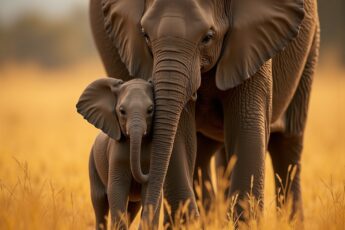
At the edge of a dusty highway town, past the last petrol station and a faded billboard nobody had repainted in years, there was a place everyone had quietly agreed to forget. It had been a roadside zoo once — the kind you pull into on a long drive, pay a few coins, walk a loop of tired enclosures, and drive away without thinking about it again. Then the visitors stopped coming, the ticket booth was boarded up, and the paint on the sign peeled until you could barely read the word “ZOO” at all.
But not everything behind that fence had been carried away when the place shut down. In the far corner, in a pen too small for her, stood a baby elephant.
Her name, back then, was nothing. Nobody had given her one. She was maybe two years old — an age when an elephant should be tucked under her mother’s belly, learning the world with a curious trunk, splashing in mud up to her ears. Instead she stood on packed grey ground, swaying a little from foot to foot, the slow rocking of an animal with a hard past and nothing in front of her but a wall she already knew by heart.
She had learned the sound of the highway. She had learned the exact hour the light left her corner. She had learned, most of all, to be quiet, because quiet was the only thing that had ever been asked of her.
The man who owned the place still came by now and then, mostly to keep people out. When a local reporter once stopped at the fence and asked about the elephant, he waved a hand as if brushing off a fly.
“She’s perfectly fine,” he said. “Look at her. Standing right there, isn’t she? She’s got shade, she’s got water. Everybody wants to make a drama out of nothing.”
And to a passing eye, maybe she did look like she was standing there just fine. That is the cruel trick of a quiet animal — the world reads stillness as contentment. It takes someone who actually knows elephants to see that a calf rocking alone in silence is not calm. She is holding herself together in the only way she has left.
Word about her travelled, though, the way these things do — a photo passed between phones, a few lines in a comment thread, a whisper that reached the right ears at last. And the right ears belonged to a small wildlife rescue team two provinces away, led by a veterinarian named Dr. Sara Whitfield.
Dr. Whitfield had spent twenty years pulling animals out of the places everyone had given up on. She had learned to keep her voice level and her paperwork thick, because in this work feelings lose to permits, and the animal always pays for the delay.
“We don’t get to be angry yet,” she told her team the night the file landed on her desk. “Angry is a luxury. Right now we get to be organized. We get her out first. We fall apart later, on our own time.”
It took weeks. Weeks of phone calls, of forms, of a sanctuary three hundred miles away clearing a space and warming a barn, of a transport crate built to the exact measurements of a calf none of them had met. Dr. Whitfield drove out once, ahead of time, just to stand at that fence herself and look.
The little elephant lifted her trunk toward the stranger at the wire — a small, uncertain reach, testing whether a new smell meant anything good. It was the first curious thing anyone had seen her do in a long while.
“Hello, sweetheart,” Dr. Whitfield said softly, keeping her hands still and her voice low. “I know. I know. You’ve been waiting a long time. We’re almost there. Just hold on a little longer for me.”
The elephant didn’t understand the words, of course. But she understood, maybe, the tone — the particular gentleness of a voice that isn’t asking anything of you. She stood a moment longer at the fence than she usually did before the rocking pulled her back into its slow, familiar rhythm.
The morning of the rescue came grey and cool. The team arrived before the sun was properly up, a small convoy of quiet, focused people — a driver, two keepers, a paperwork officer with a folder pressed to her chest, and Dr. Whitfield walking at the front with the calm of someone who has done the hardest part in her head a hundred times already. The owner met them at the gate, arms crossed, still insisting, right up to the last minute, that everyone was making a fuss over an animal who was “perfectly fine.”
The gate to the little elephant’s pen was old, and the latch had rusted half-shut. One of the keepers knelt to work it loose. Dr. Whitfield crouched a few feet from the calf, at her level, and simply waited — no ropes yet, no rush, just a person being still until the animal decided a person could be trusted.
“Easy,” she murmured, as the latch finally gave. “Easy, now. Nobody’s going to hurt you. Not ever again.”
The keeper eased the gate open. For the first time in longer than anyone could say, there was nothing between the little elephant and the world outside her corner.
And then she took her first step toward it —
…
What happened over the next few hours, and over the days that followed, was the part Dr. Whitfield had promised herself she wouldn’t cry through, and cried through anyway.
The calf did not bolt. She walked — slow, unsure, testing the ground with her trunk the way she’d tested the stranger’s smell at the fence — up the ramp and into the padded crate, where a keeper sat with her the whole long drive, talking to her in a low steady stream about nothing at all, just so she would not be alone in the dark of another journey.
Three hundred miles later, the doors opened onto green.
The sanctuary was the kind of place that doesn’t look like a rescue at all. It looks like a wide, ordinary field, with old trees and a slow brown pond and a horizon that simply keeps going. When the little elephant stepped down the ramp and her feet touched grass — actual grass, soft and cool and alive — she stopped. She lifted one foot. Set it down. Lifted the other. As if the ground itself were a language she was only now learning to read.
They named her Maya.
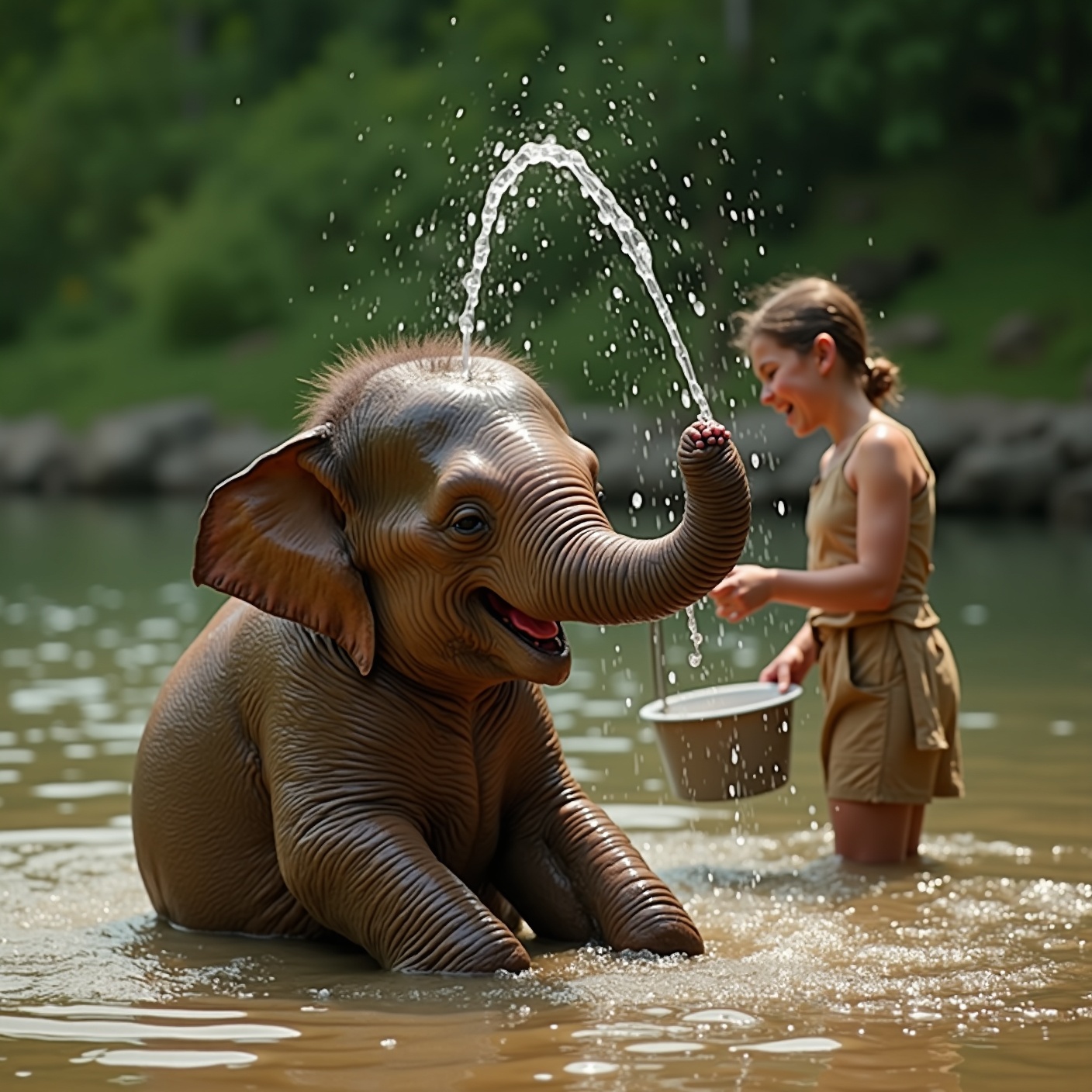
The first real bath came on her third day. There was a shallow, mud-warm edge to the pond, and a keeper stood knee-deep in it with a bucket, letting water run slow and gentle over Maya’s back while she stood very, very still — not the frozen stillness of before, but the held-breath stillness of an animal who cannot quite believe a good thing is happening to her. Then something in her let go. She sat down in the shallows with an enormous, undignified splash, curled her trunk over her own head, and sprayed herself, and sprayed the keeper, and sprayed the sky. She played. For the first time in her whole small life, in front of witnesses who had to turn away to wipe their faces, Maya played in the water like the baby she still was.
“That,” said Dr. Whitfield, watching from the bank with her arms folded and her eyes bright, “is what ‘perfectly fine’ actually looks like. Now she’s fine. Now.”
But the thing that changed Maya was not the grass, or the bath, or the barn warm with fresh hay. It was Nomsa.
Nomsa was an old elephant — grey at the edges, slow in the hips, the gentle matriarch of the sanctuary’s little herd. She had come there years before, out of her own forgotten place, and she had a habit the keepers had seen a dozen times: whenever a frightened new arrival came through the gate, Nomsa would station herself at the fence line and simply wait, patient as a mountain, until the newcomer worked up the nerve to come close.
She waited for Maya three days. On the fourth, Maya crossed the field.
The keepers held their breath from the far side. The two elephants stood trunk to trunk at the fence, the old one and the young one, breathing each other in — the great slow sniff by which elephants say the truest thing they know how to say, which is simply: I’m here. You’re not alone. When Nomsa finally reached her trunk over the low fence and rested it, feather-light, along the calf’s back, Maya leaned in. She leaned her whole small weight against that old grey side, the way she should have been able to lean against her mother two years before, and she stayed there a long time.
She had her first friend.
Maya lives at the sanctuary still. She has grown; she is louder now, and bolder, and a menace to every bucket left unattended. She has a whole herd, and a favourite tree, and a stretch of pond that everyone has quietly agreed is hers. She rocks from foot to foot sometimes, in the old way — old habits leave slowly — but only for a moment, and only until she remembers where she is, and then she trots off to find Nomsa, or the water, or trouble.
The roadside zoo stayed shut. The sign never got repainted. But the corner where a baby elephant once stood swaying alone, being told she was perfectly fine, is empty now — and that is the best thing that ever happened there.
“People kept asking me afterward if I was angry at him,” Dr. Whitfield said once, when someone asked about the man who’d owned the place. “And I was, for a while. But I don’t spend much time there anymore. I’d rather spend it watching her in the water. That’s the answer to him. Not a fight. Just Maya, happy, in the sun, where everyone can see her. That’s the whole answer.”