Kayla came off a fourteen-hour overnight in the ER and drove past her own street.
She wasn’t hungry, exactly. She just couldn’t go home yet. When you spend a night holding a stranger’s hand while machines decide things, you need a little airlock between that and your own bed, and hers was a diner on Route 9 with cracked vinyl booths and coffee that tasted like it had been on since Tuesday.
She ordered eggs. She ordered them because the waitress asked twice and she couldn’t think.
Nineteen dollars and forty cents.
The card came back declined. Kayla knew exactly why, and she felt her whole face go hot anyway. Payday was Friday. It was Thursday. She’d been a nurse for four years and she could not cover a plate of eggs, and there was a line behind her, and she started saying the thing everyone says, the “let me try another one” thing, digging in a bag she already knew was empty.
“It’s handled,” the waitress said.
Kayla looked up. “What?”
“The gentleman at the counter. He got it.”
The stool at the counter was empty. There was a coffee cup on the saucer, still steaming, and beside it a twenty and a five, and Kayla turned toward the door in time to see the back of him going out into the parking lot. Old. Slow with it. A faded Army cap, the kind that’s been washed a hundred times.
She went after him. She got as far as the doorway. He was already pulling out, and he did not look back, and she stood there in the cold in her scrubs with her mouth open like an idiot.
When she came back to her booth, the napkin was under the salt shaker.
Six words, in blue ballpoint, in the careful handwriting of a man who learned cursive when it still mattered:
“Someone did this for me in ’73. Pass it on when you can.”
Kayla kept it. She kept it through two apartments, a bad year, night shifts and day shifts and a wedding and a move. Twelve years, folded in the back of her wallet, going soft at the creases.
She never once used the word “someday” about it. She just waited.
She got good at her job. She got very good. She was the one they put in the room when a family needed to be told something they weren’t ready for, because she had a way of sitting down instead of standing over people. Somewhere in those twelve years she stopped being the girl whose card got declined and became the charge nurse who noticed things.
She noticed the young dad at the counter of the Bluebird on an ordinary Tuesday.
He had a toddler on his hip, the sticky, boneless kind, and a diaper bag on one shoulder, and he was doing the thing Kayla remembered doing. Talking a little too fast at the girl behind the register. Saying “try it again, it should work, try it as credit.” Turning his shoulder away from the room, so that nobody would see his face.
The girl handed the card back. His ears went red.
Kayla was already reaching for her wallet.
“I’ve got it,” she said.
“No, no.” He put his hand up. “No, I’ll just—”
“You’ll just let me,” said Kayla, and she smiled at him, and she said the only line she’d ever rehearsed in her life. “Somebody did this for me a long time ago. Pass it on when you can.”
She borrowed a pen from the register. She wrote the six words on a paper napkin, folded it once, and slid it under the salt shaker on his tray while he was busy hitching the toddler higher on his hip.
Then she left, fast, the way she’d been taught. That part matters. You don’t stand there and collect the thank-you. She’d understood that about the old man for twelve years.
She was three steps from her car when she heard the door bang open behind her.
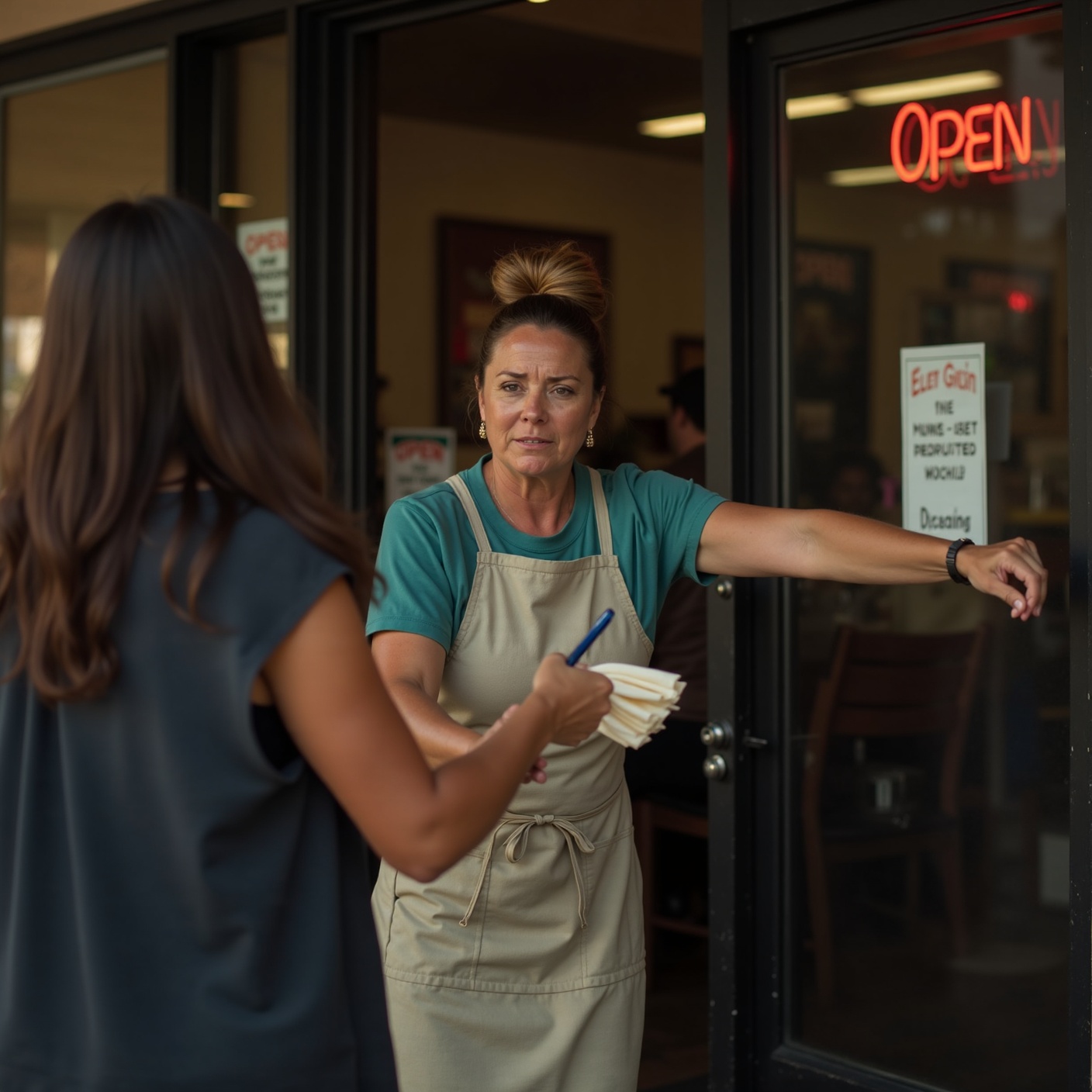
“Wait!”
The woman coming after her was maybe fifty, in an apron, with a pen still stuck in her bun. She had the napkin in her hand. She was not angry. She was crying, openly, in a parking lot, in the middle of a lunch rush.
“Wait,” she said again, and she had to stop and get her breath. “Where did you learn that line?”
Kayla stared at her. “I’m sorry?”
“This line.” The woman held the napkin up like it was evidence. Her hand was shaking. “Where did you get it?”
“An old man paid for my breakfast,” Kayla said slowly. “Twelve years ago. In a diner out on Route 9. He left me a note that said that, and he left before I could thank him, and I never even saw his face properly. He had a cap. An Army cap. That’s all I—”
The woman put her hand over her mouth.
“That’s my grandfather,” she said.
Kayla felt the parking lot tilt a little.
“His name was Ray,” the woman said. “He owned this place. I run it now, since he passed. He did that his whole life, do you understand? His whole life. Somebody paid for his supper when he was nineteen years old and flat broke, and he never got to thank them either, and he decided the thank-you was supposed to go forward instead of back.”
She looked down at the napkin again, and her face came apart.
“I know his handwriting,” she said. “The ’73. The way he does the sevens. My grandmother used to tease him about the sevens. I have forty years of grocery lists in that handwriting in a drawer upstairs, and you just wrote it on my napkin, and I thought for one second—”
She stopped. She didn’t finish it.
Kayla did the only thing there was to do. She stood in the parking lot of the Bluebird and let a stranger in an apron hold onto her, and over the woman’s shoulder she could see the young dad through the window, standing at the register with his toddler and a folded napkin in his fist, watching the two of them with an expression she recognized. Confusion, and something underneath it starting to warm up.
He’d figure it out. Give him twelve years.
The napkin is framed now. It hangs behind the register at the Bluebird, next to a photograph of a young man in an Army cap who is squinting into the sun and grinning like he knows something.
Nobody who works there will explain it to you. If you ask, they’ll just say it’s a house rule, and they’ll say it the way Ray said it, and if you’re the kind of person who’s ever stood at a register with a dead card and a hot face, you’ll understand it just fine.
Someone did this for me. Pass it on when you can.