Somebody, somewhere, had to count them.
That’s the part everyone skips. You read “20 quadrillion ants” and your brain files it under things science simply knows, the way it knows how far away the sun is. But nobody flew over the planet with a very good camera. That number came out of 489 separate studies, run by hundreds of researchers on every continent, most of whom had no idea they were feeding a global census. They were just out in a field somewhere with a bucket and a trowel.
So here’s how you actually count ants.
Method one: a cup in the ground.
You bury a small plastic cup so the rim sits perfectly flush with the soil. Then you walk away. Ants going about their day walk over the edge and can’t climb back out. You come back after a set number of hours and count what’s inside. That gives you ants per patch of ground per stretch of time. And if the cup is buried the same way in Ghana as it is in Finland, the two numbers can finally be compared to each other.
Method two: one square meter of dead leaves.
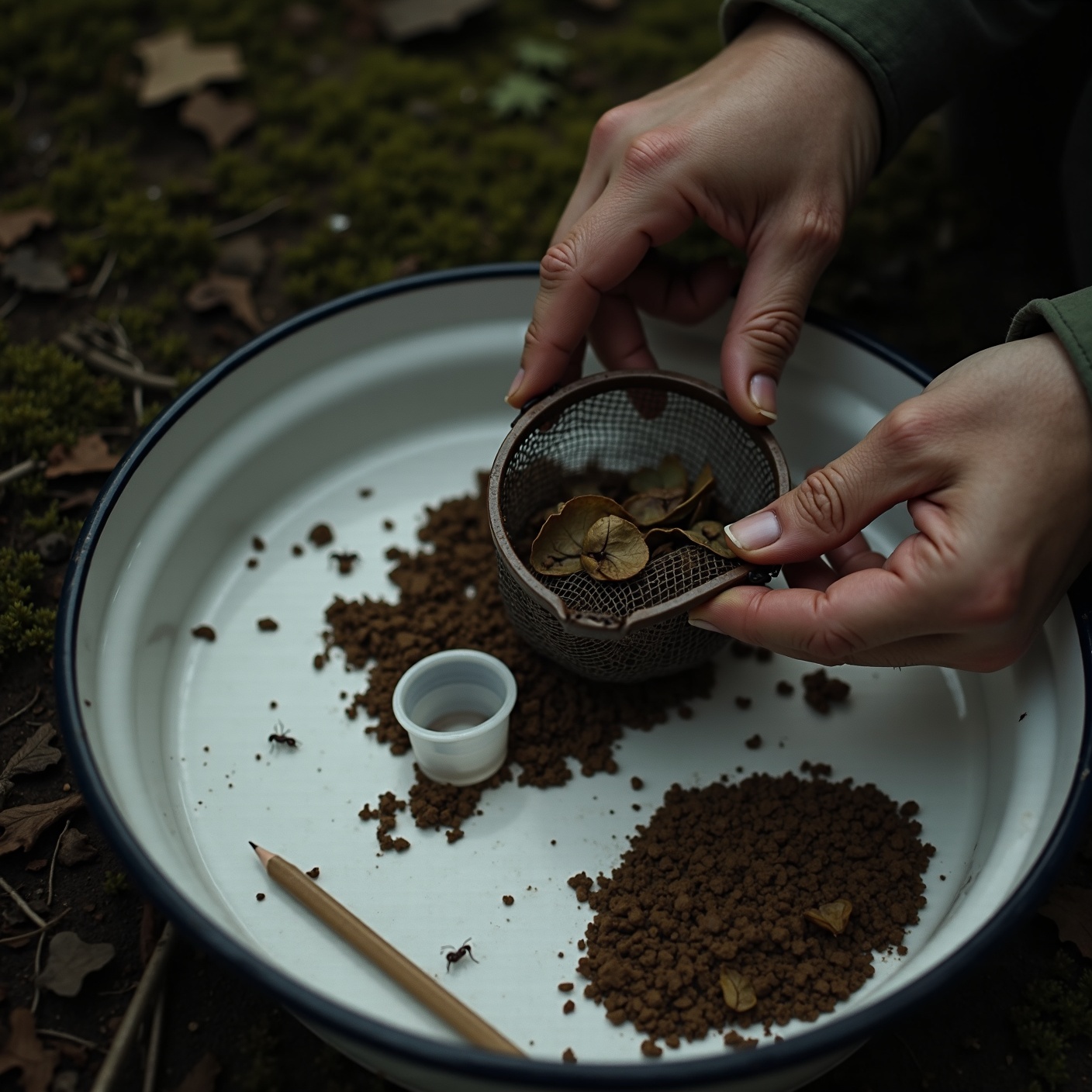
You rope off a single square meter of forest floor and you take all of it. The dead leaves, the twigs, the damp crumbling humus underneath. You sift the whole thing through a screen, pull out every ant hiding in there, and count them. Every one.
That’s the technology. Cups and sifting. No satellites, no clever shortcut, no model that guesses the answer for you.
Now multiply that by decades.
Somebody knelt in a rainforest in Borneo and sifted a square meter of rot. Somebody else did it in an Australian savanna, in a Costa Rican cloud forest, on a Mongolian steppe, in a strip of scrub behind a parking lot in Arizona. Each of them wrote it up, published it in a journal, and moved on with their lives. None of them was counting the world. They were counting one square meter.
The idea, when it finally came, was to go find all of those square meters and add them together.
Patrick Schultheiss and Sabine Nooten led the team that did it, working out of the University of Würzburg and the University of Hong Kong. They went through the literature looking for any study that had counted ants using one of those two standard methods, because standardized is the only thing that lets you compare a cup in Kenya to a cup in Kansas. They found 489 that qualified, covering 1,306 separate locations, spread across every continent that has ants and every major biome on the map.
Then they did the arithmetic that turns 1,306 patches of dirt into a planet.
The answer they published in September 2022 was twenty quadrillion.
Written out, that’s 20,000,000,000,000,000. Twenty thousand million million. There is no useful way to picture it, and picturing it is not the point. What matters is the weight.
Put all those ants together and you get roughly 12 megatons of dry carbon. That is more than every wild bird on Earth and every wild mammal on Earth, added together, all of them. Every elephant, every whale, every deer, every sparrow, every bat, every mouse in every field in every country. The ants outweigh the lot.
And here’s the honest footnote the researchers put on it themselves: twenty quadrillion is a floor, not a ceiling. Pitfall traps and leaf litter catch the ants that walk on the ground and live in the top layer of the forest floor. They mostly miss the ones living high in the tree canopy and the ones sitting deep inside underground nests. Africa, north Asia and central Asia are also thinly covered, because that’s where the fewest studies were done. So the real number is higher. Nobody knows by how much.
Which brings us to the thing you’ve probably repeated at a table at some point.
You’ve heard it phrased a dozen ways. All the ants on Earth weigh about the same as all the people on Earth. It’s a beautiful line. It has been in nature documentaries and pub quizzes and school textbooks for thirty years, and it gets a reliable little gasp every time, because it makes you feel briefly small.
It isn’t true.
Add up every ant, and you land at roughly one fifth of human biomass. Twenty percent. Not equal, not close to equal. The line everybody loves has been off by a factor of about five for as long as people have been saying it.
And the part that makes it genuinely funny is the direction the correction came from.
This study didn’t find fewer ants than expected. It found dramatically more. The new count came in somewhere between two and twenty times higher than the previous estimates, because those older numbers were built top-down, from an assumption about what fraction of all insects happen to be ants. Schultheiss and Nooten went bottom-up instead, from actual counted ants in actual buckets, and the population went up.
So the ants won on abundance and still lost the comparison. Even with a count that big, humans and their livestock are simply that heavy. There are eight billion of us, and we are not small.
That’s the real shape of the fact, and it’s better than the myth. Twenty quadrillion ants, outweighing every wild bird and wild mammal on the planet combined, counted one buried plastic cup at a time by people who thought they were just studying their own patch of forest.
Next time someone at the table says ants weigh as much as all of us, you get to tell them there are far more ants than anyone thought, and the saying is still wrong.