The dog would not leave her mouth alone.
Colleen Ferguson had bought Inca as a two-year-old German shepherd, and she’d bought her for one specific reason. Competitive obedience. Colleen taught science and math at a secondary school in Kent, she was pushing sixty, and she wanted a project for the weekends. A shepherd with good bones and a working brain. Something to train.
What she got instead was a dog who became quietly obsessed with her breath.
It started small, the way these things do. Inca would come and sit close and lift her nose. Then it became a habit, then it became the thing she did whenever she got near enough. Colleen would be reading, or standing at the kettle, and the dog would be right there at her face.
“Her behaviour towards me changed,” Colleen said. “She just started homing in on my mouth.”
And she would not accept a substitute. Not a scratch behind the ears, not a hand on her chest, not being nudged off. She wanted one thing, and she waited for it with total patience, and the look on her face while she waited is the detail that sticks.
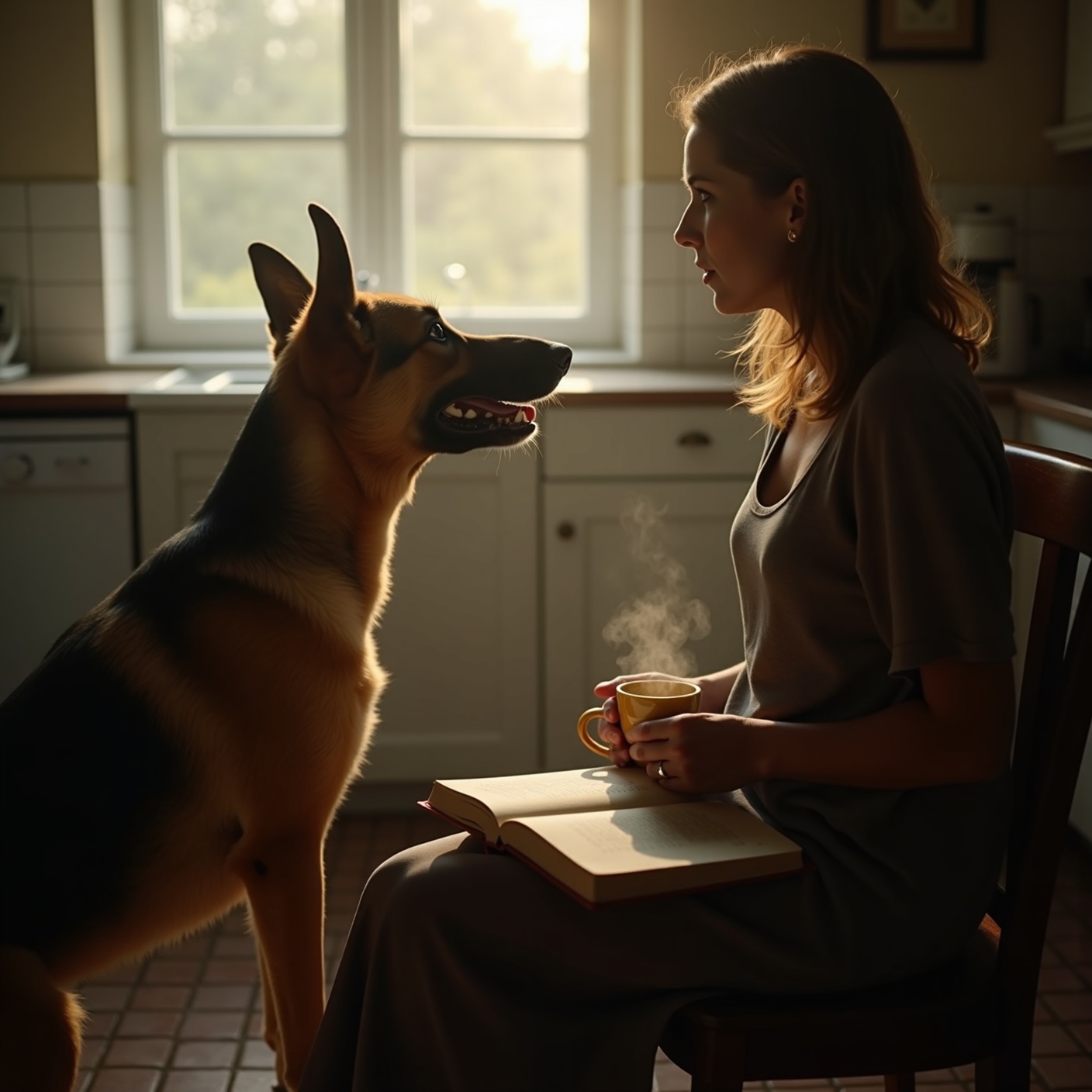
“Every time she could get a sniff of my mouth she would frown,” Colleen said. “She just had this focused intent on my mouth, and you couldn’t push her away until you had done an outbreath. When she got that she would give me such a look and walk away.”
Read that again, because it’s the strangest part. The dog wasn’t asking for affection. She was collecting a sample. She’d hold position, refuse to be moved, wait for Colleen to breathe out, take it in, and then look at her with something that wasn’t quite comfort and wasn’t quite alarm, and then leave. Task complete. Back tomorrow.
Weeks of this. Every day.
Colleen was not a smoker. She had never smoked. She had no cough, no pain, no weight loss, no shortness of breath, nothing at all on the list of things that sends a sensible person to a doctor.
“I had absolutely no symptoms at all apart from being tired,” she said, “but I thought that was just because I was coming up to 60 and still working with teenagers.”
Anyone who has ever stood in front of a room of fifteen-year-olds at three in the afternoon will grant her that one. Of course she was tired. Tired is the baseline.
But the dog kept coming.
Eventually Colleen did what most people would do with a dog fixated on their mouth, which is to assume the problem was in her mouth. She went to the doctor. There was a check of her teeth. There were tests.
Everything came back clear.
That could easily have been the end of it. A funny story about a strange dog, told at the staff room table, filed away. Plenty of people would have laughed it off and moved on, and Inca would have gone on frowning into her face every evening for years with nobody left to convince.
Colleen didn’t quite let it drop. Months later a full body scan was ordered.
It found a tumour in her left lung, about the size of a golf ball.
Lung cancer, and this is the part that changes everything about the story: stage one. Caught at the very beginning, in a woman with no symptoms and no risk factors, who had no reason on earth to be scanned.
The tumour came out in June 2015. That was the whole of the treatment. No chemotherapy. No radiotherapy. One operation, and done.
Colleen has never forgotten what her surgeon said to her about how she’d ended up on his table.
“We never catch it at stage one,” he told her. “Your dog has saved your life. Now go away and do what you want.”
She took him at his word. She left teaching. She went and did a master’s in creative writing, the thing she’d never had a spare year for, and she became a published author. Ten years on she is 70, and the only thing the surgery left her with is a bit of breathlessness on the hills.
And Inca is thirteen now.
Old for a shepherd. Grey through the muzzle, slower on the stairs, the obedience-competition career long behind her, and she has a completely different job these days. After the diagnosis, Colleen was hit with the anxiety and panic attacks that tend to arrive once the emergency is over and there’s finally room to be frightened. So Inca was retrained as a recovery assistance dog, and that is what she does now. She works the panic attacks.
Which is a tidy sort of symmetry. The dog spent weeks refusing to be pushed away from a problem her owner couldn’t see. Now she spends her old age doing the same job on a different floor.
Nobody can tell you exactly what Inca smelled. She was never a trained detection dog and she was never tested in a lab, and Colleen has never claimed anything more than what happened in her own kitchen. She bought a dog to do obedience with, and the dog kept frowning into her face until somebody finally went and looked.
There’s a photograph of the two of them from around that time, Colleen on the floor, Inca’s head across her knee, and if you didn’t know the story you’d think it was just a woman and her dog.